Overview
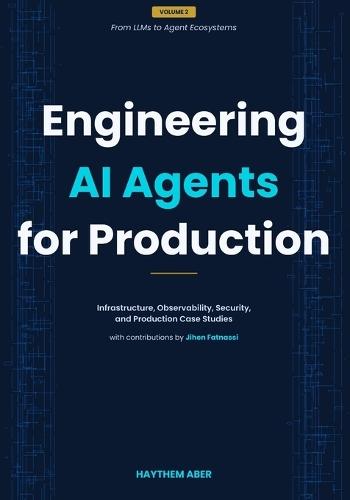
Volume 1 specified the architecture. Volume 2 builds the system.Every pattern, protocol contract, and orchestration design in Volume 1 was a specification. Engineering AI Agents for Production implements them-in production-grade Java, at distributed scale, under real operational constraints. This is not a theory extension. It is a construction manual for engineers who are shipping autonomous AI systems into production: building the runtime from scratch, deploying across distributed infrastructure, measuring quality with engineering rigor, hardening against novel threats, and operating systems whose failure modes are non-deterministic and sometimes irreversible. What this book builds - 828 pages, 31 chapters, 6 parts: Part I - A Production Java Agent Framework, from Scratch: Design principles before code (testability and observability as first-class constraints), Java 25 concurrency models (structured concurrency and Virtual Threads), the AgentRuntime as a deterministic state machine, the AgentExecutorService, and the full protocol adapter stack for MCP and A2A. Part II - Infrastructure for Distributed Agent Systems: The agent control plane (service discovery and health checking), agent sandboxing with Docker, gVisor, and eBPF, WebAssembly (WASI 2.0) for edge agents, event-driven architectures with Kafka and NATS, and durable execution with Temporal and AWS Step Functions. Part III - Observability, Evaluation, and Testing: The three observability pillars (distributed tracing, structured logging, metrics), evaluation as an engineering discipline (trajectory quality scoring, LLM-as-judge pipelines), chaos engineering for non-deterministic systems, and deterministic replay and time-travel debugging. Part IV - Security and Governance: The complete agent threat landscape (prompt injection, tool poisoning, denial-of-wallet), secure-by-design principles (least privilege, secure bootstrapping), enterprise governance (RBAC, audit logging, Policy-as-Code with OPA), and runtime circuit breakers and kill switches. Part V - Eight Production Architecture Case Studies: Detailed breakdowns including architecture decisions and production failure modes. Covers: Enterprise Copilot (M365/Google integration), Autonomous Research Agent, DevOps and SRE Agent, Multi-Agent Customer Support, Autonomous Code Review, Regulated Clinical/Financial Agent, and Decentralised Fraud Detection. Part VI - The Future of Agentic AI: The agent as a first-class software entity (identity, accountability, versioning), coordination horizons and emergent behavior at scale, the convergence of trust and delegation standards, and the frontier of agent regulation and liability. Who this book is for: Java and Python engineers implementing production agent runtimes from scratch. Platform and Infrastructure engineers deploying agent workloads on Kubernetes and distributed event systems. ML Engineers building evaluation, replay, and cost-governance infrastructure for non-deterministic systems. Security Architects extending enterprise threat models and governance frameworks to autonomous AI systems. Engineering Leads who need real-world case studies-including failure modes-that map to their own deployment context. Prerequisites: Volume 2 requires familiarity with the agentic loop, capability stack, and the MCP/A2A protocol layer-all established in Volume 1 or equivalent engineering experience. The implementation language throughout Part I is Java 25 LTS. Parts II-VI are language-agnostic. Architecture is the set of decisions that are hard to reverse. Make them deliberately.
Full Product Details
Author: Haythem Aber
Publisher: Independently Published
Imprint: Independently Published
Volume: 2
Dimensions:
Width: 17.80cm
, Height: 4.20cm
, Length: 25.40cm
Weight: 1.411kg
ISBN: 9798258511195
Pages: 830
Publication Date: 26 April 2026
Audience:
General/trade
,
General
Format: Paperback
Publisher's Status: Active
Availability: Available To Order

We have confirmation that this item is in stock with the supplier. It will be ordered in for you and dispatched immediately.