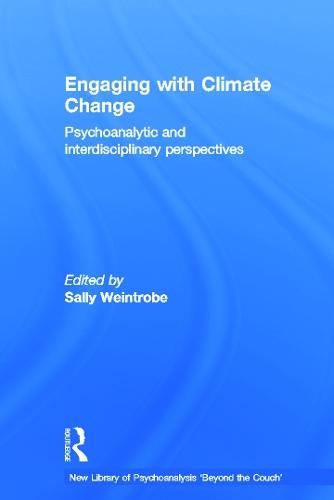
Full Product Details
Author: Sally Weintrobe (Institute of Psychoanalysis, London, UK) ,
Alessandra Lemma (Tavistock and Portman NHS Foundation Trust, London, UK)
Publisher: Taylor & Francis Ltd
Imprint: Routledge
Weight: 0.540kg
ISBN: 9780415667609
ISBN 10: 0415667607
Pages: 280
Publication Date: 20 September 2012
Audience:
Professional and scholarly
,
College/higher education
,
Professional & Vocational
,
Tertiary & Higher Education
Format: Hardback
Publisher's Status: Active
Availability: In Print

This item will be ordered in for you from one of our suppliers. Upon receipt, we will promptly dispatch it out to you. For in store availability, please contact us.
Reviews
I read this book straight through in two days. More shocking than a fantasy novel, more touching than an individual intimate story, it is an interdisciplinary book of high quality that shows how people hardly dare to face the truth about climate change and how psychoanalysis helps us explore the reality, inside and outside our minds, beyond defensive illusions and tragic disavowal - Stefano Bolognini, MD, President of the Italian Psychoanalytic Society and President Elect of the International Psychoanalytic Association By bringing together some of the most cutting-edge and creative thinkers on the ecological crisis, this anthology builds a persuasive case for how a greater understanding of human psychology -- including the psychology of denial, compassion and cruelty -- can help break the climate deadlock. A powerful riposte to the notion that climate communicators have only two options: relentlessly terrify the public, or try to fool them into action without mentioning the word climate. - Naomi Klein, author of The Shock Doctrine Throughout the book, we are repeatedly reminded of two most basic facts; that we are all much less rational than we care to think, and that we are of, not above, the natural world. - Chris Rapley, CBE, Professor of Climate Science at University College London
I read this book straight through in two days. More shocking than a fantasy novel, more touching than an individual intimate story, it is an interdisciplinary book of high quality that shows how people hardly dare to face the truth about climate change and how psychoanalysis helps us explore the reality, inside and outside our minds, beyond defensive illusions and tragic disavowal - Stefano Bolognini, MD, President of the Italian Psychoanalytic Society and President Elect of the International Psychoanalytic Association By bringing together some of the most cutting-edge and creative thinkers on the ecological crisis, this anthology builds a persuasive case for how a greater understanding of human psychology -- including the psychology of denial, compassion and cruelty -- can help break the climate deadlock. A powerful riposte to the notion that climate communicators have only two options: relentlessly terrify the public, or try to fool them into action without mentioning the word climate. - Naomi Klein, author of The Shock Doctrine Throughout the book, we are repeatedly reminded of two most basic facts; that we are all much less rational than we care to think, and that we are of, not above, the natural world. - Chris Rapley, CBE, Professor of Climate Science at University College London Challenging, hopeful, timely ... Engaging with Climate Change contains perspectives about climate change by psychoanalytic writers, sociologists, social policy academics and others, with amplifying or challenging short responses, which makes for a deeper analysis. - Robert Tollemache, The Journal of Analytical Psychology, Vol. 58, 2013 This is a rich and fascinating book that makes for gripping reading. It brings together different disciplines and is therefore interesting for a wide range of readers. The book clearly explains psychoanalytic concepts, so that a reader not accustomed to this way of thinking can gain an understanding. At the same time, there are many accounts from the consulting room and from literature, so that it is also delightful reading for those train in the field. - Helen Skogstad, Psychoanalytic Psychotherapy, 27:2 This book is a robust contribution to a body of literature currently shaping our thinking about psychic processes in relation to climate change. The interdisciplinary nature of the book is reflected in the range of contributors, which includes sociologists, academics and psychoanalysts, and also in the diversity of content and stylistic form. The writing is incisive, lively and at times riveting, and themes are enriched and enlivened by research, literary refrences and anecodtal examples of lived experience. - Caroline Firzell, Therapy Today (September 2013)
Challenging, hopeful, timely ... Engaging with Climate Change contains perspectives about climate change by psychoanalytic writers, sociologists, social policy academics and others, with amplifying or challenging short responses, which makes for a deeper analysis. - Robert Tollemache, The Journal of Analytical Psychology, Vol. 58, 2013 This is a rich and fascinating book that makes for gripping reading. It brings together different disciplines and is therefore interesting for a wide range of readers. The book clearly explains psychoanalytic concepts, so that a reader not accustomed to this way of thinking can gain an understanding. At the same time, there are many accounts from the consulting room and from literature, so that it is also delightful reading for those train in the field. - Helen Skogstad, Psychoanalytic Psychotherapy, 27:2 This book is a robust contribution to a body of literature currently shaping our thinking about psychic processes in relation to climate change. The interdisciplinary nature of the book is reflected in the range of contributors, which includes sociologists, academics and psychoanalysts, and also in the diversity of content and stylistic form. The writing is incisive, lively and at times riveting, and themes are enriched and enlivened by research, literary refrences and anecodtal examples of lived experience. - Caroline Firzell, Therapy Today (September 2013) I read this book straight through in two days. More shocking than a fantasy novel, more touching than an individual intimate story, it is an interdisciplinary book of high quality that shows how people hardly dare to face the truth about climate change and how psychoanalysis helps us explore the reality, inside and outside our minds, beyond defensive illusions and tragic disavowal - Stefano Bolognini, MD, President of the Italian Psychoanalytic Society and President Elect of the International Psychoanalytic Association By bringing together some of the most cutting-edge and creative thinkers on the ecological crisis, this anthology builds a persuasive case for how a greater understanding of human psychology -- including the psychology of denial, compassion and cruelty -- can help break the climate deadlock. A powerful riposte to the notion that climate communicators have only two options: relentlessly terrify the public, or try to fool them into action without mentioning the word climate. - Naomi Klein, author of The Shock Doctrine Throughout the book, we are repeatedly reminded of two most basic facts; that we are all much less rational than we care to think, and that we are of, not above, the natural world. - Chris Rapley, CBE, Professor of Climate Science at University College London Challenging, hopeful, timely ... Engaging with Climate Change contains perspectives about climate change by psychoanalytic writers, sociologists, social policy academics and others, with amplifying or challenging short responses, which makes for a deeper analysis. - Robert Tollemache, The Journal of Analytical Psychology, Vol. 58, 2013 This is a rich and fascinating book that makes for gripping reading. It brings together different disciplines and is therefore interesting for a wide range of readers. The book clearly explains psychoanalytic concepts, so that a reader not accustomed to this way of thinking can gain an understanding. At the same time, there are many accounts from the consulting room and from literature, so that it is also delightful reading for those train in the field. - Helen Skogstad, Psychoanalytic Psychotherapy, 27:2 This book is a robust contribution to a body of literature currently shaping our thinking about psychic processes in relation to climate change. The interdisciplinary nature of the book is reflected in the range of contributors, which includes sociologists, academics and psychoanalysts, and also in the diversity of content and stylistic form. The writing is incisive, lively and at times riveting, and themes are enriched and enlivened by research, literary refrences and anecodtal examples of lived experience. - Caroline Firzell, Therapy Today (September 2013)
Author Information
Sally Weintrobe, a practising psychoanalyst, is a Fellow of the Institute of Psychoanalysis in London. She sees a psychoanalytic approach as a vital part of understanding how to engage people about the seriousness of climate change and how to understand current levels of denial. She has written and lectured widely on these subjects and on our relationship with nature. Her commitment to fostering interdisciplinary exchange with other human scientists about engaging with climate change has led to this remarkable book.