Overview
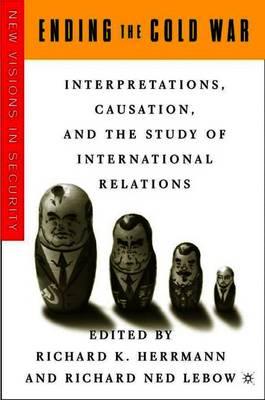
Although in hindsight the end of the Cold War seems almost inevitable, almost no one saw it coming and there is little consensus over why it ended. A popular interpretation is that the Soviet Union was unable to compete in terms of power, especially in the area of high technology. Another interpretation gives primacy to the new ideas Gorbachev brought to the Kremlin and to the importance of leaders and domestic considerations. In this volume, prominent experts on Soviet affairs and the Cold War interrogate these competing interpretations in the context of five ""turning points"" in the end of the Cold War process. Relying on new information gathered in oral history interviews and archival research, the authors draw into doubt triumphal interpretations that rely on a single variable like the superior power of the United States and call attention to the importance of how multiple factors combined and were sequenced historically. The volume closes with chapters drawing lessons from the end of the Cold War for both policy making and theory building.
Full Product Details
Author: R. Herrmann ,
R. Lebow
Publisher: Palgrave USA
Imprint: Palgrave Macmillan
Edition: 2004 ed.
Dimensions:
Width: 15.20cm
, Height: 1.30cm
, Length: 22.90cm
Weight: 0.554kg
ISBN: 9781403963833
ISBN 10: 1403963835
Pages: 248
Publication Date: 15 April 2004
Audience:
College/higher education
,
Professional and scholarly
,
Postgraduate, Research & Scholarly
,
Professional & Vocational
Format: Hardback
Publisher's Status: Active
Availability: In Print

This item will be ordered in for you from one of our suppliers. Upon receipt, we will promptly dispatch it out to you. For in store availability, please contact us.
Reviews
“ Ending the Cold War is the product of a 'Who’s Who' of scholars writing on one of the most important periods in recent history. The volume is well-framed by the editors, and the chapters are structured around a common approach that combines theoretical sophistication with impressive empirical grounding. Making good use of new knowledge available from documents and from interviews with key participants, this book will be valuable for scholars and accessible to students. Ending the Cold War will help sharpen the ongoing debate about an extraordinary series of events.”--James M. Goldgeier, George Washington University <br> Ending the Cold War is analytically coherent and empirically original, enhancing our understanding of a transition of enormous magnitude for both the theory and practice of international relations. The book advances the debate by focusing on key turning points and pondering neglected counterfactuals, as it weighs the relative importance of power
Author Information
GEORGE W. BRESLAUER University of California, Berkeley, USA ARCIE BROWN St. Antony's College, Oxford, UK JAMES A. DAVIS, University of Munich, Bavaria, Germany MATTHEW EVANGELISTA Cornell University, New York, USA RAYMOND L. GARTHOFF The Brookings Institution, Washington DC, USA JACQUES LÉVESQUE Université du Québec à Montréal, Canada JANICE GROSS STEIN University of Toronto, Canada WILLIAM H. WOHLFORTH Georgetown University, Washington DC, USA