Overview
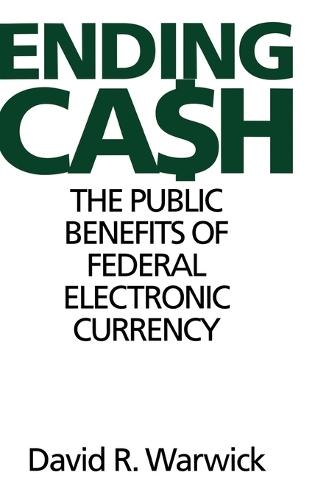
If America's tangible cash could be transformed into federal electronic currency (FEDEC), the social and economic benefits would be profound. Warwick argues eloquently why government should mandate cashlessness, then demonstrates not only why it can be done, but how to go about doing it. He shows that because the private sector will not and can not replace cash, government must do it; indeed, government FEDEC is superior to a system of private currencies. Cash handling costs the nation between one and two percent of the GDP, and cash is the lubricant for most of America's crime. By eliminating cash the saving from crime reduction alone would amount to hundreds of billions of dollars yearly. But naturally there would be issues of special concern if a FEDEC system were to become a hot public debate. Privacy, security, practicality, convenience are just some. Warwick tackles them here and, as no other books attempts to do, offers a practical plan for creating cashlessness. Well reasoned, meticulously documented, Ending Cash is a major contribution to what could soon become an important social debate—a debate that should, in the author's judgment, be started now. Ending Cash argues that America's tangible cash should be transformed into a new federal electronic currency (FEDEC). Although Warwick admits that private bank card systems and/or the Internet may some day supplant cash, he explains why this will not happen soon, certainly not in our lifetime. Warwick emphasizes that the unrealized benefits of cashlessness far exceed the mere convenience that citizens generally look for and enjoy in bank card usage. While stressing the relative inefficiency of cash, said to run $60 billion a year just in handling costs, he illustrates the profound role cash plays in most crimes, including tax evasion, all of which could be prevented with a resultant public savings in the hundreds of billions of dollars each year if a federal system were created. Against the background of consumer-oriented EFT systems, including credit-, debit-, and smart-card systems, Warwick explains the disinterest of industry in achieving cashlessness, as well as its organizational incapacity to carry it out. He thus argues the need for government involvement. Among the many facets he covers are privacy, security, technical requirements, and operational costs. He also explains the issue of employing private currencies as a replacement for cash, and how federal e-currency might impact the banking and bank card industries.
Full Product Details
Author: David R. Warwick
Publisher: Bloomsbury Publishing Plc
Imprint: Praeger Publishers Inc
Dimensions:
Width: 15.60cm
, Height: 1.40cm
, Length: 23.40cm
Weight: 0.501kg
ISBN: 9781567202397
ISBN 10: 156720239
Pages: 232
Publication Date: 19 November 1998
Recommended Age: From 7 to 17 years
Audience:
College/higher education
,
Professional and scholarly
,
Undergraduate
,
Postgraduate, Research & Scholarly
Format: Hardback
Publisher's Status: Active
Availability: Manufactured on demand

We will order this item for you from a manufactured on demand supplier.
Reviews
Ending Cash offers an extraordinarily useful assessment of the personal security implications of electronic currency as well as an intriguing vision of the potential clash between government and private industry over the exercise of monetary authority. -Dr. Judy Shelton Economist and Author of Money Meltdown
""Ending Cash offers an extraordinarily useful assessment of the personal security implications of electronic currency as well as an intriguing vision of the potential clash between government and private industry over the exercise of monetary authority.""-Dr. Judy Shelton Economist and Author of Money Meltdown ?[T]his fact-packed book argues persuasively how such a change could be brought about and why the effort needed would be worthwhile.?-The Futurist ?As electronic financial transfers continue their rapid expansion, there will be growing debate on the issues Warwick raises. For public, academic, and professional library collections.?-Choice ?Warwick has ideas that are both interesting and valid...?-Booklist ""ÝT¨his fact-packed book argues persuasively how such a change could be brought about and why the effort needed would be worthwhile.""-The Futurist ""[T]his fact-packed book argues persuasively how such a change could be brought about and why the effort needed would be worthwhile.""-The Futurist ""Warwick has ideas that are both interesting and valid...""-Booklist ""As electronic financial transfers continue their rapid expansion, there will be growing debate on the issues Warwick raises. For public, academic, and professional library collections.""-Choice
Author Information
DAVID R. WARWICK is an investor, researcher, and writer living in Santa Rosa, CA. He holds an LL.B. and J.D. from Hastings College of the Law and has practiced plaintiff's personal injury law. He later turned his attention to real estate development, then to entrepreneurship in retail electronics, importing, and security hardware manufacturing. He has a patent pending for a means to make electronic bill payments via ATM and Internet terminals. Mr. Warwick is author of The Cash Free Society, an important article published in The Futurist in 1992, and of other writing for the National Council on Crime and Delinquency. He has also aired his views on National Public Radio and regional television.