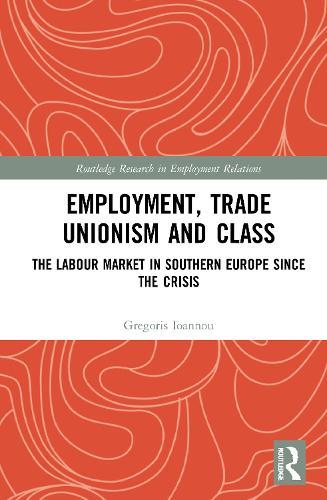
Full Product Details
Author: Gregoris Ioannou
Publisher: Taylor & Francis Ltd
Imprint: Routledge
Weight: 0.320kg
ISBN: 9781032039633
ISBN 10: 1032039639
Pages: 224
Publication Date: 31 May 2023
Audience:
College/higher education
,
Tertiary & Higher Education
Format: Paperback
Publisher's Status: Active
Availability: In Print

This item will be ordered in for you from one of our suppliers. Upon receipt, we will promptly dispatch it out to you. For in store availability, please contact us.
Reviews
"""Spain, Greece and Cyprus were the three EU countries with the worst employment crisis in recent years. Gregoris Ioannou’s book is the first to examine them together and in detail, with a clear analytical approach that digs into the causes and consequences of the crisis, challenging the mainstream institutional explanations and proposing alternative prospects for Southern Europe’s labour markets."" Prof. Guglielmo Meardi, Sociology of Economic Labour Processes, Scuola Normale Superiore Florence, Editor of the European Industrial Relations Journal ""This book offers an indispensable review of recent changes in the fields of employment, trade union activity, political representation, social security, gender, and composition of the working class in Southern Europe. The study covers the impact of neoliberalism, the Global Financial Crisis, and COVID-19. Drawing upon the best literatures in the social sciences, law, and economic policy, the book examines how economic practices and social relations were (re-)regulated under neoliberalism and its crises. A valuable resource for our understanding of the dynamics of labour in contemporary Europe."" Prof. Alfredo Saad Filho, Political Economy & International Development, King’s College London. ""Employment, Trade Unionism and Class: The Labour Market in Southern Europe since the Crisis is a crucial contribution to the literature on how the implementation of economic reforms contribute to labour flexibility and economic precariousness. Gregoris Ioannou has strong command of the political economy of Southern Europe in exploring the transformation of trade unionism and its impact on class composition in Spain, Greece, and Cyprus in the aftermath of the Great Financial Crisis. This book is a crucial contribution to the labour and political economy in Europe."" Prof. Immanuel Ness, Political Science, City University of New York. ""Gregoris Ioannou provides a detailed and insightful assessment of the changes in industrial relations systems in Southern Europe since the emergence of the 2007-2008 economic crisis. In charting effectively, the economic, social, and political dynamics in which industrial relations systems and labour regulation are embedded in, the analysis offers valuable lessons about the impact of these developments in the European periphery and beyond."" Aristea Koukiadaki, Senior Lecturer in Labour Law, University of Manchester ""This book is an important contribution to our understanding of how crises affect work and employment. Focusing on the long-lasting effects of the Great Financial Crisis and subsequent recession, the book looks in detail at the consequences for labour markets in Spain, Greece and Cyprus highlighting the role of agency in the process of institutional and labour market restructuring. By emphasising the choices open to actors, and by stressing that there are always choices even when alternative paths are sometimes less evident, the analysis presents a compelling explanation of how and why particular paths are chosen in moments of response to crisis. Reminding policy makers about the choices open to them and showing the problematic outcomes of paths previously travelled is a crucially important intellectual and practical agenda that this book centres."" Prof. Melanie Simms, Work and Employment, University of Glasgow"
Spain, Greece and Cyprus were the three EU countries with the worst employment crisis in recent years. Gregoris Ioannou's book is the first to examine them together and in detail, with a clear analytical approach that digs into the causes and consequences of the crisis, challenging the mainstream institutional explanations and proposing alternative prospects for Southern Europe's labour markets. Prof. Guglielmo Meardi, Sociology of Economic Labour Processes, Scuola Normale Superiore Florence, Editor of the European Industrial Relations Journal This book offers an indispensable review of recent changes in the fields of employment, trade union activity, political representation, social security, gender, and composition of the working class in Southern Europe. The study covers the impact of neoliberalism, the Global Financial Crisis, and COVID-19. Drawing upon the best literatures in the social sciences, law, and economic policy, the book examines how economic practices and social relations were (re-)regulated under neoliberalism and its crises. A valuable resource for our understanding of the dynamics of labour in contemporary Europe. Prof. Alfredo Saad Filho, Political Economy & International Development, King's College London. Employment, Trade Unionism and Class: The Labour Market in Southern Europe since the Crisis is a crucial contribution to the literature on how the implementation of economic reforms contribute to labour flexibility and economic precariousness. Gregoris Ioannou has strong command of the political economy of Southern Europe in exploring the transformation of trade unionism and its impact on class composition in Spain, Greece, and Cyprus in the aftermath of the Great Financial Crisis. This book is a crucial contribution to the labour and political economy in Europe. Prof. Immanuel Ness, Political Science, City University of New York. Gregoris Ioannou provides a detailed and insightful assessment of the changes in industrial relations systems in Southern Europe since the emergence of the 2007-2008 economic crisis. In charting effectively, the economic, social, and political dynamics in which industrial relations systems and labour regulation are embedded in, the analysis offers valuable lessons about the impact of these developments in the European periphery and beyond. Aristea Koukiadaki, Senior Lecturer in Labour Law, University of Manchester This book is an important contribution to our understanding of how crises affect work and employment. Focusing on the long-lasting effects of the Great Financial Crisis and subsequent recession, the book looks in detail at the consequences for labour markets in Spain, Greece and Cyprus highlighting the role of agency in the process of institutional and labour market restructuring. By emphasising the choices open to actors, and by stressing that there are always choices even when alternative paths are sometimes less evident, the analysis presents a compelling explanation of how and why particular paths are chosen in moments of response to crisis. Reminding policy makers about the choices open to them and showing the problematic outcomes of paths previously travelled is a crucially important intellectual and practical agenda that this book centres. Prof. Melanie Simms, Work and Employment, University of Glasgow
Author Information
Gregoris Ioannou is a political sociologist and research fellow at the Law School of the University of Glasgow, UK.