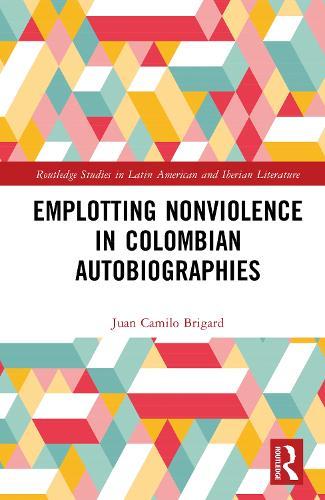
Full Product Details
Author: Juan Camilo Brigard
Publisher: Taylor & Francis Ltd
Imprint: Routledge
Weight: 0.750kg
ISBN: 9781041135364
ISBN 10: 104113536
Pages: 300
Publication Date: 11 December 2025
Audience:
College/higher education
,
Professional and scholarly
,
Postgraduate, Research & Scholarly
,
Professional & Vocational
Format: Hardback
Publisher's Status: Active
Availability: In Print

This item will be ordered in for you from one of our suppliers. Upon receipt, we will promptly dispatch it out to you. For in store availability, please contact us.
Reviews
""Brigard's Emplotting Nonviolence is a seminal example of a study that is based in the discipline of literary and cultural studies but that very convincingly manages to come into dialogue with current debates in Peace and Conflict Studies and, more broadly, in the Social Sciences."" -Professor Stefan Peters, Chair of Peace Studies Justus-Liebig-Universität Giessen and Director of the Colombo-German Peace Institute CAPAZ, Germany “Introducing the emplotment of ‘nonviolence’ as a cultural concept and structuring principle, it creatively defines the narrative conventions of each autobiography within the framework of literary genres rarely associated with life writing – the bildungsroman, the Cold War thriller, mythical realism, and classical tragedy. Emplotting Nonviolence masterfully demonstrates how a variety of distinct storytelling strategies can be applied to a hitherto narrowly defined genre, and how these plot devices are able to shape distinct narrative conceptions of nonviolent resistance.” -Prof. Ansgar Nünning, Chair of English and American Literary and Cultural Studies, Founding Director of the International Graduate Centre for the Study of Culture (GCSC), Justus-Liebig-Universität Giessen. Germany “Emplotting Nonviolence highlights the ethical stakes of narrating violence, particularly in contexts of systemic harm and historical oppression. It interrogates how narratives can perpetuate or challenge dominant paradigms of violence, contributing significantly to the study of violence and non-violence by exposing their ethical and aesthetic dimensions and their implications for collective memory and identity.” -Professor Laura Quintana Porras, Universidad de los Andes, Colombia “Emplotting Nonviolence has the potential of being a trendsetting text for envisioning the way we study and approach Colombian cultural production in the post-agreement era. Juan Camilo Brigard has accomplished a text that thoroughly studies the construction of autobiographical texts highlighting their strategies for producing a nonviolent self. Furthermore, his text will potentially help us denaturalize claims of nonviolence, question strategies for justifying violent acts, and envision ourselves beyond a homogeneous ‘self’.” -Professor Carlos Mario Mejía Suárez, Gustavus Adolphus College, USA ""In times of ongoing armed conflicts, this pioneering study brings important voices of nonviolence to the forefront. A stimulating and must-read book that offers new narratological insights from exceptional autobiographical texts, highlighting the conflict-solving potential of political (counter)narratives."" Doris Bachmann-Medick, Distinguished Research Fellow, International Graduate Centre for theStudy of Culture (GCSC), University of Giessen, Germany
“Brigard's Emplotting Nonviolence is a seminal example for a study that is based in the discipline of literary and cultural studies but that very convincingly manages to come into dialogue with current debates in Peace and Conflict Studies and more broadly from Social Sciences.” -Professor Stefan Peters, Chair of Peace Studies Justus-Liebig-Universität Giessen and Director of the Colombo-German Peace Institute CAPAZ, Germany “Introducing the emplotment of ‘nonviolence’ as a cultural concept and structuring principle, it creatively defines the narrative conventions of each autobiography within the framework of literary genres rarely associated with life writing – the bildungsroman, the Cold War thriller, mythical realism, and classical tragedy. Emplotting Nonviolence masterfully demonstrates how a variety of distinct storytelling strategies can be applied to a hitherto narrowly defined genre, and how these plot devices are able to shape distinct narrative conceptions of nonviolent resistance.” -Prof. Ansgar Nünning, Chair of English and American Literary and Cultural Studies, Founding Director of the International Graduate Centre for the Study of Culture (GCSC), Justus-Liebig-Universität Giessen. Germany “Emplotting Nonviolence highlights the ethical stakes of narrating violence, particularly in contexts of systemic harm and historical oppression. It interrogates how narratives can perpetuate or challenge dominant paradigms of violence, contributing significantly to the study of violence and non-violence by exposing their ethical and aesthetic dimensions and their implications for collective memory and identity.” -Professor Laura Quintana Porras, Universidad de los Andes, Colombia “Emplotting Nonviolence has the potential of being a trendsetting text for envisioning the way we study and approach Colombian cultural production in the post-agreement era. Juan Camilo Brigard has accomplished a text that thoroughly studies the construction of autobiographical texts highlighting their strategies for producing a nonviolent self. Furthermore, his text will potentially help us denaturalize claims of nonviolence, question strategies for justifying violent acts, and envision ourselves beyond a homogeneous ‘self’.” -Professor Carlos Mario Mejía Suárez, Gustavus Adolphus College, USA
Author Information
Juan Camilo Brigard is a doctoral candidate at the Graduate Centre for the Study of Culture at Justus Liebig University Giessen, Germany. His research focuses on the intersection of Colombian and postcolonial literature, textual criticism, performance, and the politics of aesthetics.