|
|
|||
|
||||
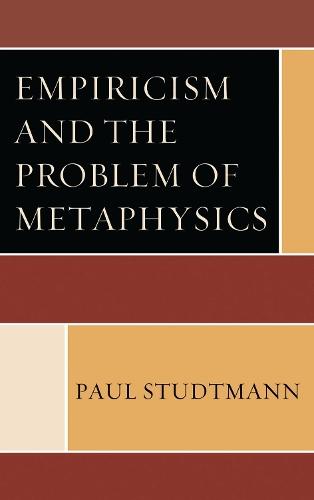
OverviewFull Product DetailsAuthor: Paul StudtmannPublisher: Bloomsbury Publishing Plc Imprint: Lexington Books Dimensions: Width: 16.20cm , Height: 1.80cm , Length: 24.00cm Weight: 0.429kg ISBN: 9780739142554ISBN 10: 0739142550 Pages: 180 Publication Date: 11 October 2010 Audience: College/higher education , Undergraduate , Postgraduate, Research & Scholarly Format: Hardback Publisher's Status: Active Availability: In Print This item will be ordered in for you from one of our suppliers. Upon receipt, we will promptly dispatch it out to you. For in store availability, please contact us. Table of ContentsReviewsIn Empiricism and the Problem of Metaphysics, Studtmann presents a clear, novel, intriguing and extended argument against metaphysics. If sound, it constitutes a devastating critique of the discipline. Studtmann argues that all metaphysics involves modal concepts, but that modal concepts are not theoretically legitimate. Unlike, say, logical positivism, Studtmann's position is itself put forward as an empirical hypothesis, one to be either confirmed or disconfirmed by science itself, but one for which the current evidence is strongly in favor. In the course of his argument he introduces a multitude of startlingly original theses, such as that all so called a priori knowledge is knowledge of the results of effective procedures, and is not really a priori at all. Like Hume, Wittgenstein and Carnap before him, Studtmann aims to leave empirical science, logic and mathematics intact while cutting a broad swathe through both traditional and contemporary metaphysics. This book is compul In Empiricism and the Problem of Metaphysics, Studtmann presents a clear, novel, intriguing and extended argument against metaphysics. If sound, it constitutes a devastating critique of the discipline. Studtmann argues that all metaphysics involves modal concepts, but that modal concepts are not theoretically legitimate. Unlike, say, logical positivism, Studtmann's position is itself put forward as an empirical hypothesis, one to be either confirmed or disconfirmed by science itself, but one for which the current evidence is strongly in favor. In the course of his argument he introduces a multitude of startlingly original theses, such as that all so called a priori knowledge is knowledge of the results of effective procedures, and is not really a priori at all. Like Hume, Wittgenstein and Carnap before him, Studtmann aims to leave empirical science, logic and mathematics intact while cutting a broad swathe through both traditional and contemporary metaphysics. This book is compulsory r Author InformationPaul Studtmann is associate professor of philosophy at Davidson College. Tab Content 6Author Website:Countries AvailableAll regions |
||||