Overview
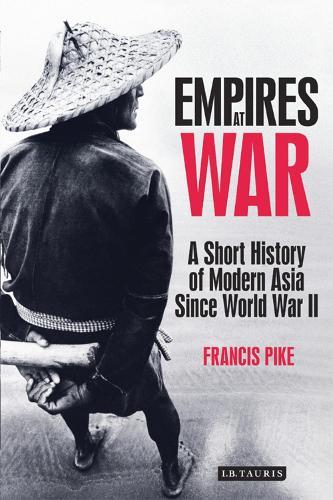
Asia - with four billion people, almost two-thirds of the world's population, a huge landmass and the fastest-growing economies - has in the past decade transformed the geopolitical global balance. ""Empires at War"" gives a dramatic narrative account of how this 'Modern Asia' came into being. Taking the bombing of Hiroshima on 6th August 1945 as its starting point, Francis Pike chronicles the modern fortunes of fourteen Asian countries. The iconic figures of post-World War II Asia - Mao, Gandhi, Nehru, Ho Chi Minh, Kim Il Sung, General MacArthur and Lord Mountbatten - figure prominently but so also do a great many lesser-known but pivotal figures. Francis Pike weaves the dramatic events and episodes of the region - the great battles between American and Soviet-backed forces in Korea and Vietnam but also episodes such as Indian 'Partition', Japan's 'Lost Decade', Indonesia's 'Year of Living Dangerously' and Cambodia's 'Killing Fields' - into a coherent whole, which forms the essential guide to the history of modern Asia.
Full Product Details
Author: Dr Francis Pike (Independent Scholar, UK)
Publisher: Bloomsbury Publishing PLC
Imprint: I.B. Tauris
Dimensions:
Width: 15.60cm
, Height: 5.60cm
, Length: 23.40cm
Weight: 1.290kg
ISBN: 9781848858657
ISBN 10: 1848858655
Pages: 896
Publication Date: 15 February 2011
Audience:
College/higher education
,
Undergraduate
,
Postgraduate, Research & Scholarly
Format: Paperback
Publisher's Status: Out of Print
Availability: In Print

Limited stock is available. It will be ordered for you and shipped pending supplier's limited stock.
Reviews
'A fantastic work of scholarship which ought to become the standard work. Francis Pike's knowledge, erudition, eye for the telling detail and sheer breadth of scope is truly astonishing.' - Andrew Roberts 'A stunning piece of work' - Norman Stone, formerly Professor of Modern History at Oxford University and author of Europe Transformed and The Eastern Front 'An absolute page-turner and deeply learned. Empires at War is the best and most comprehensive account of the history of Asia since World War II that I know. Francis Pike's narrative is gripping, original and entertaining.' - Dr. Simon May
'A fantastic work of scholarship which ought to become the standard work. Francis Pike's knowledge, erudition, eye for the telling detail and sheer breadth of scope is truly astonishing.' - Andrew Roberts, author of The Storm of War: A New History of the Second World War and A History of the English-Speaking Peoples since 1900; 'A stunning piece of work' - Norman Stone, formerly Professor of Modern History at Oxford University and author of Europe Transformed, 1878-1919 and The Eastern Front, 1914-1917; 'An absolute page-turner and deeply learned. Empires at War is the best and most comprehensive account of the history of Asia since World War II that I know. Francis Pike's narrative is gripping, original and entertaining.' - Simon May, Birkbeck College, University of London; former Professor of Philosophy at Tokyo University; 'Pike rises to the challenge of readability, and without sacrificing much in the way of essential detail, covers the ground with confidence.' - John Keay, Literary Review, Feb 2010; 'A jaw-dropping feat in terms of the sheer range it covers' - China Daily
Author Information
Francis Pike studied history at Cambridge and is an historian and journalist. He lived and worked for 20 years in Japan, China and India as an economic and political strategist and in this capacity he advised numbers of financial institutions as well as governments.