Overview
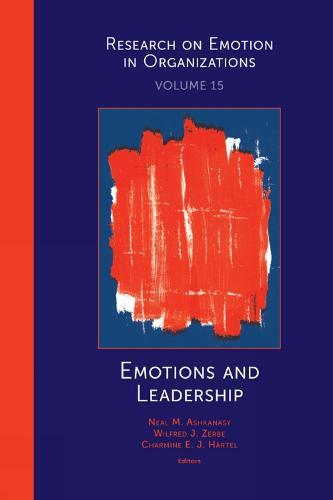
This volume of Research on Emotion in Organizations contributes to the ongoing research on emotions in the workplace, focusing on organizational leadership and interpersonal relationships within organizational structures. The chapters in this book represent a range of different methodologies that reveal the pervasive role of emotions in leadership and emphasize the need for scholars to address emotions if they are to obtain a more complete understanding of organizational leadership. Emotions and Leadership is divided into three parts which explore and analyse developments in the following areas: leadership and individual team members, leadership and its effects on the team construct, and leadership in the overall context of organizations and culture. This three-level analysis provides a foundation for future research into emotion in organizations, organizational psychology and leadership.
Full Product Details
Author: Neal M. Ashkanasy (The University of Queensland, Australia) ,
Wilfred J. Zerbe (Fairleigh Dickinson University, Canada) ,
Charmine E. J. Härtel (The University of Queensland, Australia)
Publisher: Emerald Publishing Limited
Imprint: Emerald Publishing Limited
Volume: 15
Dimensions:
Width: 15.20cm
, Height: 1.90cm
, Length: 22.90cm
Weight: 0.414kg
ISBN: 9781838672027
ISBN 10: 1838672028
Pages: 288
Publication Date: 26 August 2019
Audience:
Professional and scholarly
,
Professional & Vocational
Format: Hardback
Publisher's Status: Active
Availability: In Print

This item will be ordered in for you from one of our suppliers. Upon receipt, we will promptly dispatch it out to you. For in store availability, please contact us.
Reviews
Drawn from the 2018 International Conference on Emotion and Organizational Life, held in Chicago, Illinois, the 11 chapters in this volume explore different aspects of emotions and organizational leadership. Business and psychology researchers from the Middle East, Australia, Europe, Asia, and North America provide studies that focus on specific levels of analysis: the role of emotions in leadership at the individual level, including within-person temporal effects, between-person effects, and interpersonal effects in settings like a police department and a large transportation company, and in terms of emotional intelligence, work engagement, and emotional labor, servant leadership, and job satisfaction; the impact leaders have on teams, with discussion of team identification, team creativity, and leader empathy; and leadership and emotions at the organization-wide level, including investors in entrepreneurial ventures, different cultures, and organizational leaders. -- Annotation (c)2019 * (protoview.com) *
Author Information
Neal M. Ashkanasy is a Professor of Management at the University of Queensland Business School in Australia. His research on leadership, emotions, organizational culture and ethics has been published in international journals such as the Academy of Management Review, Journal of Organizational Behavior, and Journal of Applied Psychology. Wilfred J. Zerbe is Vancouver Campus Executive at Fairleigh Dickinson University, Canada. His research on emotions in organizations, organizational research methods, business ethics and leadership has appeared in books and journals including the Academy of Management Review and Journal of Business Research. Charmine E. J. Härtel is Professor and Chair of Inclusive Organizational Leadership and Employment at the University of Queensland Business School in Australia. Her work integrates Strengths-Oriented HRM, Positive Organizational Scholarship, and Occupational Health Psychology and appears in over 200 leading publications.