Overview
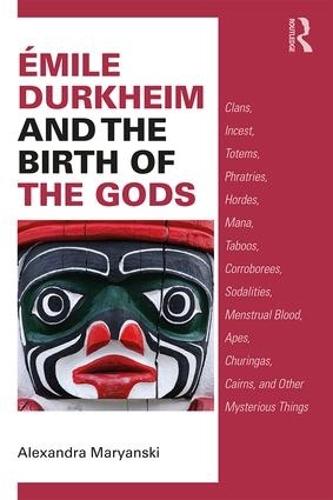
The Birth of the Gods is dedicated to Durkheim's effort to understand the basis of social integration. Unlike most social scientists, then and now, Durkheim concluded that humans are naturally more individualistic than collectivistic, that the primal social unit for humans is the macro-level unit ('the horde'), rather than the family, and that social cohesion is easily disrupted by human self-interest. Hence, for Durkheim, one of the ""gravest"" problems facing sociology is how to mold these human proclivities to serve the collective good. The analysis of elementary religions, Durkheim believed, would allow social scientists to see the fundamental basis of solidarity in human societies, built around collective representations, totems marking sacred forces, and emotion-arousing rituals directed at these totems. The first half of the book traces the key influences and events that led Durkheim to embrace such novel generalizations. The second part makes a significant contribution to sociological theory with an analysis that essentially ""tests"" Durkheim's core assumptions using cladistic analysis, social network tools and theory, and data on humans closest living relatives—the great apes. Maryanski marshals hard data from primatology, paleontology, archaeology, genetics, and neuroscience that enlightens and, surprisingly, confirms many of Durkheim’s speculations. These data show that integration among both humans and great apes is not so much group or kin oriented, per se, but orientation to a community standing outside each individual that includes a sense of self, but also encompassing a cognitive awareness of a ""sense of community"" or a connectedness that transcends sensory reality and concrete social relations. This ""community complex,"" as Maryanski terms it, is what Durkheim was beginning to see, although he did not have the data to buttress his arguments as Maryanski is able to do.
Full Product Details
Author: Alexandra Maryanski
Publisher: Taylor & Francis Ltd
Imprint: Routledge
Weight: 0.532kg
ISBN: 9781138587366
ISBN 10: 1138587362
Pages: 342
Publication Date: 22 June 2018
Audience:
College/higher education
,
General/trade
,
Tertiary & Higher Education
,
General
Format: Paperback
Publisher's Status: Active
Availability: In Print

This item will be ordered in for you from one of our suppliers. Upon receipt, we will promptly dispatch it out to you. For in store availability, please contact us.
Reviews
Maryanski uses evidence of biology and animal researchers in a new and impressive way to show how humans interact emotionally and cognitively to create socially shared institutions. This is an important theoretical broadening of human evolution, beyond the slow mechanism of genetic selection, and the usual focus on individual psychology: how humans acting together developed a mechanism to create and change social structure. - Randall Collins, University of Pennsylvania This is a brilliant, original and challenging contribution to the sociology of religion and to our understanding of social life. It is essential reading for scholars and graduate students in sociology, anthropology, and religion. Using convincing data Maryanski sheds fresh light on Durkheim's quest to provide a scientific explanation of the roots of religion and the central part it plays in the roots of human sociality. - Kenneth Thompson, The Open University, UK
Maryanski has undertaken to critically review accumulated data from various sources including evolutionary biology, primatology, and comparative history…as she methodically retraces Durkheim shedding light on the origin of the mysterious force that transforms human individualism into a collective community...Readers of Émile Durkheim and the Birth of the Gods will find it an essential new, must sociological reading. Edward A. Tiryakian, Professor Emeritus of Sociology, Duke University, from the Foreword This is an important book. Maryanski shows that the evolutionary record of human ancestors and relatives needed a mechanism that would turn very loosely organized, in many respects individualistic and a-social apes, into the strong-yet-flexible ties that have made up the history of human societies. It could not have happened by building on ape family structures, since these lacked strong ties across and within the generations. Humans took a different route by developing emotional rituals that generate symbols of membership, thus providing a flexible tool for building societies of many different kinds. Maryanski uses evidence of biology and animal researchers in a new and impressive way to show how humans interact emotionally and cognitively to create socially shared institutions. This is an important theoretical broadening of human evolution, beyond the slow mechanism of genetic selection, and the usual focus on individual psychology: how humans acting together developed a mechanism to create and change social structure. Randall Collins, Emeritus Professor of Sociology, University of Pennsylvania This is a brilliant, original and challenging contribution to the sociology of religion and to our understanding of social life. It is essential reading for scholars and graduate students in sociology, anthropology, and religion. Using convincing data Maryanski sheds fresh light on Durkheim’s quest to provide a scientific explanation of the roots of religion and the central part it plays in the roots of human sociality. Kenneth Thompson, Emerius Professor, The Open University A scintillating effort to put Durkheim into conversation with contemporary knowledge from paleoanthropology, primatology, evolutionary biology and sociobiology. Maryanski proves there is still gold to be mined in the oeuvre of this venerable founding father. Alexander Riley, Professor of Sociology, Bucknell University
This is an important book. Maryanski shows that the evolutionary record of human ancestors and relatives needed a mechanism that would turn very loosely organized, in many respects individualistic and a-social apes, into the strong-yet-flexible ties that have made up the history of human societies. It could not have happened by building on ape family structures, since these lacked strong ties across and within the generations. Humans took a different route by developing emotional rituals that generate symbols of membership, thus providing a flexible tool for building societies of many different kinds. Maryanski uses evidence of biology and animal researchers in a new and impressive way to show how humans interact emotionally and cognitively to create socially shared institutions. This is an important theoretical broadening of human evolution, beyond the slow mechanism of genetic selection, and the usual focus on individual psychology: how humans acting together developed a mechanism to create and change social structure. Randall Collins, Professor of Sociology Emeritus, University of Pennsylvania This is a brilliant, original and challenging contribution to the sociology of religion and to our understanding of social life. It is essential reading for scholars and graduate students in sociology, anthropology, and religion. Using convincing data Maryanski sheds fresh light on Durkheim's quest to provide a scientific explanation of the roots of religion and the central part it plays in the roots of human sociality. Kenneth Thompson, The Open University, UK A scintillating effort to put Durkheim into conversation with contemporary knowledge from paleoanthropology, primatology, evolutionary biology and sociobiology. Maryanski proves there is still gold to be mined in the oeuvre of this venerable founding father. Alexander Riley, Professor of Sociology, University of Bucknell
Maryanski has undertaken to critically review accumulated data from various sources including evolutionary biology, primatology, and comparative history...as she methodically retraces Durkheim shedding light on the origin of the mysterious force that transforms human individualism into a collective community...Readers of Emile Durkheim and the Birth of the Gods will find it an essential new, must sociological reading. Edward A. Tiryakian, Professor Emeritus of Sociology, Duke University, from the Foreword This is an important book. Maryanski shows that the evolutionary record of human ancestors and relatives needed a mechanism that would turn very loosely organized, in many respects individualistic and a-social apes, into the strong-yet-flexible ties that have made up the history of human societies. It could not have happened by building on ape family structures, since these lacked strong ties across and within the generations. Humans took a different route by developing emotional rituals that generate symbols of membership, thus providing a flexible tool for building societies of many different kinds. Maryanski uses evidence of biology and animal researchers in a new and impressive way to show how humans interact emotionally and cognitively to create socially shared institutions. This is an important theoretical broadening of human evolution, beyond the slow mechanism of genetic selection, and the usual focus on individual psychology: how humans acting together developed a mechanism to create and change social structure. Randall Collins, Emeritus Professor of Sociology, University of Pennsylvania This is a brilliant, original and challenging contribution to the sociology of religion and to our understanding of social life. It is essential reading for scholars and graduate students in sociology, anthropology, and religion. Using convincing data Maryanski sheds fresh light on Durkheim's quest to provide a scientific explanation of the roots of religion and the central part it plays in the roots of human sociality. Kenneth Thompson, Emerius Professor, The Open University A scintillating effort to put Durkheim into conversation with contemporary knowledge from paleoanthropology, primatology, evolutionary biology and sociobiology. Maryanski proves there is still gold to be mined in the oeuvre of this venerable founding father. Alexander Riley, Professor of Sociology, Bucknell University
Maryanski has undertaken to critically review accumulated data from various sources including evolutionary biology, primatology, and comparative history...as she methodically retraces Durkheim shedding light on the origin of the mysterious force that transforms human individualism into a collective community...Readers of Emile Durkheim and the Birth of the Gods will find it an essential new, must sociological reading. Edward A. Tiryakian, Professor Emeritus of Sociology, Duke University, from the Foreword This is an important book. Maryanski shows that the evolutionary record of human ancestors and relatives needed a mechanism that would turn very loosely organized, in many respects individualistic and a-social apes, into the strong-yet-flexible ties that have made up the history of human societies. It could not have happened by building on ape family structures, since these lacked strong ties across and within the generations. Humans took a different route by developing emotional rituals that generate symbols of membership, thus providing a flexible tool for building societies of many different kinds. Maryanski uses evidence of biology and animal researchers in a new and impressive way to show how humans interact emotionally and cognitively to create socially shared institutions. This is an important theoretical broadening of human evolution, beyond the slow mechanism of genetic selection, and the usual focus on individual psychology: how humans acting together developed a mechanism to create and change social structure. Randall Collins, Emeritus Professor of Sociology, University of Pennsylvania This is a brilliant, original and challenging contribution to the sociology of religion and to our understanding of social life. It is essential reading for scholars and graduate students in sociology, anthropology, and religion. Using convincing data Maryanski sheds fresh light on Durkheim's quest to provide a scientific explanation of the roots of religion and the central part it plays in the roots of human sociality. Kenneth Thompson, Emerius Professor, The Open University A scintillating effort to put Durkheim into conversation with contemporary knowledge from paleoanthropology, primatology, evolutionary biology and sociobiology. Maryanski proves there is still gold to be mined in the oeuvre of this venerable founding father. Alexander Riley, Professor of Sociology, Bucknell University
Author Information
Alexandra Maryanski is Professor of the Graduate Division at the University of California, Riverside, Emerita Professor of Sociology at UCR, and a founding member of the Institute for Theoretical Social Science. She holds advanced degrees in anthropology, network analysis, and interdisciplinary social science. She has co-authored six books, Functionalism, The Social Cage, Incest: Origin of the Taboo, On the Evolution of Societies by Means of Natural Selection, Handbook on Evolution and Society, and The Emergence and Evolution of Religion. She has written dozens of research articles demonstrating the utility of network analysis, cladistics, and evolutionary theory in sociological analysis and has been at the forefront of two intellectual movements in sociology: evolutionary sociology and neurosociology.