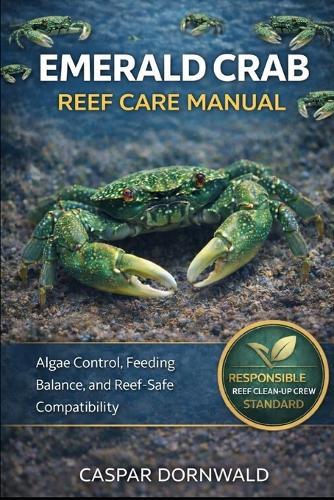
Emerald Crab Reef Care Manual: Algae Control, Feeding Balance, and Reef-Safe Compatibility

Author:   Caspar Dornwald
Publisher:   Independently Published
ISBN:  

9798246229071


Pages:   102
Publication Date:   30 January 2026
Format:   Paperback
Availability:   In Print   Availability explained
This item will be ordered in for you from one of our suppliers. Upon receipt, we will promptly dispatch it out to you. For in store availability, please contact us.

Our Price $42.24 Quantity:  
Add to Cart

Share |

Emerald Crab Reef Care Manual: Algae Control, Feeding Balance, and Reef-Safe Compatibility


Overview

The emerald crab, scientifically known as Mithraculus sculptus, is a small brachyuran crab native to the tropical and subtropical western Atlantic Ocean. Its natural range includes the Caribbean Sea, the Gulf of Mexico, Florida Keys, and portions of the Bahamas and Central American reef systems. In these environments, the emerald crab evolved as a cryptic, reef-associated crustacean whose survival depends on concealment, opportunistic feeding, and tight ecological integration with coral reef microhabitats. Unlike free-roaming crabs that traverse open sand flats, emerald crabs are structurally adapted to complex reef architecture. They inhabit crevices within live rock, coral rubble, and calcareous reef frameworks, rarely exposing themselves to open water during daylight hours. This natural history explains many of their behavioral patterns in captivity, particularly their nocturnal activity, preference for hiding spaces, and sensitivity to environmental disruption. From an evolutionary perspective, emerald crabs belong to a group of reef crabs that prioritized camouflage and dexterity over size and brute strength. Their flattened bodies allow them to wedge into narrow rock fissures, while their spoon-shaped claws are adapted for scraping algae and detritus from hard surfaces. These traits are not incidental; they are the product of long-term adaptation to grazing-based survival in nutrient-variable reef systems. In the wild, emerald crabs experience constant ecological pressure. Predatory fish, octopuses, and larger crustaceans all pose threats. As a result, emerald crabs evolved a life strategy based on concealment, rapid retreat, and selective foraging. Understanding this evolutionary background is essential for interpreting their behavior in aquariums, where the absence of predators does not eliminate ingrained survival instincts.

Full Product Details

Author:   Caspar Dornwald
Publisher:   Independently Published
Imprint:   Independently Published
Dimensions:   Width: 15.20cm , Height: 0.50cm , Length: 22.90cm
Weight:   0.149kg
ISBN:  

9798246229071


Pages:   102
Publication Date:   30 January 2026
Audience:   Children/juvenile ,  Children / Juvenile
Format:   Paperback
Publisher's Status:   Active
Availability:   In Print   Availability explained
This item will be ordered in for you from one of our suppliers. Upon receipt, we will promptly dispatch it out to you. For in store availability, please contact us.

Table of Contents

Reviews

Author Information

Tab Content 6

Author Website:  

Countries Available

All regions
Latest Reading Guide

RGFEB26


Shopping Cart
Your cart is empty
Shopping cart
Mailing List