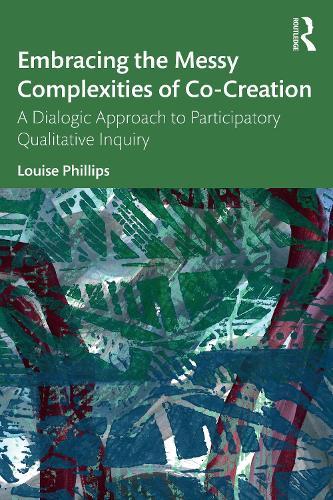
Full Product Details
Author: Louise Phillips
Publisher: Taylor & Francis Ltd
Imprint: Routledge
Weight: 0.400kg
ISBN: 9781032369686
ISBN 10: 103236968
Pages: 244
Publication Date: 30 December 2024
Audience:
College/higher education
,
Professional and scholarly
,
Tertiary & Higher Education
,
Professional & Vocational
Format: Paperback
Publisher's Status: Active
Availability: In Print

This item will be ordered in for you from one of our suppliers. Upon receipt, we will promptly dispatch it out to you. For in store availability, please contact us.
Reviews
"We rapidly approach a world condition in which we either collaborate or perish. Inquiry into the nature of dialogue, its potentials and limitations, is essential to our capacities to forge the future together. It is just here that the work of Louise Phillips is of central significance. Her scholarship, her sophisticated deliberations, and her experiences in participatory inquiry are without equal. All are reflected in this illuminating extension of her work into realms of embodied and artistic communication. --Kenneth J. Gergen, Ph.D., Senior Research Professor in Psychology at Swarthmore College, and the President of the Taos Institute Books on participatory research and related approaches often present what Erving Goffman would call the ''front stage'' to show its methods and techniques, impact and democratic potential. Louise Phillips dares to share the ''back-stage'' narrating about the messy dynamics of in- and exclusion in the process of knowledge co-creation, enacting a 'discomforting reflexivity.' Herewith she paints a very realistic picture of the relational, ethical and political complexity of participatory research, and how to navigate the power differentials around ''co"" in co-creation. --Tineke Abma, Ph.D., Professor of Participation of Older People at the Department of Public Health and Primary Care at the Leiden University Medical Centre and Executive Director of Leyden Academy on Vitality and Ageing The book makes such a useful and timely contribution to the field of social research in the way it brings participatory research, and its focus on power, together with new materialist and posthumanist forms of inquiry, and their focus on relational becoming. -- Victoria Foster, Senior External Engagement Fellow, Edge Hill University, UK"
We rapidly approach a world condition in which we either collaborate or perish. Inquiry into the nature of dialogue, its potentials and limitations, is essential to our capacities to forge the future together. It is just here that the work of Louise Phillips is of central significance. Her scholarship, her sophisticated deliberations, and her experiences in participatory inquiry are without equal. All are reflected in this illuminating extension of her work into realms of embodied and artistic communication. --Kenneth J. Gergen, Ph.D., Senior Research Professor in Psychology at Swarthmore College, and the President of the Taos Institute Books on participatory research and related approaches often present what Erving Goffman would call the ''front stage'' to show its methods and techniques, impact and democratic potential. Louise Phillips dares to share the ''back-stage'' narrating about the messy dynamics of in- and exclusion in the process of knowledge co-creation, enacting a 'discomforting reflexivity.' Herewith she paints a very realistic picture of the relational, ethical and political complexity of participatory research, and how to navigate the power differentials around ''co"" in co-creation. --Tineke Abma, Ph.D., Professor of Participation of Older People at the Department of Public Health and Primary Care at the Leiden University Medical Centre and Executive Director of Leyden Academy on Vitality and Ageing The book makes such a useful and timely contribution to the field of social research in the way it brings participatory research, and its focus on power, together with new materialist and posthumanist forms of inquiry, and their focus on relational becoming. -- Victoria Foster, Senior External Engagement Fellow, Edge Hill University, UK
Author Information
Louise Phillips is Professor of Communication, Department of Communication and Arts, Roskilde University