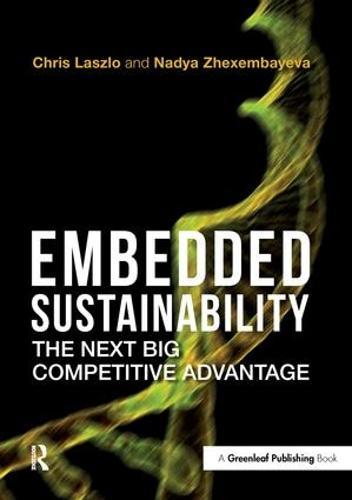
Full Product Details
Author: Chris Laszlo ,
Nadya Zhexembayeva
Publisher: Taylor & Francis Ltd
Imprint: Greenleaf Publishing
Weight: 0.580kg
ISBN: 9781906093587
ISBN 10: 190609358
Pages: 288
Publication Date: 01 March 2011
Audience:
General/trade
,
General
Format: Hardback
Publisher's Status: Active
Availability: In Print

This item will be ordered in for you from one of our suppliers. Upon receipt, we will promptly dispatch it out to you. For in store availability, please contact us.
Reviews
Market shifts create winners and losers; and companies must innovate to survive... The question does it pay to be green? becomes nonsensical. It is the same as asking does it pay to innovate? The answer depends on who does it, when they do it and how they do it. As this book explains, to answer these questions, the business executive must put aside green considerations and concentrate on business fundamentals... This is not an issue of corporate social responsibility. This is an issue of market economics and business strategy... It is just becoming the way we do business. That is the overriding message of this book. Andrew J. Hoffman, Holcim (US) Professor of Sustainable Enterprise, University of Michigan, Ann Arbor, Michigan (from the foreword) We are in the midst of a tectonic shift: The industrial corporate model of the 19th century is dying and being replaced by the sustainable enterprise model of the 21st century. In this new world of declining resources, radical transparency, and increasing expectations, corporate social responsibility will no longer be enough. In this book, Laszlo and Zhexembayeva show clearly that the defining characteristic of the successful 21st century corporation will be its ability to embed sustainability in every fiber of its being. And even more importantly, embedded sustainability will hold the key to future profit and value creation. Stuart L. Hart, S. C. Johnson Chair in Sustainable Global Enterprise, Cornell University and author of Capitalism at the Crossroad
Although I didn't, in many ways, it makes sense to start reading this book at the penultimate chapter, Chapter 9, entitled The world in 2041. Now, 2041 is not all that far away, but the description of the fictional young Jake Marstreng attending an interview with Septad Corp is as futuristic as the best sci-fi movies, as surreal as the best fantasy productions and as realistic as the best documentaries on National Geographic. It's a future which is so far-fetched as to be a perversion of the authors' imagination and yet so possible as to be just around the corner. Detailed descriptions of the radically changed global economy, sci-fi lifestyles and new technologies are truly exciting: solar cell conversion of light into electricity, PCB destruction using photozymes, Virtual Retinal Display contact lenses, 3-D virtual conferencing, vertical farms using hydroponics and crop stackers powered by methane digestion, vehicles powered by solar photovoltaic thermoelectric generator hybrid systems, construction incorporating zero-energy technologies and hydro botanic water treatment and more. And all this happens after the Water Wars and the Dark Years. All that's missing is Mr Spock (who, in 2014, is probably Indian, Chinese or Brazilian). Reading Chapter 9 helps you make sense of what Embedding Sustainability is all about. It's not another shmoozy look at how companies are doing well by doing good. It's not another collection of glowing MNE case studies that have more reputational value than sustainability substance. It's not a how-to-succeed-at-sustainability-in-3-days recipe. It is a highly intelligent (and intellectual) roadmap of the gearshift in corporate thinking and actions that are needed to transform sustainability bandaids into sustainable business. Chris Laszlo and Nadya Zhexembayeva do a magnificent job of whetting our appetites for creating sustainable value. They describe the book as organized around central themes of business strategy and change management, with two bookends. The first bookend is about the mega-trends that are driving the new business environment and the last bookend is about a future vision of business and some of the key questions we often wrestle with as we move forward on the sustainability journey. The authors shape the mega-trends around three core issues: declining resources, radical transparency and increasing expectations, offering compelling arguments relating to each. For example, bluefin tuna has become so rare that a single adult fish fetched $396,000 at an auction in Tokyo; use of Google Earth to view the plantations where bananas are grown by Dole; the sale of 190,000 organic cotton yoga outfits by Walmart in the first 10 weeks of launch; or Sourcemap.org which exposes environmental impacts of anything manufactured. Now convinced, the heart of this book provides an excellent backdrop for envisaging sustainable value creation. Seven key drivers are discussed: risk mitigation, efficiency opportunity, factor of differentiation, pathway to new markets, protect and enhance the brand, influencing industry standards and driver of radical innovation. However there are many paths to Rome and strategic approaches may differ from company to company. Embedded Sustainabilitythen takes us on a journey of strategy development using three strategic frameworks: Porter's Generic Strategies, Kim and Mauborgne's Blue Ocean Strategy and Clayton Christensen's Disruptive Innovation, showing how all these can have their place in the ways in which companies create superior sustainable value. Finally, even if you are on board so far, there is still much to debate. The final chapter of this book is an articulation of some underlying questions (the authors' starter-kit of Big Picture questions ): * Growth or No growth? Is growth itself sustainable? * What is the role of government and the nonprofit sector? Can regulation achieve what voluntary initiative cannot? * Stopping the bad or creating the good? Is your agenda bright green or dark green? * Having or being? Is a moral awakening imperative? * Evolution or revolution? Can we expect a global breakdown and rebuild to occur within a few decades? * Restoring or transforming nature? Should we aspire to the preservation of nature in its untouched state or use our technologies to fix and improve nature? * Fear or enlightened self-interest? Are we motivated to change by fear or by positive images of the future? Does inspiration drive us more than the threat of an impending disaster? Embedded Sustainability: The Next Big Competitive Advantage truly stretches our minds and turns sustainable value into a compelling direction which is within our capability, though not without fundamental repositioning of the way we perceive sustainable value and the routes to achieve it. This book is both delightful and frightful. The vision of an accessible sustainable reality created by Chris Laszlo and Nadya Zhexembayeva is delightful. The effort needed to get there is frightful. But, no gain without pain, right? Elaine Cohen is a Sustainability Consultant and Reporter at Beyond Business and blogger on sustainability reporting and author of CSR for HR: A Necessary Business Partnership for Advancing Responsible Business Practices. -- Elaine Cohen CSRwire, 29 July 2011 The book is well structured, with summaries at the end of each chapter ... The authors present a considerable number of examples of companies that have engaged with sustainability, as well as offering a chapter on change management, where they propose four areas to guide transformation ... The book is easy to read, and can serve as a starting guide for practitioners and managers, who may not be familiar with the concepts, to start rethinking their strategies and policies to start addressing and embedding sustainability into their companies. -- Rodrigo Lozano, Sustainability Research Institute, School of Earth and Environment, University of Le Journal of Cleaner Production 19 (2011) In Embedded Sustainability, authors Chris Laszlo and Nadya Zhexembayeva explain and predict how companies can better leverage global challenges for enduring profit and sustained growth. They introduce the marquis concept of embedded sustainability: the incorporation of environmental, health and social value into the heartbeat of the product life cycle with no trade-off in price or quality - no social or green premium. This book helps readers to comprehend and implement the notion of embedded sustainability. At its best, embedded sustainability is invisible, similar to quality. In addition to delivering socially and environmentally conscious products for consumers, it is capable of considerably motivating employees. Most of all, it enables smart companies to create even more value for both their shareholders and stakeholders. Laszlo and Zhexembayeva show clearly that the defining characteristic of the successful 21st century corporation will be its ability to embed sustainability in every fibre of its being. And, even more importantly, embedded sustainability will hold the key to future profit and value creation. Educational Book Review, October/November 2011
Author Information
Chris Laszlo is the author of Sustainable Value: How the World's Leading Companies Are Doing Well by Doing Good (Greenleaf Publishing and Stanford University Press, 2008) and The Sustainable Company: How to Create Lasting Value through Social and Environmental Performance (Island Press, 2003). He is an Associate Professor at Case Western Reserve University's Weatherhead School of Management, where he is the Faculty Research Director at the Fowler Center for Sustainable Value. Chris is also the co-founder and Managing Partner of Sustainable Value Partners, LLC, an advisory services firm specialized in sustainability for business advantage. Nadya Zhexembayeva is the Coca-Cola Chair of Sustainable Development at IEDC-Bled School of Management, the European business school based in Slovenia, where she teaches leadership, organizational design, and sustainability strategy. Nadya currently serves as Vice-President of Challenge:Future , a global youth think-tank. She is a member of the Advisory Board of the Fowler Center for Sustainable Value at the Weatherhead School of Case Western Reserve University in Cleveland, Ohio. Nadya is also an Associate Partner of Sustainable Value Partners, LLC.