Overview
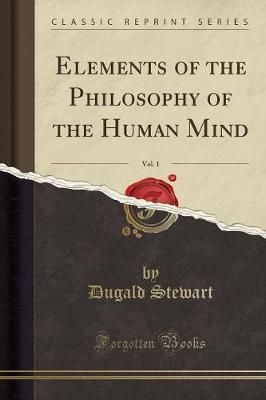
Interested in the nature of the mind? Then you should read Elements of the Philosophy of the Human Mind, a metaphysical tour-de-force by one of the Enlightenment's most influential thinkers. Dugald Stewart was a Scottish philosopher dedicated to discovering a philosophy of mind by using Sir Francis Bacon's inductive method of reasoning. Elements of the Philosophy of the Human Mind, which was published in three volumes, is one of his most comprehensive writings on the phenomena of consciousness. In this first volume, Stewart takes readers step by step through an examination of the mind. The book begins with a chapter explaining why it is valuable, indeed essential, to study human consciousness. This is in keeping with Enlightenment thinkers, who were reminding Western civilization that studying art, philosophy and the nature of the mind itself was an endeavor that would benefit humanity. It is with these lofty aspirations that Stewart begins his exploration. Stewart takes on nearly every subject that preoccupied philosophers of the day. For example, the chapter on memory ably deconstructs the different kinds of memories, the way memory seems to be acquired and retained, and how it can be improved. This is an example of using inductive reasoning to reveal the laws applicable to memory and what it means for human consciousness. Many major philosophers appear in this book, as Stewart explains their main theories. The highlight of this section is the conversation about Nomialists versus Realists. In the debate about the nature of reality, Nomialists and Realists remain the two most entrenched positions in the Western world. Nomialists believe that there are no universal truths; instead there are things particular to a person's own creation. Stewart surveys the major players, like Hume, Hobbes and Berkeley for the Nomialists, and Plato and Aristotle for the Realists. Many sections of the book conclude with a chapter where Stewart addresses the material he discussed, anticipating readers' questions and concerns. This creates a sense that the reader is communicating with a professor. It is here where Stewart's legacy is greatest, because he was a professor of John Stuart Mill and many other contributors to Western thought. Elements of the Philosophy of the Human Mind allows the reader to learn from one of the best philosophers on the subject. About the Publisher Forgotten Books publishes hundreds of thousands of rare and classic books. Find more at www.forgottenbooks.com This book is a reproduction of an important historical work. Forgotten Books uses state-of-the-art technology to digitally reconstruct the work, preserving the original format whilst repairing imperfections present in the aged copy. In rare cases, an imperfection in the original, such as a blemish or missing page, may be replicated in our edition. We do, however, repair the vast majority of imperfections successfully; any imperfections that remain are intentionally left to preserve the state of such historical works.
Full Product Details
Author: Dugald Stewart
Publisher: Forgotten Books
Imprint: Forgotten Books
Dimensions:
Width: 15.20cm
, Height: 3.30cm
, Length: 22.90cm
Weight: 0.848kg
ISBN: 9781330294086
ISBN 10: 1330294084
Pages: 646
Publication Date: 18 February 2019
Audience:
General/trade
,
General
Format: Paperback
Publisher's Status: Unknown
Availability: Available To Order

Limited stock is available. It will be ordered for you and shipped pending supplier's limited stock.