Overview
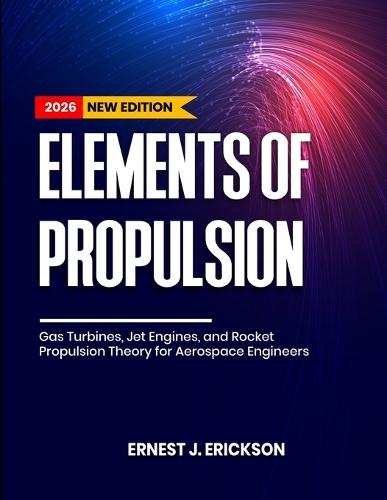
Still struggling to connect textbook theory to the engines that actually fly? Can you derive the thrust equation from first principles and then immediately turn that same derivation into a cycle analysis of a GE9X turbofan at cruise? Do you know why the PW1000G needed a reduction gearbox, why Raptor uses full-flow staged combustion while Merlin doesn't, and what ΔV budget separates a commercial GEO mission from a crewed Mars lander? If you hesitated on any of these, you are not alone. Most propulsion textbooks pick a lane. They cover turbines deeply but treat rockets as an afterthought. They derive elegant equations but never show you how a working engineer applies them. They were written for a world before reusable Falcon 9 boosters, before geared turbofans entered commercial service, and before ion thrusters became standard on satellites. This book is different. Elements of Propulsion: Gas Turbines, Jet Engines, and Rocket Propulsion Theory for Aerospace Engineers is a 400-page, ten-chapter textbook that delivers everything an upper-undergraduate or early-graduate aerospace engineer needs to analyze, design, and evaluate modern propulsion systems, from subsonic turbofans to hypersonic scramjets, from methane rockets to ion engines destined for Mars. What You'll Master Part I - Foundations builds the analytical toolkit from the ground up: - Chapter 1 - Propulsion fundamentals, thrust equation, specific impulse, Breguet range - Chapter 2 - Thermodynamics and compressible flow, shocks, stagnation properties - Chapter 3 - Aerothermodynamics of engine components with SAE ARP 755 station numbering - Chapter 4 - Combustion, chemical kinetics, Borghi diagram, SAF and hydrogen fuels - Chapter 5 - Turbomachinery, velocity triangles, Euler's equation, Smith chart, turbine coolingPart II - Applications and Design turns theory into working engines: - Chapter 6 - Turbojet and turbofan cycle analysis, geared turbofans, afterburning, GE9X case study - Chapter 7 - Turboprop, turboshaft, ramjet, scramjet, and combined-cycle engines through Mach 10+ - Chapter 8 - Rocket propulsion fundamentals: Tsiolkovsky, nozzle design, combustion chambers, cooling - Chapter 9 - Chemical rockets: GG, staged combustion, expander, FFSC cycles, solid and hybrid motors - Chapter 10 - Advanced and non-chemical propulsion: ion, Hall, nuclear, solar sails, Breakthrough StarshotPlus a complete back matter: seven appendices (mathematical reference, property tables, codes and standards, software tools, answers to selected problems, key derivations, and 20 engine data sheets from Merlin 1D to Raptor 2 to NEXT-C), a 250-term glossary, and a full conclusion on where the field is going. Don't wait until your next exam, your next project, or your next job interview to wish you had this book. Order now. Build the career. Design the engines. Shape the future of flight.
Full Product Details
Author: Ernest J Erickson
Publisher: Independently Published
Imprint: Independently Published
Dimensions:
Width: 21.60cm
, Height: 1.90cm
, Length: 27.90cm
Weight: 0.821kg
ISBN: 9798258653505
Pages: 354
Publication Date: 23 April 2026
Audience:
General/trade
,
General
Format: Paperback
Publisher's Status: Active
Availability: Available To Order

We have confirmation that this item is in stock with the supplier. It will be ordered in for you and dispatched immediately.