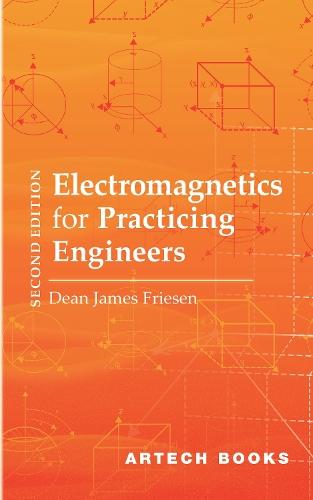
Electromagnetics for Practicing Engineers, Second Edition

Author:   Dean Friesen
Publisher:   Artech House Publishers
Edition:   2nd Unabridged edition
ISBN:  

9781685691493


Pages:   378
Publication Date:   30 November 2025
Format:   Hardback
Availability:   In Print   Availability explained
This item will be ordered in for you from one of our suppliers. Upon receipt, we will promptly dispatch it out to you. For in store availability, please contact us.

Our Price $320.85 Quantity:  
Add to Cart

Share |

Electromagnetics for Practicing Engineers, Second Edition


Overview

Electromagnetics for Practicing Engineers, Second Edition delivers an expanded, authoritative guide that fully integrates electromagnetic (EM) theory with the most critical real-world design and safety applications. The book transforms abstract EM concepts directly into effective, implementable strategies for solving practical design challenges in complex aerospace, defense, and commercial systems. Practitioners gain the expertise necessary to diagnose and resolve field complications, ensuring system integrity and reliability.   The text meticulously covers fundamental principles, including a thorough review of vector analysis and Coulomb forces, and details the critical roles of capacitance, dielectric materials, and inductance in system design. Detailed methodologies demonstrate the application of Gauss’ Law to field calculations, the use of Laplace’s Equation to resolve potential complications, and the analysis of displacement current and induced EMF in magnetic circuits. New chapters introduce guidance on free-space topics, specifically addressing electromagnetic wave propagation, boundary conditions, and Maxwell’s Equations for high frequency analysis.   This updated reference provides immediate value for practicing electrical engineers, aerospace and defense technologists, RF designers, and advanced students seeking expert applied guidance. The practical case studies and solutions (derived directly from the author’s work) show how to mitigate specific field challenges, such as reducing static charge in liquid fuel systems, achieving accurate fuel sensing in aircraft tanks, or predicting attenuation effects at higher frequencies. This book will equip engineers with the theoretical grounding and technical methods required to handle complex electromagnetics comfortably.

Full Product Details

Author:   Dean Friesen
Publisher:   Artech House Publishers
Imprint:   Artech House Publishers
Edition:   2nd Unabridged edition
ISBN:  

9781685691493


ISBN 10:   1685691498
Pages:   378
Publication Date:   30 November 2025
Audience:   Professional and scholarly ,  Professional & Vocational
Format:   Hardback
Publisher's Status:   Active
Availability:   In Print   Availability explained
This item will be ordered in for you from one of our suppliers. Upon receipt, we will promptly dispatch it out to you. For in store availability, please contact us.

Table of Contents

1 VECTOR ANALYSIS 1.1 Introduction 1.2 Vector Notation 1.3 Vector Algebra 1.4 Coordinate Systems 1.5 Differential Volume, Surface, and Line Elements 1.6 Vector Fields 1.7 Transformations Between Coordinate Systems 1.8 Problems and Solutions: Vector Analysis References   2 COULOMB FORCES AND ELECTRIC FIELD INTENSITY 2.1 Coulomb’s Law 2.2 Electric Field Intensity 2.3 Charge Distributions 2.4 Standard Charge Configurations 2.5 Problems: Coulomb Force and E-Field Intensity References   3 ELECTRIC FLUX AND GAUSS’ LAW 3.1 Net Charge in a Region 3.2 Electric Flux and Flux Density 3.3 Gauss’ Law 3.4 Relation Between Flux Density and Electric Field Intensity 3.5 Special Gaussian Surfaces 3.6 Problems and Solutions: Electric Flux and Gauss’ Law References   4 DIVERGENCE AND THE DIVERGENCE THEOREM 4.1 Divergence 4.2 Divergence in Cartesian Coordinates 4.3 Divergence of D 4.4 The Del Operator 4.5 Divergence Theorem 4.6 Problems and Solutions: Divergence and the Divergence Theorem References   5 ENERGY AND ELECTRIC POTENTIAL OF CHARGE SYSTEMS 5.1 Work Done in Moving a Point Charge 5.2 Electric Potential Between Two Points 5.3 Potential of a Point Charge 5.4 Potential of a Charge Distribution 5.5 Gradient 5.6 Relationship Between E and ∇ 5.7 Energy in Static Electric Fields 5.8 Problems and Solutions : Energy and Electric Potential of Charge Systems References   6 CURRENT, CURRENT DENSITY, AND CONDUCTORS 6.1 Introduction 6.2 Charges in Motion 6.3 Convection Current Density 6.4 Conduction Current Density 6.5 Conductivity 6.6 Current 6.7 Resistance 6.8 Current Sheet Density 6.9 Continuity of Current 6.10 Conductor: Dielectric Boundary Conditions 6.11 Problems and Solutions: Current, Current Density, and Conductors References   7 CAPACITANCE AND DIELECTRIC MATERIALS 7.1 Polarization P and Relative Permittivity 7.2 Fixed Voltage D and E 7.3 Fixed Charge D and E 7.4 Boundary Conditions at the Interface of Two Dielectrics 7.5 Capacitance 7.6 Multiple-Dielectric Capacitors 7.7 Energy Stored in a Capacitor 7.8 Problems and Solutions: Capacitance and Dielectric Materials References   8 LAPLACE’S EQUATION 8.1 Introduction 8.2 Poisson’s Equation and Laplace’s Equation 8.3 Explicit Forms of Laplace’s Equation 8.4 Uniqueness Theorem 8.5 Mean Value and Maximum Value Theorems 8.6 Cartesian Solution in One Variable 8.7 Cartesian Product Solution 8.8 Cylindrical Product Solution 8.9 Spherical Product Solution 8.10 Problems and Solutions: Laplace’s Equation References   9 AMPERE’S LAW AND THE MAGNETIC FIELD 9.1 Magnetostatics 9.2 Biot-Savart Law 9.3 Ampere’s Law 9.4 Curl 9.5 Current Density J and ∇ × H 9.6 Magnetic Flux Density B 9.7 Vector Magnetic Potential A 9.8 Stokes’ Theorem 9.9 Problems and Solutions References   10 FORCES AND TORQUES IN MAGNETIC FIELDS 10.1 Magnetic Force on Particles 10.2 Electric and Magnetic Fields Combined 10.3 Magnetic Force on a Current Element 10.4 Work and Power 10.5 Torque 10.6 Magnetic Moment of a Planar Coil 10.7 Problems and Solutions References   11 INDUCTANCE AND MAGNETIC CIRCUITS 11.1 Voltage of Self-Induction 11.2 Inductors and Inductance 11.3 Standard Forms 11.4 Internal Inductance 11.5 Magnetic Circuits 11.6 Nonlinearity of the B-H Curve 11.7 Ampere’s Law for Magnetic Circuits 11.8 Cores with Air Gaps 11.9 Multiple Coils 11.10 Parallel Magnetic Circuits 11.11 Problems and Solutions References   12 DISPLACEMENT CURRENT AND INDUCED EMF 12.1 Displacement Current 12.2 Ratio of JC to JD 12.3 Faraday’s Law 12.4 Conductors in Motion Through Time-Independent Fields 12.5 Conductors in Motion Through Time-Dependent Fields 12.6 Problems and Solutions References   13 ELECTROMAGNETIC WAVES 13.1 Characteristics of Electromagnetic Waves 13.2 Principles of Electromagnetic Waves   14 BOUNDARY CONDITIONS 14.1 Introduction 14.2 Boundary Relations for Magnetic Fields 14.3 Current Sheet at the Boundary 14.4 Summary of Boundary Conditions   15 MAXWELL’S EQUATIONS 15.1 Maxwell’s First Equation 15.2 Maxwell’s Second Equation 15.3 Maxwell’s Third Equation 15.4 Maxwell’s Fourt Equation 15.5 Other Important Equations 15.6 A Summary of the Physics-Based Ramifications of Maxwell’s Equations   16 PRACTICAL SOULTIONS TO REAL-WORLD ELECTROMAGNETIC ENGINEERING PROBLEMS 16.1 Anecdotes in Electrostatics 16.2 Anecdotes in Magnetostatics 16.3 Anecdotes in Electromagnetics 16.4 Lessons Learned 16.5 Final Remarks to the Reader   APPENDICES A SCIENTIFIC PREFIXES B SCIENTIFIC CONSTANTS C RULES BY WHICH TO PERFORM VECTOR ANALYSIS D ELECTROMAGNETIC SPECTRUM AND FREQUENCY BAND DESIGNATIONS E TRANSMISSION LINE EQUATIONS , GENERAL LINE EXPRESSIONS, AND IDEAL LINE EXPRESSIONS F MAXWELL’S EQUATIONS   ACRONYMS AND ABBREVIATIONS SELECTED BIBLIOGRAPHY ABOUT THE AUTHOR INDEX

Reviews

Author Information

earned his B.S. in electrical engineering from the University of Maryland in 1953 and worked at RCA Laboratories on early color TV broadcast systems and the first transistor radios. After completing his Ph.D. at the University of Wisconsin in 1962, he joined the faculty at Iowa State University, where he taught for nearly three decades, originated courses in information theory, error-correcting codes, and analog filter design, and twice received Professor of the Year honors. He was the first at ISU to teach SPICE for circuit analysis, contributed to advances in digital compression and coding methods, and in retirement continued to support students through textbooks, solution manuals, and simulation tools.

Tab Content 6

Author Website:  

Countries Available

All regions
Latest Reading Guide

April RG 26_2


Shopping Cart
Your cart is empty
Shopping cart
Mailing List