Overview
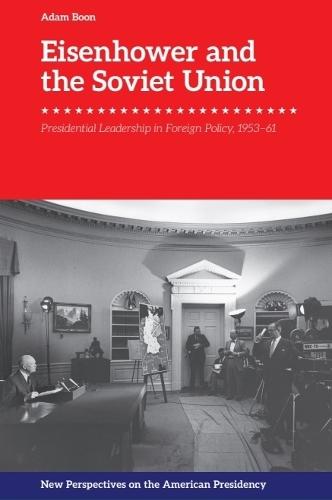
Assesses the mode and quality of Dwight D. Eisenhower's presidential leadership by analysing his contribution to American policy towards the Soviet Union from 1953 to 1961. How did Eisenhower, as president, lead his administration's policy towards the Soviet Union? What general observations can be made about Eisenhower's presidential leadership based on this account of how he managed Soviet policy? What does this mean for how Eisenhower's leadership has been framed to date? The book offers a nuanced comparison of Eisenhower's performance across separate elements of presidential leadership, how they knitted together as a whole and his evolution as a leader over eight years. It provides a basis for scrutinising cornerstones of Eisenhower scholarship, including the pervasive conception of 'hidden-hand' leadership, which has long had a transformative impact on interpretations of Eisenhower's presidency.
Full Product Details
Author: Adam Boon
Publisher: Edinburgh University Press
Imprint: Edinburgh University Press
ISBN: 9781399545310
ISBN 10: 1399545310
Pages: 336
Publication Date: 28 February 2026
Audience:
College/higher education
,
Postgraduate, Research & Scholarly
Format: Hardback
Publisher's Status: Active
Availability: Not yet available 
This item is yet to be released. You can pre-order this item and we will dispatch it to you upon its release.
Table of Contents
Acknowledgements Introduction: Leadership and Soviet policy in the Context of Eisenhower’s Presidency: ‘Be the Leader of the United States and the World!’ 1. Reviewing the Truman Inheritance, Stalin’s Death, and Atoms for Peace: ‘The Eisenhower Era Begins as the Stalin Era Ends’ 2. Implementing New Look, Pursuing Atoms for Peace, and the Resumption of Dialogue at the Berlin Conference: ‘Our Foreign Policy is Shaping up Sounder than ever Before’ 3. Eisenhower and the ‘Great Spectacle’ of the Geneva Summit: ‘Each Side Believes the Other has Horns and a Tail’ 4. The Twin Crises of Suez and Hungary, Khrushchev’s Secret Speech, and the 1956 Re-Election Campaign: ‘The Most Crowded and Demanding Period of my Presidency’ 5. Arms Control, Sputnik, and Diplomatic Paralysis: ‘The Seductive Qualities of Soviet Promises’ 6. Nuclear Testing, Berlin, and Inviting Khrushchev to America: ‘Be Careful Not to Go to War Just for the Stamp’ 7. Khrushchev at Camp David, the Paris Summit, and the End of Eisenhower’s Presidency: ‘Everything Depends on the Two of Us’ Conclusion: What does the Management of US-Soviet Relations Tell Us About Eisenhower’s Presidential Leadership? ‘The Unhappy Intimacy this Involves’ Bibliography
Reviews
This book is a compelling read, and I recommend it for all those interested in understanding what makes foreign policy. Boon contributes to an important re-assessment of Eisenhower. His analysis of the president’s role in US policy towards the USSR recognises the complexity of government decision-making and identifies missed opportunities. -- Matthew Hill, Liverpool John Moores University
Author Information
Adam Boon received a PhD in History from Queen Mary, University of London in 2021. His doctoral research provided the foundation for this book. He is now an analyst at the UK Government.
Tab Content 6
Author Website:
Countries Available
All regions
|