Overview
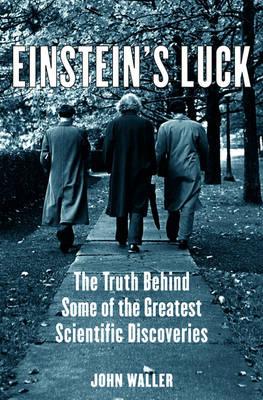
The great biologist Louis Pasteur suppressed data that didn't support the case he was making. Albert Einstein's theory of general relativity was only ""confirmed"" in 1919 because an eminent British scientist massaged his figures. Joseph Lister's famously spotless hospital wards were actually notoriously dirty. Gregor Mendel, supposed father of the science of heredity, never grasped the fundamental principles of ""Mendelian"" genetics. The history of science used to be presented as a heroic saga, in which a few far-seeing geniuses overcame the petty opposition of lesser minds to establish new scientific truths. But over recent decades, historians of science have cast a much more critical eye over their subject. Delving into laboratory notebooks and reconstructing once-fierce debates, they have challenged many of our basic assumptions about the nature of science and the roles its greatest heroes played. ""Einstein's Luck"" reveals many of these findings to the general reader.
Full Product Details
Author: John Waller
Publisher: Oxford University Press
Imprint: Oxford University Press
Dimensions:
Width: 15.00cm
, Height: 3.20cm
, Length: 23.00cm
Weight: 0.712kg
ISBN: 9780198607199
ISBN 10: 0198607199
Pages: 320
Publication Date: 26 September 2002
Audience:
General/trade
,
General
Format: Hardback
Publisher's Status: Active
Availability: To order

Stock availability from the supplier is unknown. We will order it for you and ship this item to you once it is received by us.
Reviews
<br> John Waller takes several of our treasured and carefully nurtured illusions about the nature of science and scientists, and systematically uses history to shatter them. Louis Pasteur, Joseph Lister, John Snow, Gregor Mendel--even Charles Darwin--will never be quite the same again. --Nature<br> An iconoclastic, decidedly revisionist look at the hit-or-miss business of science. Forget everything you know about snakes swallowing their own tails and the burning of blue, gemlike flames. All too often, writes Waller, science evolves despite the institution of science, in which the race goes not to the most elegant solution but to the fellow with the biggest research grant and the most political power.... Waller's interest lies more in the telling anecdote than in the overarching moral, but he does a good job overall of showing the role of accident--and referees willing to look the other way--in the everyday work of scientists.... An informal, often entertaining excursion in the history
John Waller takes several of our treasured and carefully nurtured illusions about the nature of science and scientists, and systematically uses history to shatter them. Louis Pasteur, Joseph Lister, John Snow, Gregor Mendel--even Charles Darwin--will never be quite the same again. --Nature An iconoclastic, decidedly revisionist look at the hit-or-miss business of science. Forget everything you know about snakes swallowing their own tails and the burning of blue, gemlike flames. All too often, writes Waller, science evolves despite the institution of science, in which the race goes not to the most elegant solution but to the fellow with the biggest research grant and the most political power.... Waller's interest lies more in the telling anecdote than in the overarching moral, but he does a good job overall of showing the role of accident--and referees willing to look the other way--in the everyday work of scientists.... An informal, often entertaining excursion in the history of science. --Kirkus Reviews Waller writes with clarity and flair...has a real talent for telling a story. --Roy Porter A valuable look sideways at the rolling juggernaut of modern science. --Martin Ince, New Scientist
John Waller takes several of our treasured and carefully nurtured illusions about the nature of science and scientists, and systematically uses history to shatter them. Louis Pasteur, Joseph Lister, John Snow, Gregor Mendel--even Charles Darwin--will never be quite the same again. --Nature<br> An iconoclastic, decidedly revisionist look at the hit-or-miss business of science. Forget everything you know about snakes swallowing their own tails and the burning of blue, gemlike flames. All too often, writes Waller, science evolves despite the institution of science, in which the race goes not to the most elegant solution but to the fellow with the biggest research grant and the most political power.... Waller's interest lies more in the telling anecdote than in the overarching moral, but he does a good job overall of showing the role of accident--and referees willing to look the other way--in the everyday work of scientists.... An informal, often entertaining excursion in the history of science. --Kirkus Reviews<br> Waller writes with clarity and flair...has a real talent for telling a story. --Roy Porter<br> A valuable look sideways at the rolling juggernaut of modern science. --Martin Ince, New Scientist<br>
John Waller takes several of our treasured and carefully nurtured illusions about the nature of science and scientists, and systematically uses history to shatter them. Louis Pasteur, Joseph Lister, John Snow, Gregor Mendel--even Charles Darwin--will never be quite the same again. --Nature An iconoclastic, decidedly revisionist look at the hit-or-miss business of science. Forget everything you know about snakes swallowing their own tails and the burning of blue, gemlike flames. All too often, writes Waller, science evolves despite the institution of science, in which the race goes not to the most elegant solution but to the fellow with the biggest research grant and the most political power.... Waller's interest lies more in the telling anecdote than in the overarching moral, but he does a good job overall of showing the role of accident--and referees willing to look the other way--in the everyday work of scientists.... An informal, often entertaining excursion in the history of science. --Kirkus Reviews Waller writes with clarity and flair...has a real talent for telling a story. --Roy Porter A valuable look sideways at the rolling juggernaut of modern science. --Martin Ince, New Scientist
An iconoclastic, decidedly revisionist look at the hit-or-miss business of science. Forget everything you know about snakes swallowing their own tails and the burning of blue, gemlike flames. All too often, writes Waller (History of Medicine/University College, London; The Discovery of the Germ, not reviewed), science evolves despite the institution of science, in which the race goes not to the most elegant solution but to the fellow with the biggest research grant and the most political power. Waller merrily revisits several famous moments in science, among them Pasteur's elucidation of germ theory, Robert Millikan's divination of the electron, and Einstein's development of relativity theory. In this account, none happened quite the way the textbooks tell us they did. Pasteur, for instance, fudged results, stole his assistants' ideas and passed them off as his own, refused to replicate results, and suppressed a considerable amount of negative data along the way to pasteurization; moreover, he could never quite reconcile his reactionary political and religious beliefs to what his experiments told him about the invisible world. Millikan essentially blundered his way to finding the electron, beset by the ever-shifting value of e and glad to overlook inconsistencies in the data; had he not been judged correct in the long run, Waller harrumphs, it's likely that modern commentators would invoke his story as a homiletic warning against reasoning from weakly attested theories. As for Einstein: suffice it to say that Arthur Eddington's astrophysical proofs of general relativity were a lucky hit for all concerned. Waller's interest lies more in the telling anecdote than the overarching moral, but he does a good job overall of showing the role of accident-and referees willing to look the other way-in the everyday work of scientists, whether conducted in Dr. Lister's filthy operating theater or in the most gleaming of labs. An informal, often entertaining excursion in the history of science. (Kirkus Reviews)
Author Information
John Waller is Research Fellow at the Wellcome Trust Centre for the History of Medicine at University College London. He has taught at Harvard, Oxford, and London universities. He is the author of The Discovery of the Germ: Twenty Years that Transformed our Understanding of Disease.