|
|
|||
|
||||
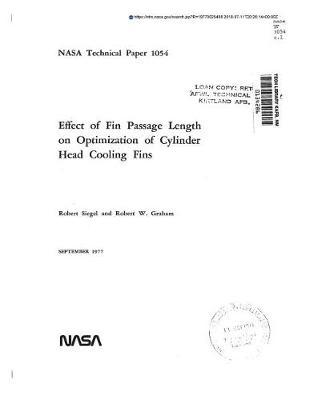
OverviewThe heat transfer performance of baffled cooling fins on cylinder heads of small, air-cooled, general-aviation aircraft engines was analyzed to determine the potential for improving cooling fin design. Flow baffles were assumed to be installed tightly against the fin end edges, an ideal baffle configuration for guiding all flow between the fins. A rectangular flow passage is thereby formed between each set of two adjacent fins, the fin base surface, and the baffle. These passages extend around each side of the cylinder head, and the cooling air absorbs heat as it flows within them. For each flow passage length, the analysis was concerned with optimizing fin spacing and thickness to achieve the best heat transfer for each fin width. Previous literature has been concerned mainly with maximizing the local fin conductance and has not considered the heating of the gas in the flow direction, which leads to higher wall temperatures at the fin passage exits. If the fins are close together, there is a large surface area, but the airflow is restricted. Siegel, R. and Graham, R. W. Glenn Research Center NASA-TP-1054, E-9098 RTOP 505-05... Full Product DetailsAuthor: National Aeronaut Administration (Nasa)Publisher: Createspace Independent Publishing Platform Imprint: Createspace Independent Publishing Platform Dimensions: Width: 21.60cm , Height: 0.20cm , Length: 28.00cm Weight: 0.111kg ISBN: 9781724794406ISBN 10: 172479440 Pages: 36 Publication Date: 06 August 2018 Audience: General/trade , General Format: Paperback Publisher's Status: Active Availability: Available To Order We have confirmation that this item is in stock with the supplier. It will be ordered in for you and dispatched immediately. Table of ContentsReviewsAuthor InformationTab Content 6Author Website:Countries AvailableAll regions |
||||