|
|
|||
|
||||
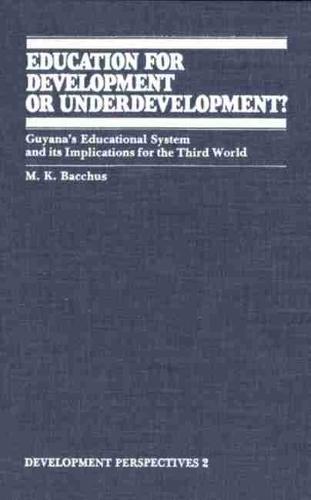
OverviewHow critical is education in the development struggle of a third world country? Responding to popular demands for more accessible education, the Guyanese government instituted numerous educational reforms, hoping to promote economic growth in both the modern and the traditional sectors of the economy. Many in the traditional sector, however, saw education as a means of economic advancement, and sought increasingly to move into higher social strata through employment in the modern sector. Consequently, the civil service and private firms gained an oversupply of personnel, while agriculture and small business suffered, and unemployment increased. The author examines Guyana's educational system from historical, political, social, and economic perspectives, and draws implications for other developing countries. Full Product DetailsAuthor: M.K. BacchusPublisher: Wilfrid Laurier University Press Imprint: Wilfrid Laurier University Press Dimensions: Width: 15.20cm , Height: 2.50cm , Length: 22.90cm Weight: 0.450kg ISBN: 9780889200852ISBN 10: 0889200858 Pages: 320 Publication Date: 30 December 1980 Audience: Professional and scholarly , Professional & Vocational Format: Paperback Publisher's Status: Active Availability: Manufactured on demand We will order this item for you from a manufactured on demand supplier. Table of ContentsEducation for Development or Underdevelopment? Guyana's Educational System and Its Implications for the Third World by M.K. Bacchus List of Tables and Charts Preface 1. Historical Introduction to Guyanese Society 2. Post-1945 Developments in Guyana 3. Primary Education 4. Teacher Education 5. Secondary Education 6. Post-Secondary and Technical Education 7. Expenditure on Education 8. Conclusion BibliographyReviewsAuthor InformationM. Kazim Bacchus was Professor of Education and Director of the Centre for International Education and Development at the University of Alberta. He helped as Director to establish the Institute for Educational Development at The Aga Khan University in Kartachi, Pakistan. He taught at the Universities of London, Guyana, West Indies, Alberta, and Chicago and was a consultant with CIDA, UNESCO, the Government of Papua New Guinea, and the Commonwealth Secretariat. Tab Content 6Author Website:Countries AvailableAll regions |
||||