Overview
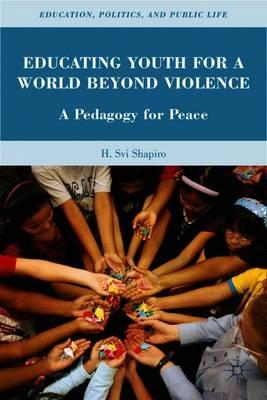
In a time of unprecedented social and economic crisis, this book represents a challenge to the orthodoxy that shapes our vision of educational purpose. It argues that now, more than ever, there is a moral imperative for educators to assume responsibility for helping to bring about a culture of peace and non-violence.
Full Product Details
Author: H. Shapiro
Publisher: Palgrave Macmillan
Imprint: Palgrave Macmillan
Dimensions:
Width: 14.00cm
, Height: 1.70cm
, Length: 21.60cm
Weight: 0.440kg
ISBN: 9780230109339
ISBN 10: 0230109330
Pages: 234
Publication Date: 19 January 2011
Audience:
Professional and scholarly
,
Professional & Vocational
Format: Hardback
Publisher's Status: Active
Availability: In Print

This item will be ordered in for you from one of our suppliers. Upon receipt, we will promptly dispatch it out to you. For in store availability, please contact us.
Reviews
<p> Few authors address the moral and spiritual dimensions of education as insightfully and accessibly as Dr. Shapiro. Far from an abstract philosophical treatise, this is a very concrete and provocative work of social/cultural criticism. An important book that I hope many people will read and consider deeply. --Sue Brooks, Professor and Chair of the Department of Secondary Education, SUNY, New Paltz<p> While he acknowledges that it will take more than schools to change our current systems of thought and action, Dr. Shapiro also acknowledges that schools offer us the opportunity to show our children a different way to be - a way to peace. While his vision is idealistic, his analysis is firmly planted in the inequities of today. He describes the suffering in the world with explicit candor, yet his critique never loses the humanity of the actors in our social conflicts and thus, the possibility for real transformation. His language invites us in and speaks to the most noble, humane, and compassionate sides of ourselves. By the end, we want to transform the education system because it seems like the most just thing to do. This book could not be more significant as it addresses the despair in the world today and gives us a sensible path for hope, a path that we can realize if we trust our better impulses. --Daniel Chapman, Assistant Professor of Curriculum Studies, Georgia Southern University
Few authors address the moral and spiritual dimensions of education as insightfully and accessibly as Dr. Shapiro. Far from an abstract philosophical treatise, this is a very concrete and provocative work of social/cultural criticism. An important book that I hope many people will read and consider deeply. - Sue Brooks, Professor and Chair of the Department of Secondary Education, SUNY, New Paltz While he acknowledges that it will take more than schools to change our current systems of thought and action, Dr. Shapiro also acknowledges that schools offer us the opportunity to show our children a different way to be - a way to peace. While his vision is idealistic, his analysis is firmly planted in the inequities of today. He describes the suffering in the world with explicit candor, yet his critique never loses the humanity of the actors in our social conflicts and thus, the possibility for real transformation. His language invites us in and speaks to the most noble, humane, and compassionate sides of ourselves. By the end, we want to transform the education system because it seems like the most just thing to do. This book could not be more significant as it addresses the despair in the world today and gives us a sensible path for hope, a path that we can realize if we trust our better impulses. - Daniel Chapman, Assistant Professor of Curriculum Studies, Georgia Southern University
<p> Few authors address the moral and spiritual dimensions of education as insightfully and accessibly as Dr. Shapiro. Far from an abstract philosophical treatise, this is a very concrete and provocative work of social/cultural criticism. An important book that I hope many people will read and consider deeply. --Sue Brooks, Professor and Chair of the Department of Secondary Education, SUNY, New Paltz<p> While he acknowledges that it will take more than schools to change our current systems of thought and action, Dr. Shapiro also acknowledges that schools offer us the opportunity to show our children a different way to be - a way to peace. While his vision is idealistic, his analysis is firmly planted in the inequities of today. He describes the suffering in the world with explicit candor, yet his critique never loses the humanity of the actors in our social conflicts and thus, the possibility for real transformation. His language invites us in and speaks to the most noble, humane, and
Author Information
H. SVI SHAPIRO Professor in the Department of Educational Leadership and Cultural Foundations at the University of North Carolina at Greensboro, USA.