Overview
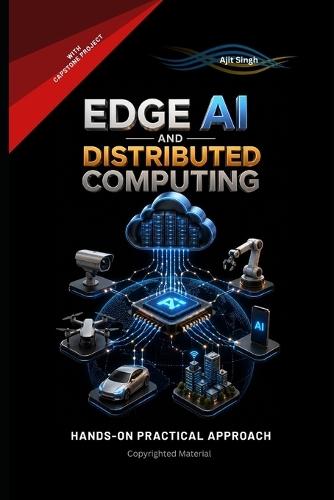
""Edge AI and Distributed Computing"" is a comprehensive, hands-on guide designed to navigate the confluence of artificial intelligence and decentralized computation. This book is engineered to be a direct bridge from foundational knowledge to professional-grade application development, focusing relentlessly on practical implementation over abstract theory. Philosophy The guiding philosophy of this book is ""learning by building."" I worked on the premise that the most profound and durable understanding of complex systems comes from constructing them. Edge AI is not treated as a collection of academic concepts but as a set of engineering disciplines, tools, and design patterns for solving real-world problems characterized by low latency, data privacy, and operational autonomy. Key Features 1. Implementation-Oriented: More than 70% of the book is focused on practical implementation, with detailed code walkthroughs, configuration guides, and deployment scripts. 2. Industry-Standard Tooling: Utilizes and teaches the most relevant tools in the industry, including TensorFlow Lite, PyTorch Mobile, ONNX Runtime, Docker, K3s (Lightweight Kubernetes), and MQTT. 3. End-to-End Project Lifecycle: Covers the complete process from data consideration and model design to on-device optimization, deployment, and fleet management. 4. Platform Agnostic Approach: While examples may use specific hardware (like a Raspberry Pi or NVIDIA Jetson), the principles and techniques taught are broadly applicable across various edge platforms. 5. Complete Capstone Project: A full-fledged final chapter dedicated to building a live, working application (e.g., an intelligent video surveillance system), including all source code and step-by-step explanations. 6. For Beginners and Advanced Learners: The structured approach allows beginners to build their skills from the ground up, while the coverage of advanced topics like MLOps, security, and distributed system orchestration provides substantial value for experienced practitioners. Key Takeaways Upon completing this book, you will be able to: 1. Architect end-to-end Edge AI and distributed computing systems. 2. Optimize and convert standard machine learning models for high-performance inference on edge devices. 3. Develop and deploy AI applications using frameworks like TensorFlow Lite and PyTorch Mobile. 4. Implement robust data communication and processing pipelines for distributed nodes using protocols like MQTT. 5. Containerize edge applications using Docker and orchestrate them using lightweight platforms like K3s. 6. Apply security and privacy best practices for edge systems. 7. Understand and implement the principles of MLOps for managing the lifecycle of AI models at the edge. 8. Build a complete, working Edge AI project from hardware setup to a functional application. Disclaimer: Earnest request from the Author. Kindly go through the table of contents and refer kindle edition for a glance on the related contents. Thank you for your kind consideration!
Full Product Details
Author: Ajit Singh
Publisher: Independently Published
Imprint: Independently Published
Dimensions:
Width: 15.20cm
, Height: 1.60cm
, Length: 22.90cm
Weight: 0.399kg
ISBN: 9798258912657
Pages: 298
Publication Date: 26 April 2026
Audience:
General/trade
,
General
Format: Paperback
Publisher's Status: Active
Availability: Available To Order

We have confirmation that this item is in stock with the supplier. It will be ordered in for you and dispatched immediately.