Overview
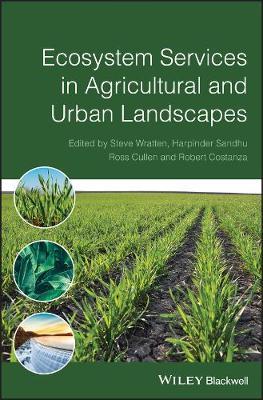
Ecosystem services are the resources and processes supplied by natural ecosystems which benefit humankind (for example, pollination of crops by insects, or water filtration by wetlands). They underpin life on earth, provide major inputs to many economic sectors and support our lifestyles. Agricultural and urban areas are by far the largest users of ecosystems and their services and (for the first time) this book explores the role that ecosystem services play in these managed environments. The book also explores methods of evaluating ecosystem services, and discusses how these services can be maintained and enhanced in our farmlands and cities. This book will be useful to students and researchers from a variety of fields, including applied ecology, environmental economics, agriculture and forestry, and also to local and regional planners and policy makers.
Full Product Details
Author: Stephen Wratten (Lincoln University) , Harpinder Sandhu (Flinders University, South Australia) , Ross Cullen (Lincoln University) , Robert Costanza (Portland State University, USA)
Publisher: John Wiley and Sons Ltd
Imprint: Wiley-Blackwell
Dimensions:
Width: 17.80cm
, Height: 1.50cm
, Length: 25.40cm
Weight: 0.603kg
ISBN: 9781405170086
ISBN 10: 1405170085
Pages: 224
Publication Date: 22 February 2013
Audience:
Professional and scholarly
,
Professional & Vocational
Format: Hardback
Publisher's Status: Active
Availability: Out of stock 
The supplier is temporarily out of stock of this item. It will be ordered for you on backorder and shipped when it becomes available.
Table of Contents
Contributors xi Reviewers xiv Foreword xv Introduction xvi Steve Wratten, Harpinder Sandhu, Ross Cullen and Robert Costanza Part A: Scene Setting 1 1 Ecosystem Services in Farmland and Cities 3 Harpinder Sandhu and Steve Wratten Abstract 3 Introduction 4 What are ecosystem services? 4 Ecosystem functions, goods and services 5 The ES framework 6 Engineered systems 7 Agricultural systems 7 Urban systems 10 ES and their interactions in engineered systems 11 2 Ecological Processes, Functions and Ecosystem Services: Inextricable Linkages between Wetlands and Agricultural Systems 16 Onil Banerjee, Neville D. Crossman and Rudolf S. de Groot Abstract 16 Introduction 17 Linking ecosystem function with ecosystem service 18 Wetlands 19 Wetland functions 20 Wetland–agricultural systems interactions 22 Some research challenges 24 Understanding complexity and resilience 24 Trade-offs 25 3 Key Ideas and Concepts from Economics for Understanding the Roles and Value of Ecosystem Services 28 Pamela Kaval and Ramesh Baskaran Abstract 28 How can ecosystem services be valued? 28 Ecosystem service valuation methodologies 31 Revealed preference methods 32 Stated preference methods 32 Other methods 33 How ecosystem services have been measured in the past 34 Ecosystem service valuation study recommendations 37 Conclusions 39 Part B: Ecosystem Services in Three Settings 43 4 Viticulture can be Modified to Provide Multiple Ecosystem Services 45 Sofia Orre-Gordon, Marco Jacometti, Jean Tompkins and Steve Wratten Abstract 45 Introduction 45 Enhancing CBC in vineyards 46 Leafrollers and Botrytis cinerea in the vineyards 48 Habitat modification to enhance naturally occurring pest control 48 Floral resource supplementation as a form of habitat modification 48 Mulch application as a form of habitat modification 49 Combining two forms of habitat modification 51 The deployment of herbivore-induced plant volatiles as a form of habitat modification 51 Habitat modification may provide further ecosystem services 52 The future 55 5 Aquaculture and Ecosystem Services: Reframing the Environmental and Social Debate 58 Corinne Baulcomb Abstract 58 Introduction 58 Aquaculture and the environment 59 A typology of aquaculture operations and the link to ecosystem services 60 Inland production systems 64 Overview 64 Case study 1: hypothetical integrated agriculture–aquaculture carp polyculture 65 Case study 2: hypothetical inland marine shrimp cultivation 68 Marine and coastal-based production systems 71 Overview 71 Case study 3: hypothetic nearshore, intensive and raft-based shellfish cultivation 72 Case study 4: hypothetical ‘best-case’ offshore aquaculture cultivation 75 The value of a complementary life-cycle approach 75 Conclusion 77 6 Urban Landscapes and Ecosystem Services 83 Jürgen Breuste, Dagmar Haase and Thomas Elmqvist Abstract 83 Growing urban landscapes 83 The process of urbanization 83 Urbanization, biodiversity and ecosystems 86 Urbanization and management of ecosystems – challenges 86 Urban ecosystem services 87 What are urban ecosystem services? 87 Classification of UES 88 Land use – basic information on human influence on ecosystem services 88 Urban green – carrier of UES 89 Types of urban green space 89 Recreation 90 Climate regulation 91 Biodiversity 94 Carbon mitigation 95 Rapid growth of soil sealing – destruction of UES and its avoidance 95 Climate change – challenges for UES 97 Increase in temperature 98 Precipitation 99 Sea level rise 100 UES in urban landscape planning 100 Part C: Measuring and Monitoring Ecosystem Services at Multiple Levels 105 7 Scale-dependent Ecosystem Service 107 Yangjian Zhang, Claus Holzapfel and Xiaoyong Yuan Abstract 107 Introduction 107 Scale 108 Ecosystem service is scale dependent 108 The ecosystem beneficiary is scale dependent 109 Ecosystem service measurement is scale dependent 109 Ecosystem service management decision making is scale dependent 112 Ecosystem service types 112 Ecosystem service studies need to consider scale 113 Case studies 114 Liberty State Park Interior 115 Qinghai-Tibet plateau 117 Conclusions 118 8 Experimental Assessment of Ecosystem Services in Agriculture 122 Harpinder Sandhu, John Porter and Steve Wratten Abstract 122 Introduction 122 ES in agroecosystems 123 Provisioning goods and services 124 Supporting services 124 Regulating services 124 Cultural services 124 Field-scale assessment of ES 127 The combined food and energy system 128 New Zealand arable farmland 129 Scenarios of production and ES in agroecosystems 131 The ethnocentric systems 131 The technocentric systems 131 The ecocentric systems 131 The ecotechnocentric systems 132 The sustaincentric systems 132 Conclusions 133 Part D: Designing Ecological Systems to Deliver Ecosystem Services 137 9 Towards Multifunctional Agricultural Landscapes for the Upper Midwest Region of the USA 139 Nicholas Jordan and Keith Douglass Warner Abstract 139 Introduction 139 Multifunctional agroecosystems 140 Re-designed agricultural landscapes for the Upper Midwest 141 Moving forward on design and implementation of multifunctional landscapes for the Upper Midwest 142 Theory of change: a social–ecological system model for increasing multifunctionality of agricultural landscapes 143 Focal level: enterprise development via ‘virtuous circles’ 143 Subsystem level: collaborative social learning for multifunctional agriculture 147 Supersystem level: re-visioning the social metabolism of American agriculture 148 Applying the theory of change: the Koda Energy fuelshed project 149 Enterprise development 150 Agroecological partnership 152 Re-shaping public opinion and policy 153 Conclusions 153 10 Supply Chain Management and the Delivery of Ecosystems Services in Manufacturing 157 Mary Haropoulou, Clive Smallman and Jack Radford Abstract 157 Towards the sustainable economic production of goods and services? 158 Ecological economics and supply chain management: a review and synthesis 158 Conventional economic and ecologically economic production 158 Conventional SCM: economic efficiency through distribution network configuration and strategy 160 Green SCM: the economic inefficiency of waste 161 Sustainable SCM: connecting social, economic and ecological performance 162 Enabling ecological economics: SSCM 163 A case in point: ‘what do we do with it now?’ 165 WYM background 166 The economic production of wool yarn 167 Goods 168 Wastes 169 Ecological services and amenities 169 Natural capital 169 Human capital 171 Social capital 173 Manufactured capital 174 Community and individual well-being 175 Discussion 175 Conclusion 176 11 Market-based Instruments and Ecosystem Services: Opportunity and Experience to Date 178 Stuart M. Whitten and Anthea Coggan Abstract 178 Introduction 179 Market-based instruments: definition and preconditions 180 Types of MBIs 180 Examples of MBIs for ecosystem services 184 Price-based MBIs 184 Quantity-based MBIs 186 Market friction MBIs 188 The brave new world of ecosystem markets 189 Designing effective MBIs 189 Where to next in the brave new world of markets for ecosystem services? 190 Epilogue: Equitable and Sustainable Systems 194 Steve Wratten, Harpinder Sandhu, Ross Cullen and Robert Costanza Index 196
Reviews
<p> In summary, I think that this book is a useful addition to the literature... Thus, I would recommend this book to economists, policy makers, land managers and students wanting to get a relatively clear and concise overview on the key aspects of ES. (Australian Journal of Agricultural & Resource Economics, 8 January 2014) <p> This book is an introductory text that will be useful to students and researchers from a broad range of fields. What I do like and thoroughly enjoyed about this book is that it demonstrates the multiple facets or faces of ecosystem services and the benefits humans derive from them. (Restoration Ecology, 1 September 2013)
This book is an introductory text that will be useful to students and researchers from a broad range of fields. What I do like and thoroughly enjoyed about this book is that it demonstrates the multiple facets or faces of ecosystem services and the benefits humans derive from them. ( Restoration Ecology , 1 September 2013)
In summary, I think that this book is a useful addition to the literature... Thus, I would recommend this book to economists, policy makers, land managers and students wanting to get a relatively clear and concise overview on the key aspects of ES. (Australian Journal of Agricultural & Resource Economics, 8 January 2014) This book is an introductory text that will be useful to students and researchers from a broad range of fields. What I do like and thoroughly enjoyed about this book is that it demonstrates the multiple facets or faces of ecosystem services and the benefits humans derive from them. (Restoration Ecology, 1 September 2013)
Author Information
Steve Wratten is Professor of Ecology at Lincoln University, New Zealand and Deputy Director of the Bio-Protection Research Centre there, one of the country's Centres of Research Excellence. He has studied or worked at the universities of Reading, Glasgow, London, Cambridge and Southampton, UK. He holds three doctorates and is an elected Fellow of the Royal Society of New Zealand. His research focuses on evaluating and enhancing ecosystem services in agriculture, especially the biological control of pests, pollination, and below-soil processes. Harpinder Sandhu is a Research Fellow in the School of the Environment, Flinders University, South Australia. His research focuses on ecosystem services in managed landscapes. Harpinder also works on poverty-environment interactions in developing countries with their implications for equitable and sustainable development. He is also interested in land use and land cover change and its impact on biodiversity and ecosystem services. Ross Cullen has taught and researched at Lincoln University, New Zealand since 1991, as Professor of Resource Economics. He is an Editor of the Australian Journal of Agricultural and Resource Economics. His current research focuses on management and evaluation of biodiversity projects, ecosystem services in agriculture and forestry, and public perceptions of the state of the environment. Robert Costanza is Professor and Chair in Public Policy at the Crawford School of Public Policy, Australian National University, Canberra, Australia. His transdisciplinary research integrates the study of humans and the rest of nature to address research, policy and management issues at multiple time and space scales, from small watersheds to global systems. He is co-founder and past-president of the International Society for Ecological Economics, and was chief editor of the society's journal, Ecological Economics from its inception in 1989 until 2002.He is founding editor-in-chief of Solutions (www.thesolutionsjournal.org) a new hybrid academic/popular journal.
Tab Content 6
Author Website:
Countries Available
All regions
|