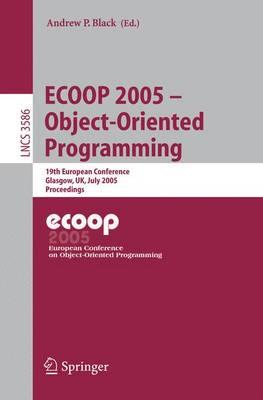
ECOOP 2005 - Object-Oriented Programming: 19th European Conference, Glasgow, UK, July 25-29, 2005. Proceedings

Author:   Andrew Black
Publisher:   Springer-Verlag Berlin and Heidelberg GmbH & Co. KG
Edition:   2005 ed.
Volume:   3586
ISBN:  

9783540279921


Pages:   631
Publication Date:   18 July 2005
Format:   Paperback
Availability:   In Print   Availability explained
This item will be ordered in for you from one of our suppliers. Upon receipt, we will promptly dispatch it out to you. For in store availability, please contact us.

Our Price $264.00 Quantity:  
Add to Cart

Share |

ECOOP 2005 - Object-Oriented Programming: 19th European Conference, Glasgow, UK, July 25-29, 2005. Proceedings


Overview

The 19th Annual Meeting of the European Conference on Object-Oriented Programming—ECOOP 2005—took place during the last week of July in Glasgow, Scotland, UK. This volume includes the refereed technical papers p- sented at the conference, and two invited papers. It is traditional to preface a volume of proceedings such as this with a note that emphasizes the importance of the conference in its respective ?eld. Although such self-evaluations should always be taken with a large grain of salt, ECOOP is undisputedly the pre- inent conference on object-orientation outside of the United States. In its turn, object-orientationis today’s principaltechnology not only for programming,but also for design, analysisand speci?cation of softwaresystems. As a consequence, ECOOP has expanded far beyond its roots in programming to encompass all of these areas of research—whichis why ECOOP has remained such an interesting conference. But ECOOP is more than an interesting conference. It is the nucleus of a technical and academic community, a community whose goals are the creation and dissemination of new knowledge. Chance meetings at ECOOP have helped to spawn collaborations that span the boundaries of our many subdisciplines, bring together researchers and practitioners, cross cultures, and reach from one side of the world to the other. The ubiquity of fast electronic communication has made maintaining these collaborations easier than we would have believed possible only a dozen years ago. But the role of conferences like ECOOP in establishing collaborations has not diminished.

Full Product Details

Author:   Andrew Black
Publisher:   Springer-Verlag Berlin and Heidelberg GmbH & Co. KG
Imprint:   Springer-Verlag Berlin and Heidelberg GmbH & Co. K
Edition:   2005 ed.
Volume:   3586
Dimensions:   Width: 15.50cm , Height: 3.30cm , Length: 23.50cm
Weight:   2.000kg
ISBN:  

9783540279921


ISBN 10:   354027992
Pages:   631
Publication Date:   18 July 2005
Audience:   Professional and scholarly ,  Professional & Vocational
Format:   Paperback
Publisher's Status:   Active
Availability:   In Print   Availability explained
This item will be ordered in for you from one of our suppliers. Upon receipt, we will promptly dispatch it out to you. For in store availability, please contact us.

Table of Contents

Invited Talks.- Attached Types and Their Application to Three Open Problems of Object-Oriented Programming.- The Emergent Structure of Development Tasks.- Java.- Loosely-Separated “Sister” Namespaces in Java.- Efficiently Refactoring Java Applications to Use Generic Libraries.- Sharing the Runtime Representation of Classes Across Class Loaders.- Aspects and Modularity.- Aspect-Oriented Programming Beyond Dependency Injection.- Open Modules: Modular Reasoning About Advice.- Evaluating Support for Features in Advanced Modularization Technologies.- Separation of Concerns with Procedures, Annotations, Advice and Pointcuts.- Expressive Pointcuts for Increased Modularity.- Sustainable System Infrastructure and Big Bang Evolution: Can Aspects Keep Pace?.- Language Design.- First-Class Relationships in an Object-Oriented Language.- The Essence of Data Access in C?.- Prototypes with Multiple Dispatch: An Expressive and Dynamic Object Model.- Efficient Multimethods in a Single Dispatch Language.- Program Analysis.- Interprocedural Analysis for Privileged Code Placement and Tainted Variable Detection.- State Based Ownership, Reentrance, and Encapsulation.- Consistency Checking of Statechart Diagrams of a Class Hierarchy.- Types.- Towards Type Inference for JavaScript.- Chai: Traits for Java-Like Languages.- A Type System for Reachability and Acyclicity.- Testing.- Eclat: Automatic Generation and Classification of Test Inputs.- Lightweight Defect Localization for Java.- Concurrency.- Extending JML for Modular Specification and Verification of Multi-threaded Programs.- Derivation and Evaluation of Concurrent Collectors.- Static Deadlock Detection for Java Libraries.

Reviews

Author Information

Tab Content 6

Author Website:  

Countries Available

All regions
Latest Reading Guide

NOV RG 20252


Shopping Cart
Your cart is empty
Shopping cart
Mailing List