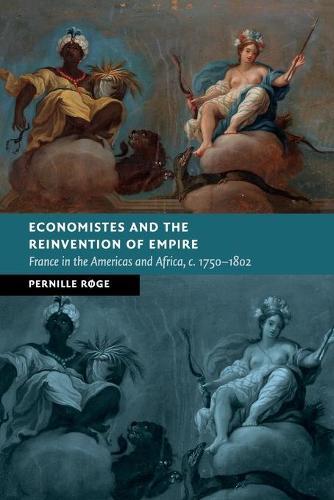
Full Product Details
Author: Pernille Røge (University of Pittsburgh)
Publisher: Cambridge University Press
Imprint: Cambridge University Press
Dimensions:
Width: 15.30cm
, Height: 2.00cm
, Length: 23.00cm
Weight: 0.400kg
ISBN: 9781108716413
ISBN 10: 1108716415
Pages: 314
Publication Date: 20 August 2020
Audience:
Professional and scholarly
,
Professional & Vocational
Format: Paperback
Publisher's Status: Active
Availability: Manufactured on demand

We will order this item for you from a manufactured on demand supplier.
Reviews
'For some time, historians have been searching for the links between the first and second French colonial Empires. Roge finds a compelling set of answers in the critique of plantation slavery and empire developed by the Physiocrats beginning in the mid eighteenth century.' Paul Cheney, University of Chicago 'This ambitious and original book illuminates the emergence of a new vision of empire in eighteenth-century France, explaining how physiocratic ideas informed colonial policy during and after the French Revolution. Roge's rigorous analysis makes important contributions to the history of political economy as she traces the transition of empire from the Caribbean to Africa.' Michael Kwass, The Johns Hopkins University 'A complete reinterpretation of the dynamics of the French colonial empire. Delving into abundant first-hand material, Roge reveals the true importance of West Africa in rethinking French imperial expansion after the Seven Years' War. She brilliantly bridges the colonial orientations of the Ancien Regime and of the First Republic, revealing the enduring influence of the Physiocrats. A fascinating and successful historical enquiry.' Francois-Joseph Ruggiu, Sorbonne Universite, France 'An elegant and subtle re-interpretation of the ideological origins of modern French imperialism: rather than a product of nineteenth-century republicanism, the book shows France's new imperial project had its roots in Old Regime ideas and practices. The balance between change and continuity and the appreciation of interactions between the imperial centre and the colonial peripheries are remarkable.' David Todd, King's College London 'The physiocrats (or economistes), market-oriented economic reformers of France's late Ancien Regime, have recently drawn increasing attention from historians. In this insightful study, Roge argues that physiocratic writings on empire in the pre-Revolutionary period helped shape a republican vision of empire as mission civilisatrice, an idea that would reach its apogee under the Third Republic ... Highly recommended.' D. A. Harvey, Choice
'For some time, historians have been searching for the links between the first and second French colonial Empires. Roge finds a compelling set of answers in the critique of plantation slavery and empire developed by the Physiocrats beginning in the mid eighteenth century.' Paul Cheney, University of Chicago 'This ambitious and original book illuminates the emergence of a new vision of empire in eighteenth-century France, explaining how physiocratic ideas informed colonial policy during and after the French Revolution. Roge's rigorous analysis makes important contributions to the history of political economy as she traces the transition of empire from the Caribbean to Africa.' Michael Kwass, The Johns Hopkins University 'A complete reinterpretation of the dynamics of the French colonial empire. Delving into abundant first-hand material, Roge reveals the true importance of West Africa in rethinking French imperial expansion after the Seven Years' War. She brilliantly bridges the colonial orientations of the Ancien Regime and of the First Republic, revealing the enduring influence of the Physiocrats. A fascinating and successful historical enquiry.' Francois-Joseph Ruggiu, Sorbonne Universite, France 'An elegant and subtle re-interpretation of the ideological origins of modern French imperialism: rather than a product of nineteenth-century republicanism, the book shows France's new imperial project had its roots in Old Regime ideas and practices. The balance between change and continuity and the appreciation of interactions between the imperial centre and the colonial peripheries are remarkable.' David Todd, King's College London 'For some time, historians have been searching for the links between the first and second French colonial Empires. Roge finds a compelling set of answers in the critique of plantation slavery and empire developed by the Physiocrats beginning in the mid eighteenth century.' Paul Cheney, University of Chicago 'This ambitious and original book illuminates the emergence of a new vision of empire in eighteenth-century France, explaining how physiocratic ideas informed colonial policy during and after the French Revolution. Roge's rigorous analysis makes important contributions to the history of political economy as she traces the transition of empire from the Caribbean to Africa.' Michael Kwass, The Johns Hopkins University 'A complete reinterpretation of the dynamics of the French colonial empire. Delving into abundant first-hand material, Roge reveals the true importance of West Africa in rethinking French imperial expansion after the Seven Years' War. She brilliantly bridges the colonial orientations of the Ancien Regime and of the First Republic, revealing the enduring influence of the Physiocrats. A fascinating and successful historical enquiry.' Francois-Joseph Ruggiu, Sorbonne Universite, France 'An elegant and subtle re-interpretation of the ideological origins of modern French imperialism: rather than a product of nineteenth-century republicanism, the book shows France's new imperial project had its roots in Old Regime ideas and practices. The balance between change and continuity and the appreciation of interactions between the imperial centre and the colonial peripheries are remarkable.' David Todd, King's College London
Author Information
Pernille Røge is Assistant Professor of History and convener of the Early Modern Worlds Initiative at the University of Pittsburgh. She is author of numerous articles and book chapters on the eighteenth-century French, Danish, and British colonial empires. She is also co-editor of The Political Economy of Empire in the Early Modern World (2013), with Sophus Reinert, and of the International Review of Social History's special issue on 'Free and Unfree Labor in Atlantic and Indian Ocean Port Cities (Seventeenth-Nineteenth Centuries)', with Pepijn Brandon and Niklas Frykman.