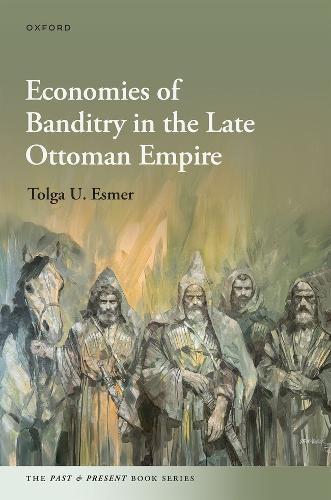
Economies of Banditry in the Late Ottoman Empire

Author:   Tolga U. Esmer (Associate Professor of History, Associate Professor of History, Central European University)
Publisher:   Oxford University Press
ISBN:  

9780192856456


Pages:   336
Publication Date:   28 May 2026
Format:   Hardback
Availability:   To order   Availability explained
Stock availability from the supplier is unknown. We will order it for you and ship this item to you once it is received by us.

Our Price $246.95 Quantity:  
Add to Cart

Share |

Economies of Banditry in the Late Ottoman Empire


Overview

Throughout the reign of Sultan Selîm III (1789-1807), Ottoman officials complained about the destruction of a notorious criminal named Kara Feyzî and thousands of his followers: they pillaged, slaughtered, and burned down communities throughout the Balkans. But these public complaints often concealed the officials' own ties with these so-called bandits and were used as opportunities to slander their political peers who whistle-blew their collusion. Economies of Banditry in the Late Ottoman Empire draws on the 'Kara Feyzî file', which comprises of extensive Ottoman archival as well as Muslim and Christian narrative sources. Tolga Esmer explores how Kara Feyzî and his irregular warrior and Janissary commander accomplices forged a transregional racketeering confederation that expanded their once, state-sanctioned terror against the empire's Serbian community to the general Christian as well as Muslim population across the Balkan peninsula. It illustrates how its repertoire of extortion, violence, and deception became a politicized site of the negotiation of social relations, economic and symbolic capital, as well as political power. Esmer tells this riveting story about inter-confessional violence, inter-imperial intrigue, as well as intra-elite mistrust and corruption through a microhistory of empire that sheds new light onto the deep moral crisis resulting from the disintegration of elite consensus and Ottoman exceptionalism during this age of revolution. By focusing on the performative aspects of officials' correspondence about one criminal confederation, the book reveals the complexity of Ottoman political culture and analyses the moral, emotional, and economic regimes that informed it.

Full Product Details

Author:   Tolga U. Esmer (Associate Professor of History, Associate Professor of History, Central European University)
Publisher:   Oxford University Press
Imprint:   Oxford University Press
Dimensions:   Width: 16.50cm , Height: 2.40cm , Length: 24.00cm
Weight:   0.726kg
ISBN:  

9780192856456


ISBN 10:   0192856456
Pages:   336
Publication Date:   28 May 2026
Audience:   College/higher education ,  Postgraduate, Research & Scholarly
Format:   Hardback
Publisher's Status:   Active
Availability:   To order   Availability explained
Stock availability from the supplier is unknown. We will order it for you and ship this item to you once it is received by us.

Table of Contents

Introduction: Ottoman Political Culture in the Age of Revolutions Viewed through the Kara Feyzî File 1: The Legacy of Eighteenth-Century Wars and the Moral Geography of Rumeli Bandit Insurgency 2: Men of Imperial (Dis)Order: Recruitment, Representation, and the Performance of Patronage among Warrior Populations in Late Ottoman Society 3: Notes on a Scandal: Transregional Networks of Violence, Gossip, and Imperial Decision-Making in the Late Eighteenth-Century Ottoman Empire 4: Economies of Banditry, Corruption, and Imperial Rackets in Late Ottoman History 5: Emotional Regimes and Imperial Hierarchies of Credibility in the Ottoman Archives 6: Conclusion: Rumeli Bandit Insurgencies Across the Empire in the Age of Revolution Epilogue: Rumeli Moral Geographies and Imperial Formations Beyond Empire Introduction: Ottoman Political Culture in the Age of Revolutions Viewed through the Kara Feyzî File 1: The Legacy of Eighteenth-Century Wars and the Moral Geography of Rumeli Bandit Insurgency 2: Men of Imperial (Dis)Order: Recruitment, Representation, and the Performance of Patronage among Warrior Populations in Late Ottoman Society 3: Notes on a Scandal: Transregional Networks of Violence, Gossip, and Imperial Decision-Making in the Late Eighteenth-Century Ottoman Empire 4: Economies of Banditry, Corruption, and Imperial Rackets in Late Ottoman History 5: Emotional Regimes and Imperial Hierarchies of Credibility in the Ottoman Archives 6: Conclusion: Rumeli Bandit Insurgencies Across the Empire in the Age of Revolution Epilogue: Rumeli Moral Geographies and Imperial Formations Beyond Empire

Reviews

Author Information

Tolga U. Esmer is Associate Professor of History at Central European University (CEU) in Vienna. He specialises in Ottoman, Middle Eastern, Balkan, and Mediterranean history, and he is also the Director of Culture, Politics, and Society BA degree at CEU. He is also the owner of an alpine vacation company in Slovenia.

Tab Content 6

Author Website:  

Countries Available

All regions
Latest Reading Guide

RGJ26


Shopping Cart
Your cart is empty
Shopping cart
Mailing List