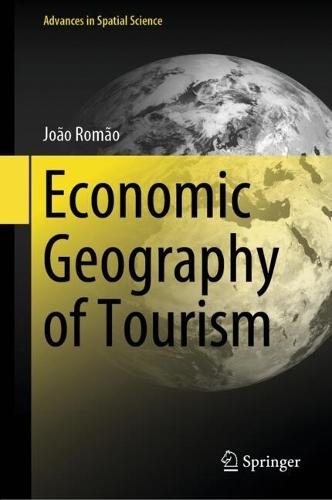
Full Product Details
Author: João Romão
Publisher: Springer International Publishing AG
Imprint: Springer International Publishing AG
ISBN: 9783031886256
ISBN 10: 3031886259
Pages: 249
Publication Date: 14 May 2025
Audience:
Professional and scholarly
,
Professional & Vocational
Format: Hardback
Publisher's Status: Active
Availability: Manufactured on demand

We will order this item for you from a manufactured on demand supplier.
Reviews
“This book succeeds in presenting tourism as a dynamic and multidisciplinary industry that evolves with contemporary trends in regional economic development. ... This book will be especially valuable to tourism scholars, policymakers, destination managers, as well as regional and urban planners, among others. It enables them to understand how tourism interacts with economic geography and contributes to spatial and economic changes.” (Ngoni C. Shereni, International Journal of Tourism Policy, Vol. 15 (6), 2025) “The book arrives at a time when both tourism research and practice grapple with challenges whose complexity transcends traditional disciplinary boundaries. … In this context, the contribution of the book is not only welcome but necessary, particularly within economic geography, a field that, over the past decades, has remained peripheral to the reconfiguration of tourism policy. … The book is an indispensable resource for students, as well as for early-career researchers including doctoral and postdoctoral candidates.” (Bogdan-Constantin Ibanescu, Papers in Regional Science, Vol. 104 (4), August 2025) “This book will be of particular value to regional economists, spatial planners, and graduate-level researchers interested in spatial data analysis and tourism policy. For those working within European contexts, its policy alignment and empirical richness are especially relevant. Even for scholars outside the quantitative tradition, the book offers conceptual tools that can sharpen thinking about how tourism’s role in reshaping spatial economies is both significant and enduring.” (Ante Mandić, Current Issues in Tourism, July 25, 2025)
“The book arrives at a time when both tourism research and practice grapple with challenges whose complexity transcends traditional disciplinary boundaries. … In this context, the contribution of the book is not only welcome but necessary, particularly within economic geography, a field that, over the past decades, has remained peripheral to the reconfiguration of tourism policy. … The book is an indispensable resource for students, as well as for early-career researchers including doctoral and postdoctoral candidates.” (Bogdan-Constantin Ibanescu, Papers in Regional Science, Vol. 104 (4), August 2025) “This book will be of particular value to regional economists, spatial planners, and graduate-level researchers interested in spatial data analysis and tourism policy. For those working within European contexts, its policy alignment and empirical richness are especially relevant. Even for scholars outside the quantitative tradition, the book offers conceptual tools that can sharpen thinking about how tourism’s role in reshaping spatial economies is both significant and enduring.” (Michael S. Engel, Entomologist’s Monthly Magazine, Vol. 161 (3), July 2025)
“This book will be of particular value to regional economists, spatial planners, and graduate-level researchers interested in spatial data analysis and tourism policy. For those working within European contexts, its policy alignment and empirical richness are especially relevant. Even for scholars outside the quantitative tradition, the book offers conceptual tools that can sharpen thinking about how tourism’s role in reshaping spatial economies is both significant and enduring.” (Michael S. Engel, Entomologist’s Monthly Magazine, Vol. 161 (3), July 2025)
“The book arrives at a time when both tourism research and practice grapple with challenges whose complexity transcends traditional disciplinary boundaries. … In this context, the contribution of the book is not only welcome but necessary, particularly within economic geography, a field that, over the past decades, has remained peripheral to the reconfiguration of tourism policy. … The book is an indispensable resource for students, as well as for early-career researchers including doctoral and postdoctoral candidates.” (Bogdan-Constantin Ibanescu, Papers in Regional Science, Vol. 104 (4), August 2025) “This book will be of particular value to regional economists, spatial planners, and graduate-level researchers interested in spatial data analysis and tourism policy. For those working within European contexts, its policy alignment and empirical richness are especially relevant. Even for scholars outside the quantitative tradition, the book offers conceptual tools that can sharpen thinking about how tourism’s role in reshaping spatial economies is both significant and enduring.” (Ante Mandić, Current Issues in Tourism, July 25, 2025)
Author Information
João Romão is an Associate Professor at Yasuda Women’s University (Japan), specializing in tourism, hospitality, and regional planning. He holds a PhD in Tourism and has 60 publications, including books, editorial works and articles in leading journals. He serves at the editorial board of several journals. As a Principal Investigator, he has conducted tourism research in Portugal and Japan, obtaining 5 competitive research grants. His interests encompass innovation, creative economies, cultural heritage, sustainable development, and public governance. He applies both quantitative and qualitative methods, emphasizing spatial analysis. He has diverse experiences as a consultant for public policies, working on regional development and urban planning. He is also a co-chair of the cluster on Tourism, Leisure and Recreation of NECTAR (Network on European Communications and Transport Activities Research).