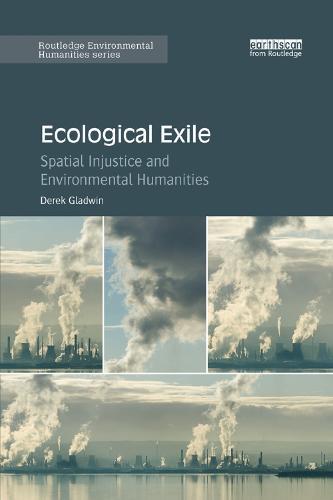
Full Product Details
Author: Derek Gladwin (University of British Columbia, Canada)
Publisher: Taylor & Francis Ltd
Imprint: Routledge
Weight: 0.453kg
ISBN: 9780367271114
ISBN 10: 0367271117
Pages: 214
Publication Date: 21 March 2019
Audience:
College/higher education
,
Tertiary & Higher Education
Format: Paperback
Publisher's Status: Active
Availability: In Print

This item will be ordered in for you from one of our suppliers. Upon receipt, we will promptly dispatch it out to you. For in store availability, please contact us.
Reviews
Derek Gladwin's Ecological Exile is a smart intervention that emerges brightly from the 'energy humanities', a fast-rising area of study which is focusing on the power of contemporary literature, film, and media culture to reveal how human societies produce corrosive infrastructures that, currently, tend to deny the contribution of carbon-based energy systems to social, spatial, and ecological injustices. Engagingly, the book illustrates why the arts and humanities are crucial to scientific and technical debates surrounding fossil fuel production and to stimulating imagination of human behaviors and activities that might be transformed to ensure a thriving, just and survivable future. - Joni Adamson, Professor of Environmental Humanities, Department of English, & Director, Environmental Humanities Initiative, Arizona State University In Ecological Exile, Derek Gladwin uses a dynamic, transdisciplinary approach in bringing together the environmental humanities, spatial justice, and cultural studies more broadly. Gladwin shows how modern literary and visual texts respond to ecological crises, altering the ways we imagine ourselves and our environment, and helping us map the shifting terrain of our world system. The result is a significant contribution to contemporary cultural theory and environmental criticism. - Robert T. Tally Jr., Professor of English at Texas State University, USA, author of Spatiality
"""Derek Gladwin’s Ecological Exile is a smart intervention that emerges brightly from the ‘energy humanities’, a fast-rising area of study which is focusing on the power of contemporary literature, film, and media culture to reveal how human societies produce corrosive infrastructures that, currently, tend to deny the contribution of carbon-based energy systems to social, spatial, and ecological injustices. Engagingly, the book illustrates why the arts and humanities are crucial to scientific and technical debates surrounding fossil fuel production and to stimulating imagination of human behaviors and activities that might be transformed to ensure a thriving, just and survivable future."" — Joni Adamson, Professor of Environmental Humanities, Department of English, & Director, Environmental Humanities Initiative, Arizona State University ""In Ecological Exile, Derek Gladwin uses a dynamic, transdisciplinary approach in bringing together the environmental humanities, spatial justice, and cultural studies more broadly. Gladwin shows how modern literary and visual texts respond to ecological crises, altering the ways we imagine ourselves and our environment, and helping us map the shifting terrain of our world system. The result is a significant contribution to contemporary cultural theory and environmental criticism."" — Robert T. Tally Jr., Professor of English at Texas State University, USA, author of Spatiality"
Derek Gladwin's Ecological Exile is a smart intervention that emerges brightly from the `energy humanities', a fast-rising area of study which is focusing on the power of contemporary literature, film, and media culture to reveal how human societies produce corrosive infrastructures that, currently, tend to deny the contribution of carbon-based energy systems to social, spatial, and ecological injustices. Engagingly, the book illustrates why the arts and humanities are crucial to scientific and technical debates surrounding fossil fuel production and to stimulating imagination of human behaviors and activities that might be transformed to ensure a thriving, just and survivable future. - Joni Adamson, Professor of Environmental Humanities, Department of English, & Director, Environmental Humanities Initiative, Arizona State University In Ecological Exile, Derek Gladwin uses a dynamic, transdisciplinary approach in bringing together the environmental humanities, spatial justice, and cultural studies more broadly. Gladwin shows how modern literary and visual texts respond to ecological crises, altering the ways we imagine ourselves and our environment, and helping us map the shifting terrain of our world system. The result is a significant contribution to contemporary cultural theory and environmental criticism. - Robert T. Tally Jr., Professor of English at Texas State University, USA, author of Spatiality
Derek Gladwin's Ecological Exile is a smart intervention that emerges brightly from the 'energy humanities', a fast-rising area of study which is focusing on the power of contemporary literature, film, and media culture to reveal how human societies produce corrosive infrastructures that, currently, tend to deny the contribution of carbon-based energy systems to social, spatial, and ecological injustices. Engagingly, the book illustrates why the arts and humanities are crucial to scientific and technical debates surrounding fossil fuel production and to stimulating imagination of human behaviors and activities that might be transformed to ensure a thriving, just and survivable future. - Joni Adamson, Professor of Environmental Humanities, Department of English, & Director, Environmental Humanities Initiative, Arizona State University In Ecological Exile, Derek Gladwin uses a dynamic, transdisciplinary approach in bringing together the environmental humanities, spatial justice, and cultural studies more broadly. Gladwin shows how modern literary and visual texts respond to ecological crises, altering the ways we imagine ourselves and our environment, and helping us map the shifting terrain of our world system. The result is a significant contribution to contemporary cultural theory and environmental criticism. - Robert T. Tally Jr., Professor of English at Texas State University, USA, author of Spatiality
Author Information
Derek Gladwin is a SSHRC Postdoctoral Fellow at the University of British Columbia, Canada. He was an Environmental Humanities Fellow at the University of Edinburgh, UK, and at Trinity College Dublin, Ireland. His authored and co-edited books include Contentious Terrains (2016), Unfolding Irish Landscapes (2016), and Eco-Joyce (2014). Please visit derekgladwin.com.