Overview
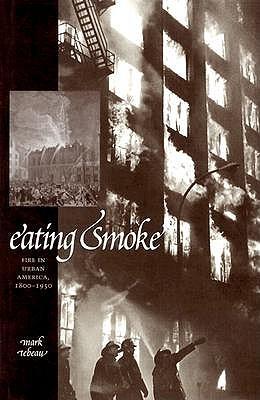
During the period of America's swiftest industrialization and urban growth, fire struck fear in the hearts of city dwellers as did no other calamity. Before the Civil War, sweeping blazes destroyed more than $200 million in property in the nation's largest cities. Between 1871 and 1906, conflagrations left Chicago, Boston, Baltimore, and San Francisco in ruins. Into the 20th century, this dynamic hazard intensified as cities grew taller and more populous, confounding those who battled it. Firefighters' death-defying feats captured the popular imagination but too often failed to provide more than symbolic protection. Hundreds of fire insurance companies went bankrupt because they could not adequately deal with the effects of even smaller blazes. Firefighters and fire insurers created an physical and cultural infrastructure whose legacy - in the form of heroic firefighters, insurance policies, building standards and fire hydrants - lives on in the urban built environment. In ""Eating Smoke"", Mark Tebeau shows how the changing practices of firefighters and fire insurers shaped the built landscape of American cities, the growth of municipal institutions and the experience of urban life. Drawing on a wealth of fire department and insurance company archives, he contrasts the invention of a heroic culture of firefighters with the rational organizational strategies by fire underwriters. Recognizing the complexity of shifting urban environments and constantly experimenting with tools and tactics, firefighters fought fire ever more aggressively - ""eating smoke"" when they ventured deep into burning buildings or when they scaled ladders to perform harrowing rescues. In sharp contrast to the manly valour of firefighters, insurers argued that the risk was quantifiable, measurable and predictable. Underwriters managed hazard with statistics, maps and trade associations, and they eventually agitated for building codes and other reforms, which cities throughout the nation implemented in the 20th century. Although they remained icons of heroism, firefighters' cultural and institutional authority slowly diminished. Americans had begun to imagine fire risk as an economic abstraction. By comparing the simple skills employed by firefighters - climbing ladders and manipulating hoses - with the mundane technologies - maps and accounting charts - of insurers, the author demonstrates that the daily routines of both groups were instrumental in making intense urban and industrial expansion a less precarious endeavour.
Full Product Details
Author: Mark Tebeau (Cleveland State University)
Publisher: Johns Hopkins University Press
Imprint: Johns Hopkins University Press
Dimensions:
Width: 15.60cm
, Height: 3.50cm
, Length: 23.50cm
Weight: 0.794kg
ISBN: 9780801867910
ISBN 10: 0801867916
Pages: 440
Publication Date: 15 January 2004
Recommended Age: From 17
Audience:
Professional and scholarly
,
Professional and scholarly
,
Professional & Vocational
,
Postgraduate, Research & Scholarly
Format: Hardback
Publisher's Status: Active
Availability: Awaiting stock

The supplier is currently out of stock of this item. It will be ordered for you and placed on backorder. Once it does come back in stock, we will ship it out for you.
Reviews
<p> In his ambitious and detailed new book, Eating Smoke, Tebeau sets out to explain the role of two largely undocumented actors -- firemen and insurance men -- in analyzing, managing, and attacking urban fire... Tebeau's study vigorously opens the way for scholars looking to make sense of the city in the midst of an era of uncertainty and risk. -- Scott Gabriel Knowles, Enterprise and Society
<p>Tebeau develops an interwoven story of gender, class, culture, and technology: contrasting the heroics of working-class firefighters with the rational order of middle-class fire underwriters... An engaging narrative and a fascinating story make this book a rare pleasure -- both an academic monograph and a good read.--Dalit Baranoff EH.Net (01/01/0001)
Author Information
Mark Tebeau, whose father was a fireman, is an associate professor of history at Cleveland State University.