Overview
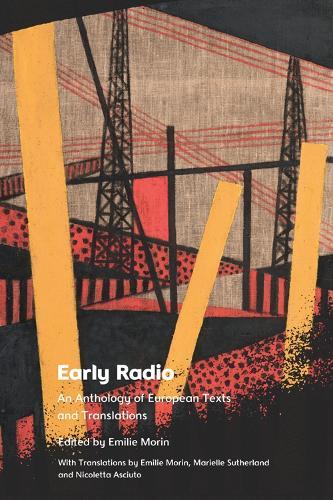
Who were the pioneers who first thought of radio as an art form, who debated how to write and perform for radio, who discussed radio's social and political dimensions? Spanning from 1924 to 1938, this anthology brings together long-forgotten texts on sound, listening and writing by radio enthusiasts, journalists, actors, radio producers and literary authors who conceptualised the new radio aesthetic between the two world wars and reflected on radio's future, as a medium requiring the invention of a new literature, new modes of performance and new ways of listening. The texts included here, drawn from British, French, German and Italian radio cultures, are representative of important pan-European debates about radio's potential at a critical moment in its history. Together, they shed light on ideas that shaped not only the emergence of radio drama, sound art and reportage, but radio as we know it today.
Full Product Details
Author: Emilie Morin (Professor of Modern Literature, University of York, UK) , Emilie Morin (Professor of Modern Literature, University of York, UK) , Marielle Sutherland (freelance translator, independent) , Nicoletta Asciuto (Lecturer in Modern Literature, University of York)
Publisher: Edinburgh University Press
Imprint: Edinburgh University Press
Dimensions:
Width: 15.60cm
, Height: 2.00cm
, Length: 23.40cm
Weight: 0.517kg
ISBN: 9781474485159
ISBN 10: 1474485154
Pages: 368
Publication Date: 28 February 2025
Audience:
General/trade
,
General
Format: Paperback
Publisher's Status: Active
Availability: Temporarily unavailable 
The supplier advises that this item is temporarily unavailable. It will be ordered for you and placed on backorder. Once it does come back in stock, we will ship it out to you.
Table of Contents
Acknowledgements Note on the Selection, Translation and Presentation of Texts Introduction Part One: Radio as Technology, Radio as Art 1.1 Hilda Matheson, from Broadcasting 1.2 Walter Ruttmann, New Compositional Modes for Sound Film and Radio. Programme for an Art of Acoustic Photography 1.3 Paul Deharme, from For a Radiophonic Art 1.4 Pierre Keszler, Is There Such a Thing as a Radiophonic Art? 1.5 Paul Dermée, Will We Have a Radiophonic Art? 1.6 Suzanne Malard, Radio, An Autonomous Art 1.7 Pierre Schaeffer, The Problem Central to Radio Broadcasting 1.8 Enzo Ferrieri, Radio as Creative Force 1.9 From Radio Investigation: F. T. Marinetti, A Futurist Radio; Ottorino Respighi, Radio and Art; Eugenio Colorni, Radio’s Artistic Possibilities; Lucio D’Ambra, Life, Poetry, Radio Part Two: Behind the Microphone 2.1 Anon., On Emotion and Life Before the Microphone 2.2 Paul Dermée, Microphone Rudiments for Radio Actors 2.3 France Darget, How to Act in Front of the Microphone 2.4 Anon., The Speaker’s Qualities 2.5 Sheila Borrett, Scene – and Unseen! 2.6 Mabel Constanduros, My First Broadcast 2.7 Victor Margueritte, Facing the Microphone 2.8 Walter Benjamin, On Time to the Minute 2.9 Egon Erwin Kisch, Woe Betide the One Who Sees 2.10 Florence Milnes, A Day in the Life of the BBC Librarian Part Three: The Art of Listening 3.1 Fernand Divoire, The Zone of the Storms 3.2 Fernand Divoire, The Don Juan of the Air Waves 3.3 Guido Sommi Picenardi, Murmurs from the Ether 3.4 Rose Macaulay, The Arm-Chair Millennium 3.5 Fritz Zoreff, Radio Drama and the Inner Vision 3.6 Enrico Rocca, from A Geography of the Invisible 3.7 Rolf Gunold, The Seventh Sense 3.8 Ella Fitzgerald, Wireless and Women 3.9 Camilla, The Woman Listener 3.10 Ernst Hardt, The Echo of the Listeners’ Needs 3.11 Annette Kolb, from Book of Complaints 3.12 Carlos Larronde, Radio Drama3.13 Anton Kuh, Fear of Radio 3.14 Colette, An Interview About the Wireless Part Four: Radio Genres 4.1 Hans Flesch, The Future Shape of Radio Programming 4.2 Hermynia Zur Mühlen, Radio Programmes for Women 4.3 Alfred Döblin, Literature and Radio 4.4 Barbara Burnham, Adaptations 4.5 Anon., The Broadcasting of Poetry 4.6 Kurt Weill, On the ‘Musical Radio Play’ 4.7 Paul Dermée, The Broadcasting of Silence 4.8 Alex Virot, Reflections on Radio-Reportage 4.9 Hermann Kasack, Micro-Reportage 4.10 Olive Shapley, Night Romance of the Roads 4.11 B.E.N., Feature Programmes 4.12 Laurence Gilliam, ‘Actualities’ and ‘Features’ 4.13 Charles Siepmann, Talks 4.14 Desmond MacCarthy, The Art of Broadcasting Talks 4.15 André Saudemont, The Radio Interview 4.16 Henry Lytton, The Mystery of Radio Humour 4.17 Grace Wyndham Goldie, Listening to Comedy 4.18 Robert Desnos, ‘The Key to Dreams’ on the Poste Parisien Part Five: A Theatre for the Ear 5.1 George Bernard Shaw, The Drama and the Microphone 5.2 Augustin Habaru, We Must Discover the Radio 5.3 René Christauflour, Will Radio Create ‘Superhearing,’ as Cinema Created ‘Superimposition’? 5.4 R. E. Jeffrey, Wireless Drama 5.5 Rolf Gunold, Routes to Acoustic Drama 5.6 Gabriel Germinet, from Radio Drama: A New Mode of Artistic Expression 5.7 Lance Sieveking, from The Stuff of Radio 5.8 Tristan Bernard, For the Invisible Blind Public 5.9 Hans Kyser, How Do We Create Radio Plays and a Dramatic Literature for Radio? 5.10 Alida and Pierre Calel, A Conception of Radio Drama 5.11 Tyrone Guthrie, Introduction to Squirrel’s Cage and Two Other Microphone Plays 5.12 Marc Denis, An Essay on Radio Drama 5.13 Lugné-Poë, Radio Drama’s Marvellous Resources 5.14 Georges Colin, In the Service of Radio Drama 5.15 Madeleine Montvoisin, On the Possibilities and Exigencies of Radio Drama 5.16 Carlos Larronde, The Poetry of Space 5.17 Carlos Larronde, A Lesson in Attempting a Radio Play 5.18 Grace Wyndham Goldie, Let Us Be Thrilled 5.19 Leopold Jessner, Radio and Theatre 5.20 Ernst Hardt, Drama Part Six: Radio Politics and Radio Frontiers 6.1 Suzanne Cilly, Women and Radio 6.2 Yvane Arthaud, Women’s Voice in the World 6.3 Egon Erwin Kisch, Radio Reporter from Red Square: ‘The Moscow Microphone Never Lies!’ 6.4 Alfons Paquet, Radio and the State 6.5 Kurt Tucholsky, Free Radio! Free Film! 6.6 Kurt Tucholsky, Radio Censorship 6.7 René Schickele, A Pan-Europe of Radio Stations 6.8 Louis Le Crestois, Radio and Peace 6.9 Gabriel Germinet, Radiophonic Art in the Service of Moral Disarmament 6.10 Paul Vaillant-Couturier, Radio and Peace6.11 Ernst Toller, International Radio Select Bibliography
Reviews
It’s almost impossible to overstate the amount of labor that has gone into the assembling of Emilie Morin’s valuable new anthology, Early Radio[...] all of these have produced an anthology unprecedented in its scope, one that will be essential for any scholar of modernist radio studies. -- Debra Rae Cohen, University of South Carolina * Modernism/modernity * Early Radio works best as an evocative and somewhat haunting time capsule for the anxieties, enthusiasm and the boundless optimism surrounding the relatively young technology and artistic medium of radio broadcasting during the interwar period, specifically between 1924 and 1938. [...] therein lies Early Radio’s novelty as an invaluable repository, as well as a benchmark for further work along similar lines. No other English-language anthology on the radio deals with the same time period in quite the same manner, or with the express intent of focusing on writings that might otherwise have slipped through the cracks of history. -- Shantam Goyal, University at Buffalo * Media History * The publication of this anthology is a pivotal event in the field of radio studies. With its sound historical grounding, canny selection of archival texts, superb editorial apparatus, and intellectually crisp introduction, Early Radio sets the standard against which other such collections will be measured. The scholarship in the volume is of the highest order. -- Damien Keane, State University of New York at Buffalo This brilliant collection brings early radio history to life in the words of contemporaries fascinated by a revolutionary new medium and its experimental aesthetics. Making these international primary sources available in translation provides a rich resource for global and comparative studies of communication in the early twentieth century. It also offers a vital historical perspective on current debates about 'new media'. -- Professor Kate Lacey, University of Sussex
Author Information
Emilie Morin is Professor of Modern Literature at the University of York, UK. Her interests revolve around transnational modernisms, forms of political writing, literatures of exile and migration, and the intersections between literature and technology. Her most recent monograph is Beckett’s Political Imagination (2017). Emilie Morin is Professor of Modern Literature at the University of York, UK. Her interests revolve around transnational modernisms, forms of political writing, literatures of exile and migration, and the intersections between literature and technology. Her most recent monograph is Beckett’s Political Imagination (2017). Marielle Sutherland is a freelance translator (German to English). Her key areas are contemporary literature, arts and humanities. Her recent translations include Rainer Maria Rilke’s Selected Poems, with Susan Ranson (2011), Bauhaus Architecture 1919-1933, by Hans Engels (2018), and Rulantica: Hidden Island, by Manuela Hanauer (2021). Nicoletta Asciuto is Lecturer in Modern Literature at the University of York, UK. A passionate linguist with knowledge of ten languages, she specialises in comparative literature, and has particular interests in modernism and technology. She is currently completing a monograph entitled Brilliant Modernism: Cultures of Light and Modernist Poetry, 1909-1930.
Tab Content 6
Author Website:
Countries Available
All regions
|