Overview
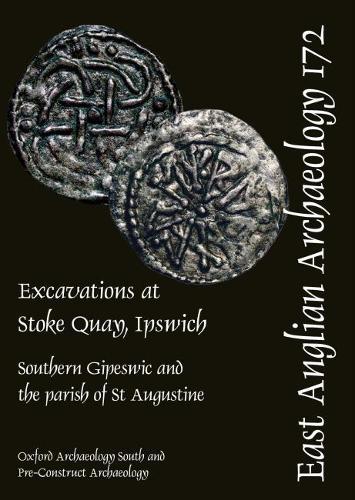
Ipswich is one of England’s oldest urban centres. It has long been recognised as an emporium - a specialised, managed trading place of royal power within the eastern kingdom with royal input into trade and with commercial and diplomatic relations with the Frankish empire. Its origins are linked to a royal vill or centre, close to which settlement developed. Its archaeology is of international significance, but sadly remains obscured by the previous lack of publication. Understanding of the role of emporia has developed considerably in recent years and new evidence - such as that from Stoke Quay - is crucial to furthering such study. Fuelled by an industrious pottery industry and international trade, Gipeswic rapidly emerged in the 7th and 8th centuries as one of the first post-Roman settlements which could truly be described as a town. Excavations by Oxford Archaeology and Pre-Construct Archaeology at Stoke Quay provide crucial new evidence about the urban fabric of Middle Saxon Ipswich, particularly since this is the first major excavation to have taken place south of the river. The remains demonstrate the setting out of plots, streets and buildings akin to the other wics (London, Southampton and York) and show strong influences from Frankia and Scandinavia. Industries, such as pottery production, led to substantial trade links with the continent and the town produced the first kiln-fired pottery made in Britain since the Romans on a quasi-industrial scale. The discovery of an exceptionally well-preserved Ipswich ware kiln at Stoke Quay is of crucial importance since it indicates that production was dispersed across a wider area of the town than was previously suspected. This has potential implications for settlement linked to craft specialisation. During the Late Saxon and medieval periods, the site was dominated by the church and cemetery of St Augustine’s, the precise location of which had been lost for 500 years. Sited in one of Ipswich’s poorer areas, the population must surely have included ‘men of the sea’ as is suggested by the presence of reused boat timbers in many of the graves. The cemetery contained over 1,100 burials and this is the first group of burials associated with a major English port to have been archaeologically excavated and analysed: the findings indicate that the group is quite distinct from other non-port populations. Once the church had fallen from use, the site and its environs saw commercial and industrial use, including a cooperage and shipyard, that reflects the development of Ipswich into its modern form.
Full Product Details
Author: Richard Brown ,
Steven Teague ,
Louise Loe ,
Berni Sudds
Publisher: Oxford Archaeology
Imprint: Oxford Archaeology
Volume: 172
ISBN: 9780904220841
ISBN 10: 0904220842
Pages: 524
Publication Date: 15 October 2020
Audience:
Professional and scholarly
,
Professional & Vocational
Format: Hardback
Publisher's Status: Active
Availability: Available To Order

We have confirmation that this item is in stock with the supplier. It will be ordered in for you and dispatched immediately.
Reviews
...a detailed report on the major excavations by Oxford Archaeology South and Pre-Construct Archaeology at the site of Stoke Quay. [...] it is the report on the human remains and final discussions that make this monograph stand out. * Current Archaeology *
…a detailed report on the major excavations by Oxford Archaeology South and Pre-Construct Archaeology at the site of Stoke Quay. […] it is the report on the human remains and final discussions that make this monograph stand out. * Current Archaeology *
Author Information
Senior Project Manager, OA Project Officer, OA Dr Louise Loe is Honorary Research Associate at the School of Archaeology, University of Oxford, UK and Head of Burials at Oxford Archaeology. She has worked on archaeological burial investigations in Britain, France and Malta, and is the co-author of Living and Dying in Southwark 1587-1831: Excavations at Cure's College Burial Ground, Park Street (2017), ‘Given to the Ground’ (2014), ‘Remember Me To All’ (2014), and Life and death in a Roman city: excavation of a Roman cemetery with a mass grave at 120-22 London Road, Gloucester (2008). Pottery Specialist, PCA Post-Excavation and Publications Manager, OA