Overview
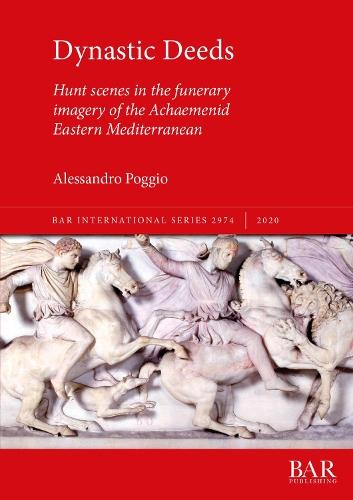
This study adopts a transregional approach that focuses on connectivity dynamics in order to present a wider picture of artistic, cultural and political phenomena in the Mediterranean. It examines dynastic funerary art at the end of the fifth century and in the fourth century BC by focusing - through a wide range of evidence - on what funerary images can reveal about the societies that produced them. It analyses renowned dynastic tombs from south-western Anatolia (present-day Turkey) such as the Mausoleum of Halicarnassus and the Nereid Monument of Xanthos, but also from Phoenicia (present-day Lebanon). A common element among the similarities displayed by these tombs is the nearly constant presence of the multiple-quarry hunt iconography, which consists of prey from different species depicted in one figurative programme. The Eastern Mediterranean under Persian Achaemenid rule is portrayed as an interconnected cultural and political area with specific features instead of merely being an area between the Greek and Persian worlds.
Full Product Details
Author: Alessandro Poggio
Publisher: BAR Publishing
Imprint: BAR Publishing
Weight: 0.694kg
ISBN: 9781407356389
ISBN 10: 1407356380
Pages: 174
Publication Date: 31 March 2020
Audience:
Professional and scholarly
,
Professional & Vocational
Format: Paperback
Publisher's Status: Active
Availability: Available To Order

We have confirmation that this item is in stock with the supplier. It will be ordered in for you and dispatched immediately.
Reviews
'Poggio's work contributes a radically different, eastern Mediterranean perspective to the interpretation of the material, arguing that Persian Art was the main source of inspiration for hunting scenes on dynastic monuments in this region.' Professor Clemente Marconi, NYU Institute of Fine Arts '[It] is a very refreshing use of the art and methodologically this will be a great contribution to Achaemenid history and to Classical and Near Eastern art history.' Dr Catherine Draycott, Durham University 'I would anticipate this monograph having a broad international appeal. It will be relevant to researchers whose interests lie in the iconography and visual arts of geographical region and time period under consideration, as well as to historians interested in the dynasts, whose tombs form the focus of this monograph.' Dr Jessica Doyle, University College Dublin
{\rtf1\fbidis\ansi\ansicpg1252\deff0\deflang2057{\fonttbl{\f0\fswiss\fprq2\fcharset0 Calibri;}{\f1\fnil\fcharset0 Verdana;}} \viewkind4\uc1\pard\ltrpar\sa160\sl252\slmult1\kerning2\f0\fs22\lquote Poggio is to be congratulated for enriching our comprehension of life within and beyond the Persian empire in the period. His compendium of the evidence makes readily accessible information about the important monuments now scattered and published in monographs not all readily available: even apart from its innovative argument the book with its nuanced readings will serve as a valuable resource.\rquote Margaret C. Miller, Ancient West and East, Vol 21 (2022)\kerning0\par \lquote Poggio\rquote s work contributes a radically different, eastern Mediterranean perspective to the interpretation of the material, arguing that Persian Art was the main source of inspiration for hunting scenes on dynastic monuments in this region.\rquote Professor Clemente Marconi, NYU Institute of Fine Arts\par \lquote [It] is a very refreshing use of the art and methodologically this will be a great contribution to Achaemenid history and to Classical and Near Eastern art history.\rquote Dr Catherine Draycott, Durham University \par \lquote I would anticipate this monograph having a broad international appeal. It will be relevant to researchers whose interests lie in the iconography and visual arts of geographical region and time period under consideration, as well as to historians interested in the dynasts, whose tombs form the focus of this monograph.\rquote Dr Jessica Doyle, University College Dublin\par \pard\ltrpar\f1\fs17\par }
Author Information
Alessandro Poggio is Assistant Professor in Classical Archaeology at the IMT School for Advanced Studies Lucca. He studied archaeology and ancient art history at the University of Pisa and the Scuola Normale Superiore. He received his PhD from the Scuola Normale Superiore. He has conducted research in Italy and abroad as a fellow at numerous institutions, such as the École Normale Supérieure (Paris), the American Academy in Rome, Koç University Research Center for Anatolian Civilizations (Istanbul), Mimar Sinan Güzel Sanatlar Üniversitesi (Istanbul), the Scuola Normale Superiore (Pisa), The Warburg Institute (London), and the Getty Research Institute (Los Angeles).