|
|
|||
|
||||
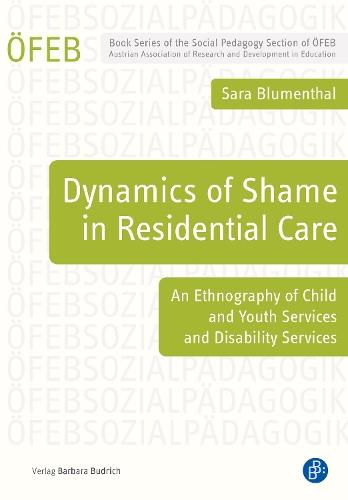
OverviewIn diesem Buch untersucht die Autorin Schamdynamiken in der stationären Betreuung von Jugendlichen anhand eines ethnografischen Ansatzes. Ausdrucksformen von Scham seitens der Jugendlichen, ihrer Betreuer und die Wahrnehmung von Scham durch die Forscherin dienen als Bezugspunkte, um Kontraste und strukturelle Zusammenhänge in den Daten zu identifizieren. Die Autorin bezieht auch moderne Affekttheorien ein, die betonen, dass ein dichotomes Verständnis von Affekten als entweder positiv oder negativ ihrer komplexen Funktion nicht gerecht wird. Auf diese Weise beleuchtet die Arbeit die soziale Bedeutung von Affekten und zeigt den Wert der Affektforschung für die Sozialpädagogik auf. Full Product DetailsAuthor: Prof. Dr. Sara Blumenthal , Prof. Dr. Sara BlumenthalPublisher: Verlag Barbara Budrich Imprint: Verlag Barbara Budrich Volume: 20 Dimensions: Width: 14.80cm , Height: 0.90cm , Length: 21.00cm Weight: 0.215kg ISBN: 9783847431947ISBN 10: 3847431943 Pages: 143 Publication Date: 16 March 2026 Audience: College/higher education , Professional and scholarly , Tertiary & Higher Education , Professional & Vocational Format: Paperback Publisher's Status: Active Availability: In Print This item will be ordered in for you from one of our suppliers. Upon receipt, we will promptly dispatch it out to you. For in store availability, please contact us. Language: German Table of ContentsIntroduction 1 State of research on residential care for young people 1.1 An insight into the historical genesis of today’s child and youth services in Austria 1.2 Perspectives on the history of violence in child and youth services in Austria 1.3 An insight into the historical genesis of care for children and young people funded by disability services 2 References to affect and shame theory 2.1 The concept of affect in this study 2.2 Social functions of shame: relationship regulation 2.3 Social functions of shame: incorporation of social orders 2.4 Social functions of shame: negotiating social conformity by confronting emotional norms 2.5 Hatred, anger, contempt, and aggression 2.6 Affects in the context of aggression and violence 3 Methods: Ethnographic research into shame and other affects in residential care 3.1 Participant observation 3.2 Semi-structured interviews 3.3 Data analysis and interpretation 3.4 Ethical issues 4 Shame dynamics in residential care of young people 4.1 Shame dynamics inbetween the emotional stress of care workers and their pedagogical scope of action 4.2 Shame dynamics in the context of the pedagogical handling of violence from the perspective of young males 4.3 Education-related shaming as a pedagogical sanction of girls by care workers 4.4 Suicidal behaviour as a cause of shame and guilt among care workers and young people in residential care 5 The social functions of shame with a focus on the pedagogical behaviour of care workers in residential care 5.1 Stigmatisation of young people in institutions by care workers as epistemic violence 5.2 Education-related shaming as an educational sanction for young people in the context of social orders 5.3 Conclusions on professionalisation processes in residential care Outlook − quo vadis residential care? Literature IndexReviewsAuthor InformationSara Blumenthal is an assistant professor at the Research Unit for Social Pedagogy and Inclusion Research, Department of Educational Science, University of Klagenfurt, Austria. Tab Content 6Author Website:Countries AvailableAll regions |
||||