Overview
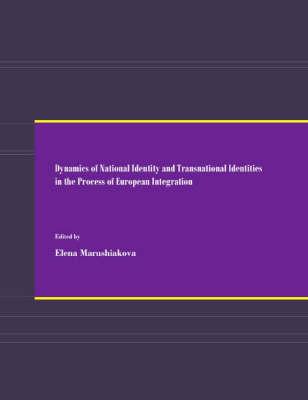
This collection was inspired by the international conference 'Dynamics of National Identity and Transnational Identities in the Process of European Integration', organized by the Balkan Ethnology Department of the Ethnographic Institute and Museum at the Bulgarian Academy of Sciences and realized as project of the European Commission Jean Monnet Action Program for the support of Study and Research Centers. The book opens a debate on the changing notions of identity in the region of Central and Eastern Europe on the base of analysis of social developments influenced by EU accession and EU integration process. The most important aspect is the analysis of processes of breaking up the borders of national identity and transition towards new forms of transnational identities and emerging of consciosness of All-European unity. The book has a dual focus: on general topics related to the study of national and transnational identities and on the process of European integration. It brings together the work of researchers not only from different parts of Europe (from France to Russia) but from USA and Asia too. This book is a starting point for East-West discussion and brings new knowledge that will be an invaluable contribution to the common European research area.
Full Product Details
Author: Elena Marushiakova
Publisher: Cambridge Scholars Publishing
Imprint: Cambridge Scholars Publishing
Edition: Unabridged edition
Dimensions:
Width: 14.80cm
, Height: 3.60cm
, Length: 21.20cm
Weight: 0.771kg
ISBN: 9781847184719
ISBN 10: 1847184715
Pages: 525
Publication Date: 18 February 2008
Audience:
College/higher education
,
Professional and scholarly
,
Undergraduate
,
Postgraduate, Research & Scholarly
Format: Hardback
Publisher's Status: Active
Availability: Out of stock

The supplier is temporarily out of stock of this item. It will be ordered for you on backorder and shipped when it becomes available.
Reviews
'This book proposes a study of transnational identities and the process of European integration. One of its main strengths is its multidisciplinary approach combining approaches from experts in humanities and social sciences; these comprise inter alia ethnology, anthropology, history and cultural studies. Another asset is that it offers both theoretical frameworks and empirical studies covering several themes and countries, with regards to particular populations in their homeland and abroad such as Gypsies, Turks in exile. It is innovative in the sense that the question of Central European countries and European integration is still in progress and remains under researched. It will be an important tool of analysis for researchers and policy makers interested in new development in Central and Eastern Europe.'—Daniele Joly, Director of Centre for Research in Ethnic Relations, University of Warwick""Dynamics of National Identity"" is a most timely contribution to our understanding of the complexities of collective identities, and their rapid changes since the end of socialism, in the Balkans. The broad range of topics addressed by eminent scholars in this volume is truly impressive and opens up new and comparative perspectives on the issue of nationality in Southeastern Europe.""—Ulf Brunnbauer (Reader in Southeast and East European History at the Free University of Berlin)'The contributions to the book present a welcome departure from mainstream approaches to the relations between EU integration and minorities. All too often analysts reduce the essence of European processes to an asymetrical interaction between European pressures for legal reforms and a (reluctant) adoption of European standards by candidate states. Relying on well-grounded empirical research, the contributors to this volume remind us of the need to grasp the reshaping of identities in the context of EU integration at the crossroads between multiple scales (local, regional, European and international) and a variety of social processes (new social mobilities and migrations, among others). The contributions also fruitfully underscore the need to move beyond normative distinctions between Central European and (exoticized) Balkan trajectories in order to provide a nuanced understanding of the twin process of europeanization and globalization in post-communist Europe.' —Nadege Ragaru, CNRS research Fellow, Lecturer at Sciences Po Paris.'A fascinating collection of essays written in delicious East European English. It conveys the vigour of scholarship in the New Europe on issues of personal and social identity in that area. The volume is particularly strong in exploring the complex and multi-dimensional relation to 'Europe,' as constructed in the homeland and by migrants. This book will be read with profit by anyone interested in the intimate life of new peoples within the EU as well as of those in the Balkans excluded from it.'—Andre Liebich, Head of the International History and Politics Section of the Graduate Institute of International Studies, Geneva.
This book proposes a study of transnational identities and the process of European integration. One of its main strengths is its multidisciplinary approach combining approaches from experts in humanities and social sciences; these comprise inter alia ethnology, anthropology, history and cultural studies. Another asset is that it offers both theoretical frameworks and empirical studies covering several themes and countries, with regards to particular populations in their homeland and abroad such as Gypsies, Turks in exile. It is innovative in the sense that the question of Central European countries and European integration is still in progress and remains under researched. It will be an important tool of analysis for researchers and policy makers interested in new development in Central and Eastern Europe. -Daniele Joly, Director of Centre for Research in Ethnic Relations, University of Warwick Dynamics of National Identity is a most timely contribution to our understanding of the complexities of collective identities, and their rapid changes since the end of socialism, in the Balkans. The broad range of topics addressed by eminent scholars in this volume is truly impressive and opens up new and comparative perspectives on the issue of nationality in Southeastern Europe. -Ulf Brunnbauer (Reader in Southeast and East European History at the Free University of Berlin) The contributions to the book present a welcome departure from mainstream approaches to the relations between EU integration and minorities. All too often analysts reduce the essence of European processes to an asymetrical interaction between European pressures for legal reforms and a (reluctant) adoption of European standards by candidate states. Relying on well-grounded empirical research, the contributors to this volume remind us of the need to grasp the reshaping of identities in the context of EU integration at the crossroads between multiple scales (local, regional, European and international) and a variety of social processes (new social mobilities and migrations, among others). The contributions also fruitfully underscore the need to move beyond normative distinctions between Central European and (exoticized) Balkan trajectories in order to provide a nuanced understanding of the twin process of europeanization and globalization in post-communist Europe. -Nadege Ragaru, CNRS research Fellow, Lecturer at Sciences Po Paris. A fascinating collection of essays written in delicious East European English. It conveys the vigour of scholarship in the New Europe on issues of personal and social identity in that area. The volume is particularly strong in exploring the complex and multi-dimensional relation to Europe, as constructed in the homeland and by migrants. This book will be read with profit by anyone interested in the intimate life of new peoples within the EU as well as of those in the Balkans excluded from it. -Andre Liebich, Head of the International History and Politics Section of the Graduate Institute of International Studies, Geneva.
This book proposes a study of transnational identities and the process of European integration. One of its main strengths is its multidisciplinary approach combining approaches from experts in humanities and social sciences; these comprise inter alia ethnology, anthropology, history and cultural studies. Another asset is that it offers both theoretical frameworks and empirical studies covering several themes and countries, with regards to particular populations in their homeland and abroad such as Gypsies, Turks in exile. It is innovative in the sense that the question of Central European countries and European integration is still in progress and remains under researched. It will be an important tool of analysis for researchers and policy makers interested in new development in Central and Eastern Europe. -Daniele Joly, Director of Centre for Research in Ethnic Relations, University of Warwick Dynamics of National Identity is a most timely contribution to our understanding of the complexities of collective identities, and their rapid changes since the end of socialism, in the Balkans. The broad range of topics addressed by eminent scholars in this volume is truly impressive and opens up new and comparative perspectives on the issue of nationality in Southeastern Europe. -Ulf Brunnbauer (Reader in Southeast and East European History at the Free University of Berlin) The contributions to the book present a welcome departure from mainstream approaches to the relations between EU integration and minorities. All too often analysts reduce the essence of European processes to an asymetrical interaction between European pressures for legal reforms and a (reluctant) adoption of European standards by candidate states. Relying on well-grounded empirical research, the contributors to this volume remind us of the need to grasp the reshaping of identities in the context of EU integration at the crossroads between multiple scales (local, regional, European and international) and a variety of social processes (new social mobilities and migrations, among others). The contributions also fruitfully underscore the need to move beyond normative distinctions between Central European and (exoticized) Balkan trajectories in order to provide a nuanced understanding of the twin process of europeanization and globalization in post-communist Europe. -Nadege Ragaru, CNRS research Fellow, Lecturer at Sciences Po Paris. A fascinating collection of essays written in delicious East European English. It conveys the vigour of scholarship in the New Europe on issues of personal and social identity in that area. The volume is particularly strong in exploring the complex and multi-dimensional relation to Europe, as constructed in the homeland and by migrants. This book will be read with profit by anyone interested in the intimate life of new peoples within the EU as well as of those in the Balkans excluded from it. -Andre Liebich, Head of the International History and Politics Section of the Graduate Institute of International Studies, Geneva.
Author Information
The editor of this book, Dr. Elena Marushiakova, is chair of the Department of Balkan Ethnology at the Institute of Ethnography and Museum at the Bulgarian Academy of Sciences. She has a number of publications about Gypsies in Bulgaria, Balkans and Central and Eastern Europe. Her major publications (together with Vesselin Popov) include the first monographic research on history, ethnography, social structure and culture of the Gypsies in Bulgaria (1997) and book on Gypsies in Ottoman Empire (2000), book on servise nomadism of Gypsies in former USSR (2005). Both authors are publishing Series of Collections in field of Gypsy/Romani Studies ""Studii Romani"" (vol.1, 1994; vol. II, 1995; vol. III-IV, 1997; vol. V-VI, 1998, vol VI, 2007). Dr. Elena Marushiakova toghether with Dr. Vesselin Popov created Roma Heritage Museum Fund at National Ethnographical museum in Sofia (1995) and specialised Romani/Gypsy Studies Library with Archive (http://www.studiiromani.org) at the Institute of Ethnography and Museum at of the Bulgarian Academy of Sciences.