Overview
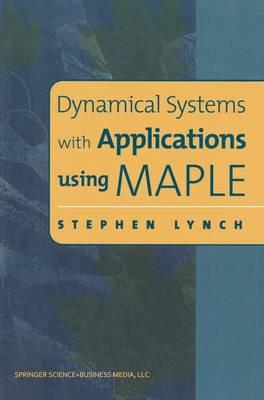
This work covers material for an introductory course in the theory of dynamical systems. There is a short tutorial in MAPLE to facilitate the understanding of the theory. The text is divided into two parts: continuous systems using differential equations and discrete dynamical systems. Differential equations are used to model examples taken from various topics such as mechanical systems, interacting species, electronic circuits, chemical reactions, and meterology. The second part of the text deals with real and complex dynamical systems. Examples are taken from population modelling, nonlinear optics, and materials science. Linear algebra and real and complex analysis are prerequisites.
Full Product Details
Author: Stephen J. Lynch
Publisher: Birkhauser Boston
Imprint: Birkhauser Boston
Volume: No. 183
Dimensions:
Width: 15.60cm
, Height: 2.10cm
, Length: 23.40cm
Weight: 0.585kg
ISBN: 9780817641504
ISBN 10: 0817641505
Pages: 433
Publication Date: 01 April 2001
Audience:
College/higher education
,
Professional and scholarly
,
Undergraduate
,
Postgraduate, Research & Scholarly
Format: Paperback
Publisher's Status: Out of Print
Availability: Out of stock

Reviews
The text treats a remarkable spectrum of topics and has a little for everyone. It can serve as an introduction to many of the topics of dynamical systems, and will help even the most jaded reader, such as this reviewer, enjoy some of the interactive aspects of studying dynamics using Maple. a UK Nonlinear News (1st Edition) <p> This book covers standard material for an introduction to dynamical systems theory. Written for both advanced undergraduates and new postgraduate students, this book is split into two distinctive parts: continuous systems using ordinary differential equations and discrete dynamical systems. Lynch uses the Maple package as a tool throughout the text to help with the understanding of the subject. The book contains over 250 examples and exercises with solutions and takes a hands-on approach. There are over 300 individual figures including about 200 Maple plots, with simple commands and programs listed at the end of each chapter...This publication will provide a solid basis for both research and education in nonlinear dynamical systems. a The Maple Reporter (1st Edition) <p> The book will be useful for all kinds of dynamical systems coursesa ]. [It] shows the power of using a computer algebra program to study dynamical systems, and, by giving so many worked examples, provides ample opportunity for experiments. a ] [It] is well written and a pleasure to read, which is helped by its attention to historical background. a Mathematical Reviews (1st Edition) <p> a ] a very nice tutorial on Maple in which quite a few mathematical and graphical commands are illustrated. A student could quickly work through this tutorial and then be ready to do quite a bit withMaplea ].[The second part of Hilberta (TM)s 16th problem] is not the topic encountered in most ODE texts, even if the question has been open for 100 years! a ] Lyncha (TM)s book provides great references, as well as Maple code that could be easily modified by readers who have the tools to quickly engage in quite sophisticated numerical experimentation. a SIAM Review (1st Edition) <p> A student or scientist, who works through some chapters of the book, learns a good deal about the presented mathematical concepts and possibilities of the symbolic algebra package to assist the researcher in understanding his mathematical model. a Dynamical Systems Magazine (1st Edition)
The text treats a remarkable spectrum of topics and has a little for everyone. It can serve as an introduction to many of the topics of dynamical systems, and will help even the most jaded reader, such as this reviewer, enjoy some of the interactive aspects of studying dynamics using Maple. a UK Nonlinear News (1st Edition) This book covers standard material for an introduction to dynamical systems theory. Written for both advanced undergraduates and new postgraduate students, this book is split into two distinctive parts: continuous systems using ordinary differential equations and discrete dynamical systems. Lynch uses the Maple package as a tool throughout the text to help with the understanding of the subject. The book contains over 250 examples and exercises with solutions and takes a hands-on approach. There are over 300 individual figures including about 200 Maple plots, with simple commands and programs listed at the end of each chapter...This publication will provide a solid basis for both research and education in nonlinear dynamical systems. a The Maple Reporter (1st Edition) The book will be useful for all kinds of dynamical systems coursesa ]. [It] shows the power of using a computer algebra program to study dynamical systems, and, by giving so many worked examples, provides ample opportunity for experiments. a ] [It] is well written and a pleasure to read, which is helped by its attention to historical background. a Mathematical Reviews (1st Edition) a ] a very nice tutorial on Maple in which quite a few mathematical and graphical commands are illustrated. A student could quickly work through this tutorial and then be ready to do quite a bit withMaplea ].[The second part of Hilberta (TM)s 16th problem] is not the topic encountered in most ODE texts, even if the question has been open for 100 years! a ] Lyncha (TM)s book provides great references, as well as Maple code that could be easily modified by readers who have the tools to quickly engage in quite sophisticated numerical experimentation. a SIAM Review (1st Edition) A student or scientist, who works through some chapters of the book, learns a good deal about the presented mathematical concepts and possibilities of the symbolic algebra package to assist the researcher in understanding his mathematical model. a Dynamical Systems Magazine (1st Edition)