|
|
|||
|
||||
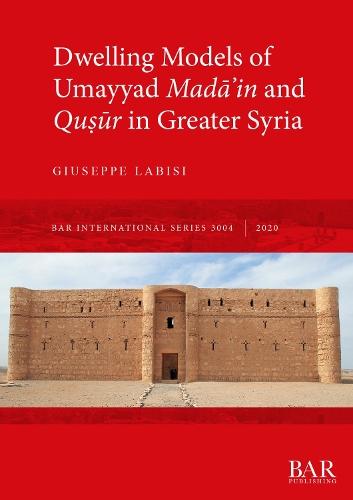
OverviewThis book is the first systematic collection and discussion of dwellings in the Umayyad 'cities' (mada?in) and 'palaces' (qu?ur) of Bilad al-Sham. Giuseppe Labisi offers an overview of the apartments within and identifies the architectural models that inspired Umayyad dwellings. This study also allows the precise identification of the origin of pre-Islamic dwelling models and their reinterpretation in Umayyad domestic architecture. Through classification, the author has been able to group the apartments of qu?ur chronologically by the reigns of the Umayyad caliphs. The identification of the dictates of Islamic domestic tradition and the characteristics of early Islamic Arabia and Late Antique houses offer original insight and allow us to situate the Umayyad residences of Bilad al-Sham in their wider cultural context. Additionally, Umayyad dwellings have been classified and presented in a rich catalogue as an appendix within the text. Full Product DetailsAuthor: Giuseppe LabisiPublisher: BAR Publishing Imprint: BAR Publishing Weight: 1.404kg ISBN: 9781407357225ISBN 10: 1407357220 Pages: 352 Publication Date: 29 September 2020 Audience: Professional and scholarly , Professional & Vocational Format: Paperback Publisher's Status: Active Availability: Available To Order We have confirmation that this item is in stock with the supplier. It will be ordered in for you and dispatched immediately. Table of ContentsPreface Introduction Part 1: The early Islamic settlement phenomenon and its origins 1. The early Islamic settlement phenomenon 1.1. Origins of the early Islamic settlement models 1.2. The early Islamic settlement models 1.3. The territory and the history of Bilad al-Sham 1.4. Dwelling types in the Umayyad Bilad al-Sham 1.5. The origin of 'five room units' and bana? al-?iris: pre-Islamic models Part 2: Dwellings in mada?in and qu?ur 2. Dwellings in mada?in 2.1. ?Anjar 2.1.1. Previous research 2.1.2. Historical context 2.1.3. Site description 2.1.3.1. The main palace 2.1.3.2. The secondary palaces 2.1.3.3. The congregational mosque 2.1.3.4. The bath complex 2.1.3.5. The insulae 2.1.4. The ?Anjar settlement models 2.1.4.1. The palaces 2.1.4.2. The extra-palatial dwellings 2.1.4.3. The 'five room units' 2.1.5. Conclusions 2.2. Qa?r al-?ayr al-Sharqi 2.2.1. A brief history of research 2.2.2. Historical context 2.2.3. Site description 2.2.3.1. The Small Enclosure or Palace 2.2.3.2. The Large Enclosure or madina 2.2.3.3. The Baths 2.2.3.4. The Northern Settlement 2.2.3.5. The Southern Buildings 2.2.4. Qa?r al-?ayr al-Sharqi's settlement model 2.2.4.1. The madina's dwellings 2.2.4.2. The palace's dwellings 2.2.4.3. The Northern Settlement's dwellings 2.2.4.4. The 'five room units' 2.2.5. Conclusions 2.3. ?Amman 2.3.1. A brief history of research 2.3.2. Historical context 2.3.3. Site description 2.3.3.1. The governor's residence 2.3.3.2. The bath complex 2.3.3.3. The courtyard-market 2.3.3.4. The mosque 2.3.3.5. The extra-palatial dwellings 2.3.4. The ?Amman settlement model 2.3.4.1. The palace 2.3.4.2. The extra-palatial dwellings 2.3.4.3. 'Pseudo bana? al-?iris' and 'five room units' in ?Amman houses and living units 2.3.5. Conclusions 3. Umayyad qu?ur of Bilad al-Sham and 'five room units' 3.1. Qa?r al-Kharana 3.2. Khirbat al-Minya 3.3. Jabal Says 3.4. Qa?r al-?ayr al-Gharbi 3.5. Al-Qas?al 3.6. Al-Ru?afa 3.7. Khirbat al-Mafjar 3.8. Balis 3.9. Al-Fudayn 3.10. Qa?r al-?uba 3.11. Mshatta 3.12. The 'five room units' of qu?ur: dimensions and dating Part 3: Final remarks 4. The Umayyad residential context of Bilad al-Sham 4.1. Vestibules 4.1.1. Vestibules of mada?in palaces 4.1.2. Vestibules of the extra-palatial mada?in dwellings 4.1.3. Qu?ur vestibules 4.2. Courtyards 4.2.1. Courtyards of mada?in palatial dwellings 4.2.2. Courtyards of mada?in extra-palatial dwellings 4.2.3. Qu?ur courtyards 4.3. 'Five room units' and hybrid models of 'pseudo bana? al-?iris' 4.3.1. 'Five room units' and hybrid models of mada?in palaces 4.3.2. 'Five room units' of mada?in extra-palatial dwellings 4.3.3. Qu?ur 'five room units' and hybrid models of 'pseudo bana? al-?iri' 4.4. Audience halls 4.4.1. Audience halls of mada?in palaces 4.4.2. Audience halls of the qu?ur 5. The residential contexts of the Umayyad period: readapting the tradition 5.1. Other examples of Umayyad mada?in and qu?ur dwellings of Bilad al-Sham 5.2. Kufa 5.3. Tulul al-Shu?ayba 5.4. The Umayyad house: readapting the tradition Conclusions Appendix 1 Appendix 2 Appendix 3. Mada?in Dwellings 1. ?Anjar palace Dwellings 1.2. ?Anjar extra-palatial Dwellings 2. Qa?r al-?ayr al-Sharqi 3. ?Amman 3.1. Palace's Dwellings 3.2. ?Amman, extra-palace Dwellings Appendix 4. Qu?ur dwellings 1. Qa?r al-Kharana 2. Khirbat al-Minya 3. Jabal Says 4. Qa?r al-?ayr al-Gharbi 5. Al-Qas?al 6. Al-Ru?afa 7. Khirbat al-Mafjar 8. Balis 9. Al-Fudayn 10. Qa?r al-?uba Appendix 5. Models of Umayyad mada?in dwellings of Bilad al-Sham ?Anjar Appendix 6. Other Umayyad dwellings Mada?in contexts 1. Madinat al-Far, 'Bayt mansion' 2. Kufa, Dar al-Imara Qu?ur contexts 3. Tulul al-Shu?ayba Bibliography Abreviations Sources Studies IndexReviews{\rtf1\ansi\ansicpg1252\deff0\deflang2057{\fonttbl{\f0\fswiss\fprq2\fcharset0 Calibri;}{\f1\fnil\fcharset0 Verdana;}} \viewkind4\uc1\pard\sa160\sl252\slmult1\f0\fs22\lquote This is an interesting and important piece of work providing a large amount of data some of which is otherwise very hard to find. The analysis of the buildings is very detailed and provides the first systematic attempt to understand how the Umayyad rulers arranged the residential areas of their palaces. The bibliography is excellent and provides the most comprehensive information on Umayyad architecture.\rquote Professor Andrew Petersen, University of Wales Trinity St David\par \pard\f1\fs17\par } Author InformationGiuseppe Labisi is a post-doctoral fellow at the University of Konstanz. He earned his joint PhD in Islamic Archaeology from the University of Rome 'La Sapienza' and the University of Paris 1 'Panthéon-Sorbonne' in 2017. His research interests include Islamic archaeology and architecture, Medieval topography, and Late Antique - early Islamic transitions. Tab Content 6Author Website:Countries AvailableAll regions |
||||