Overview
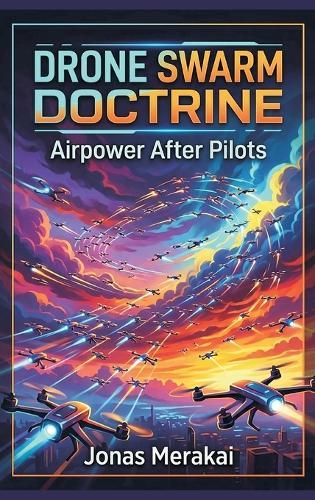
In every era of airpower, advantage has depended on what could be concentrated and controlled: squadrons over targets, radar over the skies, networks over weapons. Drone swarms promise a new kind of concentration - not of a few exquisite aircraft, but of many cheap systems whose losses can be absorbed. That promise is also a warning. As air combat becomes more distributed, it can grow more dependent on fragile links, ambiguous identification, and delegated decision-making that is hard to supervise in real time. Drone Swarm Doctrine: Airpower After Pilots offers a clear framework for judging what swarms can and cannot do. It explains how drone swarm doctrine differs from simply launching many drones, and why command and control is the real centre of gravity: bandwidth, latency, authentication, and what happens when the link fails. It examines target identification under clutter and deception, the constraints imposed by rules and delegated authority, and the operational trade-offs between payload, range, endurance, and basing. It also maps how defenders adapt, from layered counter-drone systems to the systematic use of electronic warfare to jam, spoof, and manipulate the swarm's perception. Written for students, general readers, and analysts, the book treats swarming as a contest of systems rather than a triumph of novelty. By the end, readers understand why attritable mass can be decisive only when the organisation can sustain it - industrially, logistically, and cognitively - and how attrition warfare changes planning, learning, and risk. The result is a disciplined way to evaluate claims about autonomous airpower: not by hype or platform glamour, but by the resilience of communications, the credibility of identification, and the design of decision authority under pressure.
Full Product Details
Author: Jonas Merakai
Publisher: Vij Books
Imprint: Vij Books
Dimensions:
Width: 15.20cm
, Height: 2.20cm
, Length: 22.90cm
Weight: 0.621kg
ISBN: 9789377940553
ISBN 10: 9377940559
Pages: 338
Publication Date: 20 May 2026
Audience:
General/trade
,
General
Format: Hardback
Publisher's Status: Active
Availability: Not yet available

This item is yet to be released. You can pre-order this item and we will dispatch it to you upon its release.
Author Information
Jonas Merakai writes at the intersection of airpower, emerging military technologies, and the institutions that decide how force is used. His work is driven by a simple concern: when tools change faster than doctrines, the greatest risks are often conceptual - sloppy definitions, borrowed metaphors, and unexamined assumptions about control. He approaches autonomy and swarming as questions of strategy and governance as much as engineering, with an emphasis on how real organisations translate technical possibility into rules, training, and operational practice.Merakai is interested in the way modern air combat inherits older patterns of thought: the bomber debates, air defence revolutions, electronic warfare contests, and the recurring belief that a new machine will finally make war clean, quick, or decisive. Against that background, he focuses on the less glamorous determinants of effectiveness: communications links, identification under uncertainty, logistics capacity, and the design of command authority. His style is analytical but readable, aimed at readers who want clarity without hype and scepticism without cynicism.A quiet thread running through his writing is the long memory of twentieth-century air war and its landscapes - airfields, memorials, and contested skies that turned industrial capacity and doctrinal choices into national fate. That historical gravity informs his insistence that autonomy is not merely a technical upgrade, but a shift in who bears risk, how decisions are made, and what can be credibly controlled when violence moves at machine speed.