Overview
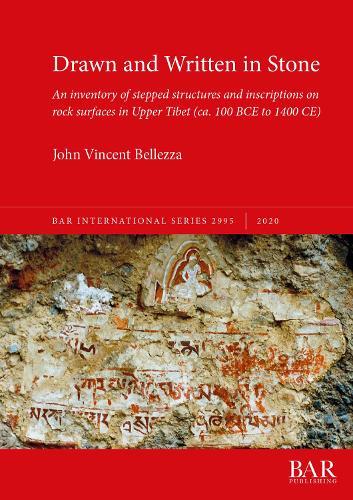
Drawn and Written in Stone explores the religious history of the highest part of the Tibetan Plateau through its rock art and inscriptions. It is focused on facsimiles of ritual and ceremonial monuments carved and painted on stone surfaces and rock inscriptions in the Tibetan language, vital archaeological and historical materials for appraising the development of religion in Tibet, ca. 100 BCE to 1400 CE. By probing the complexion of figures and letters in stone, this work considers how early cult traditions contributed to the establishment of Tibetan Buddhism and a rival faith known as Yungdrung Bon. Outside of the Indian cultural context, relatively little has been written about the historical antecedents of these popular Tibetan religions for a want of sources. This monograph helps remedy this large gap in Tibetan studies by drawing upon the author's surveys of rock art and rock inscriptions conducted in upmost Tibet between 1995 and 2013.
Full Product Details
Author: John Vincent Bellezza
Publisher: BAR Publishing
Imprint: BAR Publishing
Weight: 1.340kg
ISBN: 9781407356396
ISBN 10: 1407356399
Pages: 336
Publication Date: 27 August 2020
Audience:
Professional and scholarly
,
Professional & Vocational
Format: Paperback
Publisher's Status: Active
Availability: Available To Order 
We have confirmation that this item is in stock with the supplier. It will be ordered in for you and dispatched immediately.
Table of Contents
List of Figures List of Tables General Introduction Précis Methods and perspectives Part I. A Comprehensive Survey of Stepped Structures in the Rock Art of Upper Tibet 1. Introduction to Stepped Structures in the Rock Art of Upper Tibet Overview Chronology Locations of Upper Tibetan rock art sites with stepped structures 2. The Origins of Stepped Structures in Upper Tibet Elementary stepped structures in the literary and ethnographic records Archaic built stepped structures in the archaeological record Archaic stepped structures in the artefactual record Ancient chorten 3. Typological Illustrations and Data on Stepped Structures in Upper Tibetan Rock Art Categorisation Key to the typological inventory Group I: elementary two-tiered stepped structures (three specimens) Group III: elementary three-tiered stepped structures with a bulbous top (11 specimens) Group IV: elementary multi-tiered stepped structures (23 specimens) Group V: elementary segmented stepped structures (five specimens) Group VI: elementary stepped structures with a spatulate or inverted crescent-shaped finial (four specimens) Group VII: elementary stepped structures with a multifoliate finial (two specimens) Group VIII: elementary stepped structures with a tricuspidate finial (four specimens) Group IX: idiosyncratic elementary stepped structures (12 specimens) Group X: well-developed stepped structures with a bulbous upper stage (22 specimens) Group XI: twin stepped structures sharing a common base (three specimens) Group XII: simple-style chorten (seven specimens) Group XIII: chorten with forked finials (20 specimens) Group XIV: chorten with a cross-piece spire (15 specimens) Group XV: giant pictographic stepped structures (five specimens) Group XVI: flat-topped chorten (eighteen specimens) Group XVII: chorten with a simple spire (12 specimens) Group XVIII: intricate non-Buddhist chorten (23 specimens) Group XIX: intricate chorten of Brag-gyam (25 specimens) Group XX: Buddhist chorten (seven specimens) 4. Cross-cultural Influences Acting upon Stepped Structures in Upper Tibetan Rock Art Orientation Spiti Ladakh Northern Pakistan Mechanisms of interaction 5. Photographic Catalogue of Stepped Structures in Upper Tibetan Rock Art Group I: elementary two-tiered stepped structures Group II: elementary three-tiered stepped structures Group III: elementary three-tiered stepped structures with a bulbous top Group IV: elementary multi-tiered stepped structures Group V: elementary segmented stepped structures Group VI: elementary stepped structures with a spatulate or crescent-shaped finial Group VII: elementary stepped structures with a multifoliate finial Group VIII: elementary stepped structures with a tricuspidate finial Group IX: idiosyncratic elementary stepped structures Group X: stepped structures with a bulbous upper stage Group XI: twin stepped structures sharing a common base Group XII: simple-style chorten Group XIII: chorten with a forked finial Group XIV: chorten with a cross-piece spire Group XV: giant pictographic stepped structures Group XVI: flat-topped chorten Group XVII: chorten with a simple spire Group XVIII: intricate non-Buddhist chorten Group XIX: intricate chorten of Brag-gyam Group XX: Buddhist chorten Part II. A Comprehensive Survey of Early Rock Inscriptions in Upper Tibet 6. Introduction to Upper Tibetan Rock Inscriptions Overview Locations of sites with rock inscriptions 7. The Archaeology and History of Upper Tibetan Rock Inscriptions The archaeological context The variable development of epigraphy on the Western Tibetan Plateau Rock inscriptions of the Vestigial period 8. Palaeographic Analysis of Upper Tibetan Rock Inscriptions Palaeographic methods of dating Palaeographic typology Early Historic period Vestigial period Physical qualities of rock inscriptions 9. A Statistical and Religious Profile of Rock Inscriptions in Upper Tibet Statistical analysis Doctrinal significance of mantras Buddhist and non-Buddhist contestation 10. Photographic Catalogue and Readings of Upper Tibetan Rock Inscriptions Introduction Note on methodological exactitude Bkra-shis-do, Gnam-mtsho Bkra-shis do-chen, Gnam-mtsho Bkra-shis- do-chung, Gnam-mtsho Other sites at Gnam-mtsho Rta-mchog ngang-pa do, Gnam-mtsho Khyi-rgan gag-pa do, Gnam-mtsho Lug do, Gnam-mtsho Ra-ma do, Gnam-mtsho Stong-shong phug, Gnam-mtsho Se-mo do, Gnam-mtsho Rigs-lnga do, Gnam-mtsho Lce do, Gnam-mtsho Other sites on the Byang-thang Lha-ris sgrub-phug, Smad-pa Slob-dpon phug, Gzhung-smad Chos-lung O-rgyan bsam-gtan-gling, Gzims-phug Rta-ra dmar-lding, Gzims-phug Chu-ro, Gzhung-smad Dar-lung phug-pa, Gzhung-smad Bshag-bsangs, Gro-ba Am-nag, Dang-ra g.yu-mtsho Do dril-bu, Bkra-ri gnam-mtsho Gu-ru rin-po-che phug, Bkra-ri gnam-mtsho Lha-khang dmar-chags, Da-rog mtsho Rdzong pi-phi, Bar-yangs Ri-rgyal, Sger-rtse Far Western Tibet Rdu-ru-can, Gu-ge Gser-sgam, G
Reviews
{\rtf1\ansi\ansicpg1252\deff0\deflang2057{\fonttbl{\f0\fswiss\fprq2\fcharset0 Calibri;}{\f1\fnil\fcharset0 Verdana;}} \viewkind4\uc1\pard\sa160\sl252\slmult1\f0\fs22\lquote John Vincent Bellezza has carried out extensive surveys in the Tibetan plateau, and his knowledge of this vast territory and its sites is unsurpassed. Bellezza simply walked across mountain deserts and climbed mountain passes, and literally documented everything. Every scholar of Tibetology will be extremely interested in reading this.\rquote Professor Luca Maria Olivieri, Ca' Foscari University of Venice\par \pard\f1\fs17\par }
{\rtf1\ansi\ansicpg1252\deff0\deflang2057{\fonttbl{\f0\fswiss\fprq2\fcharset0 Calibri;}{\f1\fnil\fcharset0 Verdana;}} \viewkind4\uc1\pard\sa160\sl252\slmult1\f0\fs22\lquote John Vincent Bellezza has carried out extensive surveys in the Tibetan plateau, and his knowledge of this vast territory and its sites is unsurpassed. Bellezza simply walked across mountain deserts and climbed mountain passes, and literally documented everything. Every scholar of Tibetology will be extremely interested in reading this.\rquote Professor Luca Maria Olivieri, Ca' Foscari University of Venice\par \pard\f1\fs17\par }
Author Information
John Vincent Bellezza PhD is an archaeologist and cultural historian specialising in the pre-Buddhist heritage of Tibet. Author of twelve books and numerous articles, Bellezza has over many years comprehensively charted archaic monuments and rock art in Upper Tibet and has worked extensively on Old Tibetan mytho-ritual texts.
Tab Content 6
Author Website:
Countries Available
All regions
|