|
|
|||
|
||||
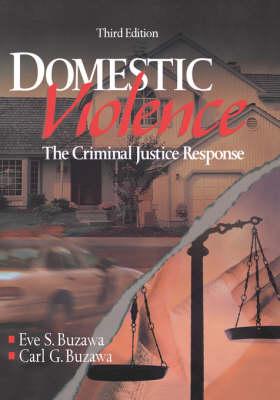
OverviewThis is the fully revised and updated Third Edition of one of the top books on domestic violence. Eve S Buzawa and Carl G Buzawa have incorporated a wealth of new empirical research on how the criminal justice system's responses to domestic violence have changed in the seven years since the last edition was written. Domestic Violence is unique in that it places an emphasis on the victim's perspective: the needs, preferences and satisfaction for intervention, as well as the impact of interventions. Domestic Violence examines the victim diversity and how this effects their needs, preferences, and attitudes, as well as their service needs and interventions. It also highlights the diversity among batterers and how this impacts the efficacy of various intervention strategies. It provides an analysis of where innovative programmes have had mixed or inconclusive results, as well as where major strides in research and treatment have been made. This New Edition is multidisciplinary and will be of interest to academics and students in social work, domestic violence and health administration and policy. Full Product DetailsAuthor: Eve S. Buzawa , Carl G. BuzawaPublisher: SAGE Publications Inc Imprint: SAGE Publications Inc Edition: 3rd Revised edition Dimensions: Width: 17.80cm , Height: 1.90cm , Length: 25.40cm Weight: 0.848kg ISBN: 9780761924470ISBN 10: 0761924477 Pages: 332 Publication Date: 01 October 2002 Audience: College/higher education , Tertiary & Higher Education Format: Hardback Publisher's Status: Unknown Availability: In Print Limited stock is available. It will be ordered for you and shipped pending supplier's limited stock. Table of ContentsChapter 1 - Introduction: The Role and Context of the CJ System The Primacy of the CJ System A. Have Multiple Goals of the CJ System led to a loss of clarity? B. Why Changes Occurred? PART I: CONTEXT OF THE PROBLEM Chapter 2 - Defining and Measuring Domestic Violence and its Impact A. What is Domestic Violence B. How Definitions Impact upon Measurement C. How Widespread is Domestic Violence: The Problem of Conflicing Studies D. What is the Incidence of Domestic Violence E. The Impact of Domestic Violence F. Is Stalking the Prototypical Offence on Dating Relationships? Chapter 3 - Risk Markers for Victims, Offenders, and Families A. Specialized Profile B. Risk Factors for Victims and the Phenomenon of Revictimization C. Risk Markers for Families and Sociological Based Theories of the Incidence of Domestic Violence Chapter 4 - Societal and Historical Factors in Domestic Violence A. Does Society Create an Atmosphere Conducive to Domestic Violence? B. Religion and Historical Perspectives C. The Context of Early American strategies and interventions D. Does History still Matter PART II: THE EVOLVING POLICE RESPONSE Chapter 5 - The Traditional Police Response and Early Innovations A. The Traditional Approach: Minimal Intervention B. Crisis Management C. Does Police Intervention Help? Chapter 6 - The Push for Greater Criminal Justice Intervention A. Political Pressure on the Criminal Justice System B. The Role of Research in Forcing Change C. Legal Liability as an Agent for Change Chapter 7 - The Development of State and Federal Legislation A. Domestic Violence Related Laws B. Specific Anti-Stalking Legislation C. The Federal Legislative Response Chapter 8 - The Increased Policy Preference for Arrest A. The Increasing Policy Preference for Arrest B. The Limits and Costs of Mandatory Arrest C. The Cost of Unintended Effects of Arrest D. The Diversity for the Victim Needs and Divergent Impacts of Madatory Arrest Chapter 9 - Factors Effecting Organizational Variations A. Situational and Incident Characteristics B. Police Evaluation of Victim Traits and Conduct C. Assailant Behavior and Demeanor D. Organizational Variations Among Police Departments E. The Importance of Training F. Domestic Violence in the Context of Community Policing Chapter 10 - Variations in Police Response to Domestic and Non-Domestic Violence A. Impact of Differential Police Interveintions PART III: WHAT HAPPENS AFTER ARREST? THE ROLE OF THE PROSECUTORS AND THE COURTS Chapter 11 - Classic Patterns of Non-Intervention by the Prosecutors and Courts A. The Victim's Experience B. Unique Factors Limiting Effectiveness of Prosecutors in Combating Domestic Violence C. The Impact of Pro-Arrest Practices: The Dilemma of Growing Caseloads D. Case Disposition by the Judiciary Chapter 12 - The Increased Role of Restraining and Protective Orders A. The Increasing Use of Protective Orders B. The Complex Problem of Re-Abuse C. Are there Other Avenues for Civil Court Relief of Violence? Chapter 13 - The Changing Prosecutorial Response A. Victim Support And Victim Advocacy Programs Within Prosecutor Offices B. No - Drop Policies C. Victims Charged with Child Endagerment D. Are there Alternate Models of Empowering Victims that Prosecutors can Follow? E. Can Comprehensive Prosecutorial Programs have an Impact on Domestic Violence: A Case Study Chapter 14 - Judicial Innovations: the First Steps Diversions from the Criminal Justice Systems A. The Lack of a Coordinated Response by the Judiciary B. Court Sponsored Diversions C. Court Sponsored Mediation Programs D. Batterer Intervention Programs Chapter 15 - Innovations in Judicial Processing and Disposition A. The Role of Specialized Domestic Courts B. Integrated Domestic Violence Case Management C. Integrated Coordinating Councils D. Do Integrated Programs Work?ReviewsAuthor InformationEve S. Buzawa is Professor and Chair in the Department of Criminal Justice at the University of Massachusetts -- Lowell. She received her B.A. from the University of Rochester (1973) and Ph.D. (1979) from Michigan State University in criminal justice. She is a lifetime member of the Academy of Criminal Justice Sciences, the American Society of Criminology, and the Northeast Association of Criminal Justice Sciences. She previously served as a member of the Executive Board of the Academy of Criminal Justice Sciences and as President of the Northeast Association of Criminal Justice Sciences. Professor Buzawa has written primarily in the areas of domestic violence and policing. She is the author of Domestic Violence: The Criminal Justice Response (with Carl Buzawa) and Domestic Violence: The Changing Criminal Justice Response. She also is an active researcher and has served as the Principal Investigator or Co-Principal Investigator on numerous large scale federal research projects through the Department of Justice. As a result of her research, she has served as an expert witness in a variety of civil rights and equal protection cases involving police policies and practices. Carl G. Buzawa is an attorney in private practice and a member of the adjunct faculty at the University of Massachusetts ---Lowell. He received his B.A. from the University of Rochester, his M.A. from the University of Michigan, and his J.D. from Harvard Law School. With Eve Buzawa, he is the coauthor of numerous books and articles on the topic of domestic violence. Tab Content 6Author Website:Countries AvailableAll regions |
||||