Overview
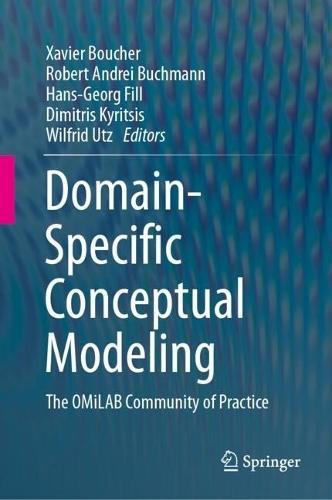
This third volume of the book series “Domain-Specific Conceptual Modeling” presents new application cases for domain-specific modeling languages and for the engineering of modeling languages and tools. All cases use the ADOxx metamodeling platform or toolkits from the Digital Innovation Environment, shared by the OMiLAB Community of Practice and available for open use. Through this platform, participants can share ideas and engage in an exploration process regarding model-based decision making, augmented intelligence, or model-driven systems engineering. All reported cases originate from research initiatives but are also suitable for teaching, demonstrations, or experimentation tooling that can be further expanded to better grasp the benefits of metamodeling and scripting of model-based functionalities. Each chapter result is elevated with the possibility to download the modeling tool and practically apply the theoretical concepts through case studies and examples provided by the author. In addition to describing novel domain-specific languages or language extensions for diverse purposes and levels of specificity, the book offers detailed instructions on how to build models in a particular application domain – including the management of Internet of Things facilities, decentralized governance, intelligence augmentation, and digital nudging strategies. Overall, the collection of works presented here will benefit experts and practitioners from both academia and industry, including members of the conceptual modeling community, as well as lecturers and students.
Full Product Details
Author: Xavier Boucher ,
Robert Andrei Buchmann ,
Hans-Georg Fill ,
Dimitris Kyritsis
Publisher: Springer International Publishing AG
Imprint: Springer International Publishing AG
ISBN: 9783031986598
ISBN 10: 3031986598
Pages: 376
Publication Date: 11 January 2026
Audience:
Professional and scholarly
,
Professional & Vocational
Format: Hardback
Publisher's Status: Forthcoming
Availability: Not yet available

This item is yet to be released. You can pre-order this item and we will dispatch it to you upon its release.
Author Information
Xavier Boucher is Professor in Industrial Management at the Ecole des Mines de Saint Etienne, France. He is Research Director at the FAYOL Institute, a research center focusing on sustainable industrial performance and organisations. His current research focuses on product service systems (PSS), service-oriented production systems, collaborative-agile networks and decision models to manage the supply chain agility. He is currently leading several collaborative research projects in the field of design and management of PSS with an economic and manufacturing point of view. Robert Andrei Buchmann is Professor in Business Information Systems and manages the OMILAB laboratory at Babeș-Bolyai University, Romania, focusing on Knowledge Graphs for Business Information Systems. He is the Scientific Director of the Business Informatics Research Center, where his team is investigating opportunities of interplay between knowledge graphs, large language models and enterprise modeling. Hans-Georg Fill is full Professor at the University of Fribourg, Switzerland, and Head of the Research Group Digitalization and Information Systems. He was a visiting researcher at Stanford University, USA, Karlsruhe Institute of Technology, Germany, and Ecole Nationale Supérieure des Mines at St. Etienne, France. His research activities focus on the development of IT-based modeling tools, distributed ledger technologies, visualization, and the alignment of conceptual modeling and semantic technologies. Dimitris Kyritsis is Professor Emeritus of ICT for Sustainable Manufacturing at EPFL in Lausanne, Switzerland, and Senior Adviser at SIRIUS Labs of the Department of Informatics at the University of Oslo, Norway. His research interests are Closed-Loop Lifecycle Management, Sustainable Manufacturing, Cognitive Digital Twins and Industrial Ontologies. Wilfrid Utz is one of the managing directors of OMiLAB NPO, the non-profit organisation headquartered in Berlin, Germany, supporting the conceptual modeling community organized around emerging topics with respect to domain-specific conceptual modeling. He has been involved in numerous international research and innovation projects and gained experience in the field of modeling method conceptualisation, design and implementation of modeling tools using the open ADOxx Metamodeling Platform.