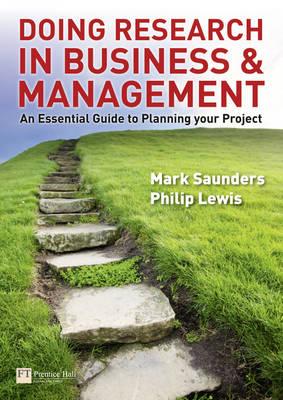
Doing Research in Business and Management: an essential guide to planning your project

Author:   Mark N.K. Saunders ,  Philip Lewis
Publisher:   Pearson Education Limited
ISBN:  

9780273726418


Pages:   256
Publication Date:   31 October 2011
Replaced By:   9781292133522
Format:   Paperback
Availability:   In Print   Availability explained
This item will be ordered in for you from one of our suppliers. Upon receipt, we will promptly dispatch it out to you. For in store availability, please contact us.

Our Price $74.95 Quantity:  
Add to Cart

Share |

Doing Research in Business and Management: an essential guide to planning your project


Overview

Doing Research in Business and Management brings the theory and techniques of research methods to life and covers all of the areas of research, from a review of secondary data or literature, or writing a research proposal, to completing an entire research project. The book is written for students on undergraduate and postgraduate degree programmes in business, management or related disciplines.

Full Product Details

Author:   Mark N.K. Saunders ,  Philip Lewis
Publisher:   Pearson Education Limited
Imprint:   Financial Times Prentice Hall
Dimensions:   Width: 17.40cm , Height: 1.50cm , Length: 24.10cm
Weight:   0.416kg
ISBN:  

9780273726418


ISBN 10:   0273726412
Pages:   256
Publication Date:   31 October 2011
Audience:   College/higher education ,  Tertiary & Higher Education
Replaced By:   9781292133522
Format:   Paperback
Publisher's Status:   Active
Availability:   In Print   Availability explained
This item will be ordered in for you from one of our suppliers. Upon receipt, we will promptly dispatch it out to you. For in store availability, please contact us.

Table of Contents

Contents Guided tour Authors About this book 1 Choosing your research topic1.1 Why you should read this chapter1.2 Why choosing the right research topic is important1.3 Why choosing the right research topic is difficult1.4 Ten ways to generate ideas for a research topic1.5 How to refine research topic ideas1.6 What makes a good research topic?1.7 How to turn a research idea into a research project1.8 Summary1.9 Thinking about your research 2 Reviewing the literature2.1 Why you should read this chapter2.2 What a literature review is2.3 Why it is important to review the literature2.4 The types of literature available to you2.5 Searching for and obtaining the literature2.6 Evaluating the usefulness of literature to your research2.7 Reading, noting and correctly referencing useful literature2.8 Writing your literature review2.9 Summary2.10 Thinking about your critical literature review 3 Managing the research process3.1 Why you should read this chapter3.2 Getting access to your research organisation and your respondents3.3 What about access to information?3.4 Six strategies for making sure you get the organizational access you want3.5 Managing yourself3.6 Managing your supervisor3.7 Managing your university3.8 The ethics of doing research3.9 Summary3.10 Thinking about the research process 4 Using secondary data4.1 Why you should read this chapter4.2 What forms does secondary data take?4.3 Why you should use secondary data  the potential?4.4 What are the pitfalls of using secondary data?4.5 Assessing the suitability of secondary data4.6 Where and how to find secondary data4.7 Summary4.8 Thinking about using secondary data 5 Choosing your research design5.1 Why you should read this chapter5.2 The importance of research philosophy5.3 Differing approaches to research: deduction and induction5.4 Differing types of studies: exploratory, descriptive or explanatory studies5.5 Differing types of strategies5.6 Making sure your research conclusions are believable5.7 Summary5.8 Thinking about your research design 6 Collecting data6.1 Why you should read this chapter6.2 Selecting samples6.3 Collecting data using questionnaires6.4 Collecting data using semi structured or unstructured interviews6.5 Summary6.6 Thinking about collecting data 7 Analysing data7.1 Why you should read this chapter7.2 What are different types of data?7.3 Analysing data quantitatively7.4 Analysing data qualitatively7.5 Summary7.6 Thinking about analysing data 8 Writing and presenting the research proposal8.1 Why you should read this chapter8.2 Why is the research proposal so important?8.3 When should I write my research proposal?8.4 What should I include in my research proposal?8.5 In what style should my research proposal be written?8.6 How will my research proposal be judged?8.7 Summary8.8 Thinking about your research proposal Bibliography Index

Reviews

Author Information

Tab Content 6

Author Website:  

Countries Available

All regions
Latest Reading Guide

NOV RG 20252


Shopping Cart
Your cart is empty
Shopping cart
Mailing List