Overview
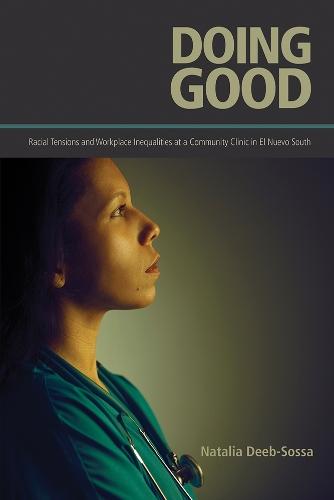
Throughout the “New South,” relationships based on race, class, social status, gender, and citizenship are being upended by the recent influx of Latina/o residents. Doing Good examines these issues as they play out in the microcosm of a community health center in North Carolina that previously had served mostly African American clients but now serves predominantly Latina/o clients. Drawing on eighteen months of experience as a participant- observer in the clinic and in-depth interviews with clinic staff at all levels, Natalia Deeb-Sossa provides an informative and fascinating view of how changing demographics are profoundly affecting the new social order. Deeb-Sossa argues persuasively that “moral identities” have been constructed by clinic staff. The high-status staff—nearly all of whom are white—see themselves as heroic workers. Mid- and lower-status Latina staff feel like they are guardians of people who are especially needy and deserving of protection. In contrast, the moral identity of African American staffers had previously been established in response to serving “their people.” Their response to the evolving clientele has been to create a self-image of superiority by characterizing Latina/o clients as “immoral,” “lazy,” “working the system,” having no regard for rules or discipline, and being irresponsible parents. All of the health-care workers want to be seen as “doing good.” But they fail to see how, in constructing and maintaining their own moral identity in response to their personal views and stereotypes, they have come to treat each other and their clients in ways that contradict their ideals.
Full Product Details
Author: Natalia Deeb-Sossa
Publisher: University of Arizona Press
Imprint: University of Arizona Press
Dimensions:
Width: 15.20cm
, Height: 1.20cm
, Length: 22.60cm
Weight: 0.253kg
ISBN: 9780816536535
ISBN 10: 0816536538
Pages: 176
Publication Date: 30 January 2017
Audience:
Professional and scholarly
,
Professional & Vocational
Format: Paperback
Publisher's Status: Active
Availability: Temporarily unavailable

The supplier advises that this item is temporarily unavailable. It will be ordered for you and placed on backorder. Once it does come back in stock, we will ship it out to you.
Reviews
"A meticulous ethnography"""". - American Journal of Sociology """"The analysis is well supported with qualitative and demographic evidence. I expect others will find this analysis fresh and useful as they think about the consequences of 'Latinization' in other regions and how staff accommodate a different clientele."""" - Patricia Zavella, author of Neither Here nor There: Mexicans’ Quotidian Struggles with Migration and Poverty """"It’s more than constructing identities in a health-care clinic; it’s about reconfiguring race relations in a context of hyper immigration."""" - Cecilia Menjívar, author of Enduring Violence: Ladina Women’s Lives in Guatemala"
The analysis is well supported with qualitative and demographic evidence. I expect others will find this analysis fresh and useful as they think about the consequences of 'Latinization' in other regions and how staff accommodate a different clientele. Patricia Zavella, author of<i>I'm Neither Here nor There: Mexicans Quotidian Struggles with Migration and Poverty</i> It s more than constructing identities in a health-care clinic; it s about reconfiguring race relations in a context of hyper immigration. Cecilia Menjivar, author of <i>Enduring Violence: Ladina Women s Lives in Guatemala</i>
A meticulous ethnography . - American Journal of Sociology The analysis is well supported with qualitative and demographic evidence. I expect others will find this analysis fresh and useful as they think about the consequences of 'Latinization' in other regions and how staff accommodate a different clientele. - Patricia Zavella, author of Neither Here nor There: Mexicans' Quotidian Struggles with Migration and Poverty It's more than constructing identities in a health-care clinic; it's about reconfiguring race relations in a context of hyper immigration. - Cecilia Menjivar, author of Enduring Violence: Ladina Women's Lives in Guatemala
Author Information
Natalia Deeb-Sossa is an assistant professor in the University of California at Davis’ Chicana/o Studies Department.