Overview
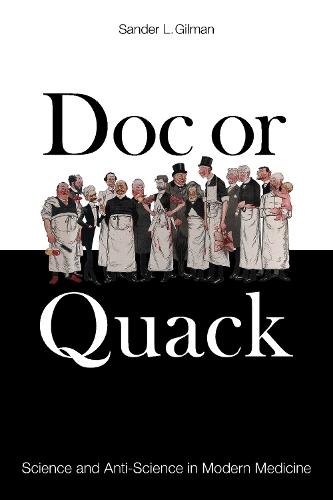
Reaching from the beginnings of scientific medicine in the 19th century through to the present, Sander L. Gilman examines the ever-shifting boundary between scientific medicine and quackery, asking if such a fixed boundary can actually exist within mainstream medical practice. Through detailed case studies stomach ulcers, eye disease and acupuncture it reveals the influence of pharmaceutical companies in determining the science of medical practice, the pros and cons of the increasing specialisation in medical practice, and the murky issue of 'race' in scientific medicine. This readable account covers medical practice from the Enlightenment to the present, offering a realistic view of health politics in the US, Germany and the UK. It's an essential read for anyone interested in the history and politics of Western medicine.
Full Product Details
Author: Sander L. Gilman
Publisher: Reaktion Books
Imprint: Reaktion Books
ISBN: 9781836390152
ISBN 10: 1836390157
Pages: 360
Publication Date: 01 April 2025
Audience:
General/trade
,
General
Format: Hardback
Publisher's Status: Active
Availability: Available To Order

We have confirmation that this item is in stock with the supplier. It will be ordered in for you and dispatched immediately.
Reviews
Doc or Quack is the most comprehensive investigation to date of relations between mainstream, scientific doctoring and its imperishable Other – nonscientific, quack practice. Through a series of intricate case studies of how diseases gain medical recognition over significant periods of time, Sander L. Gilman finds affiliation as well as antagonism in the divergent ways diseases come to be delineated and understood. In each chapter he poses the question: in responding to diseases, what does it mean for policy advisers and governments to “follow the science”? His response is a profound interrogation of scientific and quack practices – the Ying and the Yang of medicine – which shows they are less polar and more interconnected than their differing philosophies, methods and remedies would suggest, with elements of each interwoven in the evidence base. In charting how medical knowledge develops, Gilman brings a powerful historical lens to the shifting and ambiguous meanings of evidence and science in medicine. * Brian Hurwitz, D’Oyly Carte Professor of Medicine and the Arts Emeritus, King’s College London * This book could not be timelier, coming at an inflection point in popular belief about health and disease, when waning trust in the medical profession throws conventional understandings of evidence-based science up for grabs. Employing erudition along with wit, Sander L. Gilman’s opus takes the reader on a magisterial journey through centuries of radical changes in beliefs about and the practices of the healing arts. * Ruth Mandel, Professor of Anthropology, University College London * During the COVID-19 pandemic, the messiness of science and its relationship to medical practice burst into the open. Masks or no masks? Were the vaccines safe? Where were the lines between scientific facts, “best” medical practices, and quackery? As experts’ views shifted, our lives hung in the balance. Now, one of our great historians, Sander L. Gilman, takes up these matters, diving into questions of authority, what is lost in the “translation” of science to medical practice, and the complex play of certainty and doubt that makes one caregiver trustworthy and another a danger. * George Makari, Professor of Psychiatry and Director of the DeWitt Wallace Institute of Psychiatry: History, Policy, and the Arts, Weill Cornell Medical College * In his broad, compelling narrative, Gilman interrogates the shifting and often murky line between scientific medicine and quackery. He shows that what constitutes scientific medicine is contingent upon place, time and numerous other issues like education and licensure, research methods and type of evidence, and professional and public suspicion or trust. He illustrates how beliefs about racial and ethnic differences are entangled in defining scientific validity and physician authority. Gilman’s case studies span numerous locations, historical periods, medicinal treatments and healing modalities to bring these issues to light. In this impressive and timely history, the author demonstrates that claims of “following the science” are frequently more complicated than they seem. * Sandra M. Sufian, Professor of Health Humanities and History of Medicine and Disability, University of Illinois at Chicago *
""Both quacks and a level of distrust in medical practices from the public have pervaded in medicine since its origins. As medical historian Gilman observes, several governments backed their COVID-19-related decisions with the phrase 'following the science.' But 'following science' makes more sense--because science is constantly developing. Gilman's nuanced book, focused on stomachs, eyes and backs, concludes that 'the line between the quack and the doc is amorphous but always present.'""-- ""Nature"" ""Spanning centuries, the list of wacky, ineffective, and sometimes dangerous remedies for illness is quite lengthy. In this standout history of scientific medicine from the mid-nineteenth century to the present, Gilman navigates 'the ever-shifting boundary between good medicine and quackery.' . . . A thoughtful study of historically 'good' and 'bad' medicine and the occasional blurring between the two.""-- ""MedHum.org's Biblioscopy"" ""In his broad, compelling narrative, Gilman interrogates the shifting and often murky line between scientific medicine and quackery. He shows that what constitutes scientific medicine is contingent upon place, time and numerous other issues like education and licensure, research methods and type of evidence, and professional and public suspicion or trust. He illustrates how beliefs about racial and ethnic differences are entangled in defining scientific validity and physician authority. Gilman's case studies span numerous locations, historical periods, medicinal treatments and healing modalities to bring these issues to light. In this impressive and timely history, the author demonstrates that claims of 'following the science' are frequently more complicated than they seem.""--Sandra M. Sufian, professor of health humanities and history of medicine and disability, University of Illinois at Chicago ""During the COVID-19 pandemic, the messiness of science and its relationship to medical practice burst into the open. Masks or no masks? Were the vaccines safe? Where were the lines between scientific facts, 'best' medical practices, and quackery? As experts' views shifted, our lives hung in the balance. Now, one of our great historians, Gilman, takes up these matters, diving into questions of authority, what is lost in the 'translation' of science to medical practice, and the complex play of certainty and doubt that makes one caregiver trustworthy and another a danger.""--George Makari, professor of psychiatry and director of the DeWitt Wallace Institute of Psychiatry: History, Policy, and the Arts, Weill Cornell Medical College ""This book could not be timelier, coming at an inflection point in popular belief about health and disease, when waning trust in the medical profession throws conventional understandings of evidence-based science up for grabs. Employing erudition along with wit, Gilman's opus takes the reader on a magisterial journey through centuries of radical changes in beliefs about and the practices of the healing arts.""--Ruth Mandel, professor of anthropology, University College London ""This book is filled with fascinating historical asides, which makes it a pleasure to read for those interested in how medical decisions are made"" -- ""Choice"" ""Doc or Quack is the most comprehensive investigation to date of relations between mainstream, scientific doctoring and its imperishable Other--nonscientific, quack practice. Through a series of intricate case studies of how diseases gain medical recognition over significant periods of time, Gilman finds affiliation as well as antagonism in the divergent ways diseases come to be delineated and understood. In each chapter he poses the question: in responding to diseases, what does it mean for policy advisers and governments to 'follow the science?' His response is a profound interrogation of scientific and quack practices--the Ying and the Yang of medicine--which shows they are less polar and more interconnected than their differing philosophies, methods and remedies would suggest, with elements of each interwoven in the evidence base. In charting how medical knowledge develops, Gilman brings a powerful historical lens to the shifting and ambiguous meanings of evidence and science in medicine.""--Brian Hurwitz, D'Oyly Carte Professor of Medicine and the Arts Emeritus, King's College London
Author Information
Sander L. Gilman is Distinguished Professor Emeritus of the Liberal Arts and Sciences as well as Emeritus Professor of Psychiatry at Emory University. A cultural and literary historian, he is the author or editor of more than a hundred books, including Stand Up Straight! A History of Posture (Reaktion, 2018).