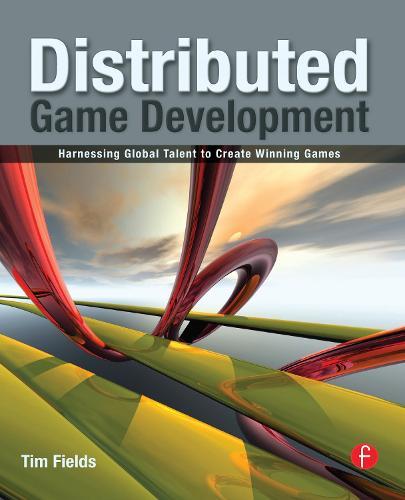
Distributed Game Development: Harnessing Global Talent to Create Winning Games

Author:   Tim Fields
Publisher:   Taylor & Francis Ltd
ISBN:  

9780240812717


Pages:   240
Publication Date:   02 March 2010
Format:   Paperback
Availability:   In Print   Availability explained
This item will be ordered in for you from one of our suppliers. Upon receipt, we will promptly dispatch it out to you. For in store availability, please contact us.

Our Price $88.99 Quantity:  
Add to Cart

Share |

Distributed Game Development: Harnessing Global Talent to Create Winning Games


Overview

Full Product Details

Author:   Tim Fields
Publisher:   Taylor & Francis Ltd
Imprint:   Focal Press
Dimensions:   Width: 19.10cm , Height: 1.20cm , Length: 23.50cm
Weight:   0.521kg
ISBN:  

9780240812717


ISBN 10:   0240812719
Pages:   240
Publication Date:   02 March 2010
Audience:   Professional and scholarly ,  Professional & Vocational
Format:   Paperback
Publisher's Status:   Active
Availability:   In Print   Availability explained
This item will be ordered in for you from one of our suppliers. Upon receipt, we will promptly dispatch it out to you. For in store availability, please contact us.

Table of Contents

Distributed Game Development Introduction i. Overview ii. Who is this document for? Preamble on Distributed Development i. Why would you have distributed development? ii. Who we will meet in our case studies, and why we care about what they have to say. Chapter 1: Organizing Your Teams i. Types of Distributed Collaboration: How to Know what you need ii. How to pick external collaborators a. INTERVIEW: Fay Griffith - Head of outsourcing and external development, Electronic Arts. On How to Select Partners iii. How to pick an external team iv. Insourcing v. Roles & Responsibilities a. INTERVIEW: Sergio Rosas - Studio Head CGBot, Monterrey Mexico. On Tailoring Creation Teams for Different Clients vi. Subcontractors vii. Quality Assurance viii. Localization ix. Infrastructure x. The contract and other legal issues xi. Failure Study: When the Organization phase went wrong. Chapter 2: Getting off on the right foot i. Defining project parameters 1. Scheduling Goals, Techniques, Milestones ii. Make sure you have a shared vision. a. INTERVIEW: Bill Byrne - Freelance Motion Graphics Editor. Setting project tone through visuals. iii. Kickoff Meetings iv. Scheduling Types & Tactics 1. SCRUM/AGILE vs. WATERFALL a. INTERVIEW: Everett Lee - Producer, Sony Entertainment. ?How to lead great teams through more agile planning. v. Failure Study: When the schedule is wrong. vi. Failure Study: When your vision is clouded. Chapter 3: Maintaining the organism i. Establishing & Maintaining Trust a. INTERVIEW: Kyle Clark - VP Production, ReelFX. Delivering content to spec for motion pictures & television. ii. Progress Checkpoints iii. Milestones iv. How to deal with product goal or design changes a. INTERVIEW: Rhett Bennatt - Project Manager, Aspyre Entertainment. Nimble projects for maximum profits. v. Cross Pollination vi. Finaling and product submission vii. Planning for your next date viii. Failure Study: Feature Creep and the carnival of design changes. Chapter 4: Site Visits i. Site visits ii. Who to send & why iii. When to go? a. INTERVIEW: Michael Wyman - Founder, Big Splash Entertainment. Distributed development for Casual Games. iv. Representing your company and the project while on site. v. Communication vi. Language barriers vii. Dealing with distractions viii. Cultural Differences a. INTERVIEW: Frank Klier - Senior Technical Director, Microsoft. Coordinating technical solutions across cultural boundaries. ix. Regional Conditions x. Helpful Tools for staying in touch with home base xi. Failure Study: What happens when communication between home base and the field goes awry. Chapter 5: Common Situations i. Hot Potato Projects a. INTERVIEW: Mark Greenshields - President, Firebrand Games. Delivering quality products on time. ii. Crisis Management iii. The constantly moving target iv. Bug Counts / Defect management v. Localization vi. Central Content Teams vii. Central Tech Groups viii. Sense of Urgency a. INTERVIEW: Dave Hawkins - Managing Director, Exient LTD. How to select projects for your development team. ix. Failure Case: When the bugs eat you. Conclusions: i. Wrapping it up ii. What the future holds iii. Where to get more information iv. Helpful templates

Reviews

Author Information

Tim Fields has been in the game industry since 1995 as a producer, project manager, design lead, and business developer. Tim has helped small studios and top publishers like EA and Microsoft run teams that create great games. He has worked on shooters, sports games, racing titles, and RPGs using talent and teams from North America, Asia, Europe, and the UK.

Tab Content 6

Author Website:  

Countries Available

All regions
Latest Reading Guide

NOV RG 20252


Shopping Cart
Your cart is empty
Shopping cart
Mailing List