Overview
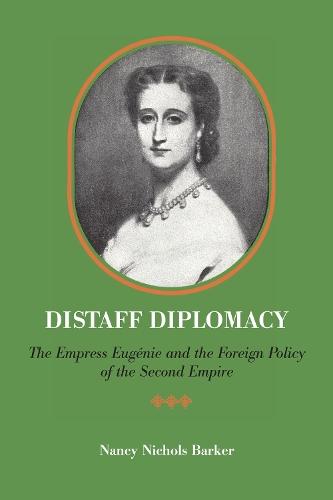
The Empress Eugenie, wife of Napoleon III and one of the most beautiful women ever to grace a throne, was the victim of her own inconstant mind. A daughter of an aristocratic Spanish family, she had a natural reverence for legitimate monarchy; yet her high-spirited temperament and chivalric outlook made her admire instinctively the boldness and aura of glory that she associated with the Napoleonic empire. The incongruous principles of Legitimism and Bonapartism battling within the Empress produced in her a double-mindedness that had tragic consequences. The Empress has always been a controversial figure. Her enemies have blamed her the fall of the Second Empire and the defeat of France; her admirers have disclaimed for her any part in the mistakes that led to the disastrous Franco-Prussian War of 1870. To determine the actual role that Eugenie played, Barker, using material from public and private European archives and a wide range of published works, examines in Distaff Diplomacy the development of the Empress' views on foreign affairs and ascertains their effect on the formation of the policies of the Second Empire. Eugenie's influence fluctuated widely over the years. As a bride she was neither interested in nor knowledgable about foreign matters; as a middle-aged woman, in the late years of the Empire, she was discredited by her past errors, but she continued to pull strings outside of normal diplomatic channels. Her most sustained and effective work, from 1861 to 1863, was largely the inspiration for a grand design to remake the map to assure French hegemony in Europe and to establish an empire in Mexico. The success of this design rested on an Austro-French alliance; but the design itself, reflecting the Empress' incoherent thinking, contained the fatal inconsistencies that made Austrian rejection of it inevitable. Since the Mexican expedition and the diplomatic muddle of 1863 were the watershed from which the subsequent troubles of the Empire flowed, the Empress must be held responsible for seriously undermining the foreign policy of the Empire. Despite Eugenie's many fine qualities-her generosity of spirit, her splendid courage, and her moral integrity-her diplomatic efforts, affected as they were by her background, temperament, state of health, and changing moods, did not amount to statesmanship. This first systematic examination of the Empress' influence on foreign policy delves deeply and carefully into the subject.
Full Product Details
Author: Nancy Nichols Barker
Publisher: University of Texas Press
Imprint: University of Texas Press
Dimensions:
Width: 15.20cm
, Height: 1.50cm
, Length: 22.90cm
Weight: 0.454kg
ISBN: 9780292735927
ISBN 10: 0292735928
Pages: 268
Publication Date: 01 January 1967
Audience:
Professional and scholarly
,
Professional & Vocational
Format: Paperback
Publisher's Status: Active
Availability: In Print

This item will be ordered in for you from one of our suppliers. Upon receipt, we will promptly dispatch it out to you. For in store availability, please contact us.
Author Information
Nancy Nichols Barker (1925–1994) was Professor of History at the University of Texas at Austin.