Awards
- Winner of American Sociological Association Collective Behaviour & Social Movements Section: Charles Tilly Award 2009
- Winner of American Sociological Association Collective Behaviour & Social Movements Section: Charles Tilly Award 2009.
- Winner of American Sociological Association Science, Knowledge & Technology Section Robert K. Merton Award 2011
- Winner of American Sociological Association Science, Knowledge & Technology Section Robert K. Merton Award 2011.
- Winner of Charles Tilly Best Book Award, Collective Behavior and Social Movements Section, American Sociological Association 2009 (United States)
- Winner of Robert K. Merton Book Award, Science, Knowledge, and Technology Section, American Sociological Association 2011 (United States)
Overview
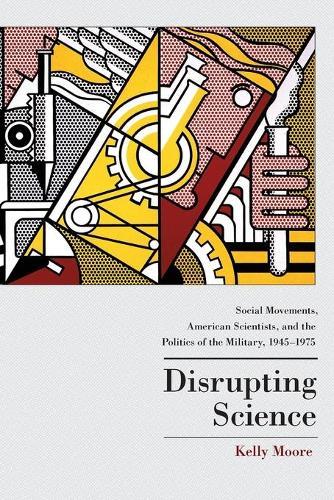
In the decades following World War II, American scientists were celebrated for their contributions to social and technological progress. They were also widely criticized for their increasingly close ties to military and governmental power--not only by outside activists but from among the ranks of scientists themselves. Disrupting Science tells the story of how scientists formed new protest organizations that democratized science and made its pursuit more transparent. The book explores how scientists weakened their own authority even as they invented new forms of political action. Drawing extensively from archival sources and in-depth interviews, Kelly Moore examines the features of American science that made it an attractive target for protesters in the early cold war and Vietnam eras, including scientists' work in military research and activities perceived as environmentally harmful. She describes the intellectual traditions that protesters drew from--liberalism, moral individualism, and the New Left--and traces the rise and influence of scientist-led protest organizations such as Science for the People and the Union of Concerned Scientists.Moore shows how scientist protest activities disrupted basic assumptions about science and the ways scientific knowledge should be produced, and recast scientists' relationships to political and military institutions. Disrupting Science reveals how the scientific community cumulatively worked to unbind its own scientific authority and change how science and scientists are perceived. In doing so, the book redefines our understanding of social movements and the power of insider-led protest.
Full Product Details
Author: Kelly Moore
Publisher: Princeton University Press
Imprint: Princeton University Press
Volume: 32
Dimensions:
Width: 15.20cm
, Height: 1.80cm
, Length: 23.50cm
Weight: 0.482kg
ISBN: 9780691162096
ISBN 10: 0691162093
Pages: 328
Publication Date: 15 December 2013
Audience:
College/higher education
,
Professional and scholarly
,
General/trade
,
Tertiary & Higher Education
,
Professional & Vocational
Format: Paperback
Publisher's Status: Active
Availability: Manufactured on demand

We will order this item for you from a manufactured on demand supplier.
Language: English
Reviews
Winner of the 2011 Robert K. Merton Book Award, Science, Knowledge, and Technology Sectio of the American Sociological Association Honorable Mention for the 2009 Charles Tilly Best Book Award, Collective Behavior and Social Movements Section of the American Sociological Association In Disrupting Science, Kelly Moore attempts to explain how scientists' attitudes about the proper role of science and scientists in public life changed so dramatically within two generations...Moore's well-researched account introduces the pacifists, petition writers, newsletter publishers, and protestors--who doggedly drew attention to the ways that militarism was infiltrating the practice of science in the United States. --Audra J. Wolfe, Science Disrupting Science is an important scholarly addition to the literature in the sociology of science and history of science. The book's examination of archival sources shows a complex relationship between scientists and the military from 1945 to 1975. --G.D. Oberle, Choice The book prompts intriguing questions about the professional role, the boundaries by which it is constituted, and the potential consequences of overstepping those boundaries. --Joseph C. Hermanowicz, American Journal of Sociology As the U.S. government's budget for national and homeland security approaches three-quarters of a trillion dollars in fiscal year 2009, and the roles of science and technology continue to expand in our daily lives, our collective need for nuanced studies of the relations between the military and science is ever more pressing. Moore's thoughtful study points the way. --William J. Astore, H-Net Reviews Disrupting Science is first rate work... Moore's account serves as an exemplary case study in what she and Scott Frickel have billed in their 2006 book as 'the new political sociology of science.' I expect her new book to be read widely across the discipline. --Steven Epstein, Mobilization Moore's book is very well-written, scholarly, and impeccably organized, making it a useful reference tool. It is relevant to those interested in political sociology, the 'fact-value' debate in the philosophy of science, questions of science and ideology, and science studies. --Ronjon Paul Datta, Canadian Journal of Sociology Useful for academics studying the history of science and social movements, this book offers an interesting, unique, and insightful look at the role of scientists in challenging the boundaries of their own expertise and positions of influence. From scientists as elite experts to science 'for the people,' this work offers a captivating glimpse as social movement activists among scientists during this time in history. --Chelsea Schelly, Social Science Journal
Winner of the 2011 Robert K. Merton Book Award, Science, Knowledge, and Technology Section of the American Sociological Association Honorable Mention for the 2009 Charles Tilly Best Book Award, Collective Behavior and Social Movements Section of the American Sociological Association In Disrupting Science, Kelly Moore attempts to explain how scientists' attitudes about the proper role of science and scientists in public life changed so dramatically within two generations...Moore's well-researched account introduces the pacifists, petition writers, newsletter publishers, and protestors--who doggedly drew attention to the ways that militarism was infiltrating the practice of science in the United States. --Audra J. Wolfe, Science Disrupting Science is an important scholarly addition to the literature in the sociology of science and history of science. The book's examination of archival sources shows a complex relationship between scientists and the military from 1945 to 1975. --G.D. Oberle, Choice The book prompts intriguing questions about the professional role, the boundaries by which it is constituted, and the potential consequences of overstepping those boundaries. --Joseph C. Hermanowicz, American Journal of Sociology As the U.S. government's budget for national and homeland security approaches three-quarters of a trillion dollars in fiscal year 2009, and the roles of science and technology continue to expand in our daily lives, our collective need for nuanced studies of the relations between the military and science is ever more pressing. Moore's thoughtful study points the way. --William J. Astore, H-Net Reviews Disrupting Science is first rate work... Moore's account serves as an exemplary case study in what she and Scott Frickel have billed in their 2006 book as 'the new political sociology of science.' I expect her new book to be read widely across the discipline. --Steven Epstein, Mobilization Moore's book is very well-written, scholarly, and impeccably organized, making it a useful reference tool. It is relevant to those interested in political sociology, the 'fact-value' debate in the philosophy of science, questions of science and ideology, and science studies. --Ronjon Paul Datta, Canadian Journal of Sociology Useful for academics studying the history of science and social movements, this book offers an interesting, unique, and insightful look at the role of scientists in challenging the boundaries of their own expertise and positions of influence. From scientists as elite experts to science 'for the people,' this work offers a captivating glimpse as social movement activists among scientists during this time in history. --Chelsea Schelly, Social Science Journal
Author Information
Kelly Moore is assistant professor of sociology at the University of Cincinnati.