Overview
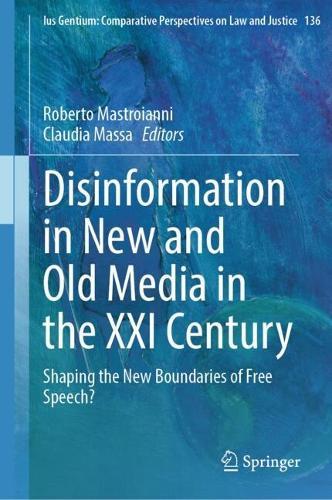
The volume examines, from a legal point of view, various regulatory, political, technological and democratic issues related to the disinformation phenomenon in both ""old media"" (newspapers and broadcasting) and ""new media"" (digital platforms, social media and artificial intelligence) in two different scenarios: elections and war. Disinformation is in fact relevant, inter alia, in light of two very significant events of recent years. First, 2024 marks a year of general elections in numerous regions globally, involving 76 countries (including, within our continent, the elections for the European Parliament as well as parliamentary and presidential elections in several EU Member States such as Portugal, Belgium, Austria, and, on the other side of the Atlantic, the Presidential elections in the United States). Second, 2025 is the fourth year of the Russia/Ukraine military conflict. The common thread that binds these two situations is clear: disinformation may significantly impact the formation of public opinion, thereby prompting public decisions that risk being based on false or seriously distorted news. Starting from the two-abovementioned scenarios, the chapters of the volume concern the current ""state of health"" of freedom of expression in both ""old media"" and ""new media"", and they contribute to answer three main questions. First, are governmental repressive, corrective or even preventive actions against ""false"" information in the two scenarios discussed here the right solution? Could any prohibition of disinformation rather lead, paradoxically, to the opposing result of producing a ""chilling effect"", in itself harmful to the free circulation of ideas, including those who ""shock or disturb""? Second, is it still valid that the best antidote to disinformation and hate speech is more speech? Is this conclusion still correct in case of absence of pluralism in the media, when the main sources of information are controlled by one or few media companies? Third, is propaganda of war a specific situation that merits being distinguished from any other form of disinformation?
Full Product Details
Author: Roberto Mastroianni ,
Claudia Massa
Publisher: Springer Nature Switzerland AG
Imprint: Springer Nature Switzerland AG
ISBN: 9783032188298
ISBN 10: 3032188296
Pages: 249
Publication Date: 12 June 2026
Audience:
Professional and scholarly
,
College/higher education
,
Professional & Vocational
,
Postgraduate, Research & Scholarly
Format: Hardback
Publisher's Status: Forthcoming
Availability: Not yet available

This item is yet to be released. You can pre-order this item and we will dispatch it to you upon its release.
Author Information
Roberto Mastroianni is since 2000 a Full Professor of European Union Law at the Law School of the University of Naples Federico II (Italy) and former Judge of the Court of Justice of the EU (General Court, from September 2019 to September 2025). He also teaches at the University of Luxembourg, LLM Programs. Before his appointment at the CJEU as an attorney specializing in EU law and media law, he argued several cases before the same Court, the ECHR and national Courts. He graduated in Law at the University of Florence, Italy (1987), and holds a PhD in European Law from the University of Bologna (1991) as well as an LL.M. from the Penn State/Dickinson School of Law in Carlisle (PA), USA (1992). He specialized in International Copyright Law and European Media Law at the Universities of Geneva, Amsterdam and New York (NYLS). Former Researcher of International Law at the University of Florence (1992–1997), he served as Referendaire at the European Court of Justice (ECJ), in the Cabinets of Advocate General Giuseppe Tesauro and Antonio Saggio (1997–2000). He is the author of two handbooks on EU institutional and procedural law, several monographs and articles in European Law, Media Law and International Law, and has contributed to the publications of the Council of Europe's European Audiovisual Observatory and to research projects of the European institutions in the area of media law. Claudia Massa is Tenure Track Assistant Professor of European Union Law at the Law School of the University of Naples Federico II, where she teaches European Union Law and EU Media Law. She graduated in Law at the University of Naples Federico II (2014) and obtained an LL.M. in European Law from the Université de Paris II Panthéon-Assas (2015) and a Ph.D. (cum laude) in Economic Law from the University of Naples Federico II (2019). She followed specializing courses in European Union Law at the European University Institute, King's College London and University of Naples Federico II. She has been an intern at the Court of Justice of the European Union, the Italian Antitrust Authority and the Department for European Policies of the Presidency of the Council of Ministers of the Italian State. She is the author of a monograph and several articles in European Law and Media Law. She received the prize for the best scientific journal article in European Union Law published in 2021 from the Italian Association of European Union Law Scholars (AISDUE). She obtained the National qualification to practice as Associate Professor of European Union Law (2024-2035).