Overview
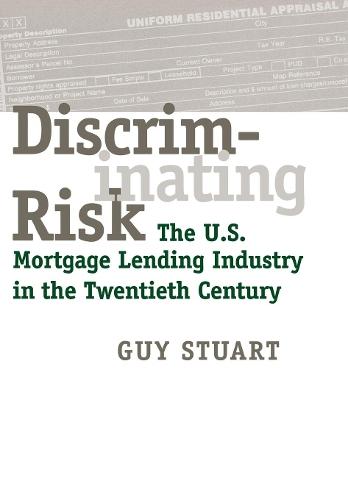
The U.S. home mortgage industry first formalized risk criteria in the 1920s and 1930s to determine which applicants should receive funds. Over the past eighty years, these formulae have become more sophisticated. Guy Stuart demonstrates that the very concepts on which lenders base their decisions reflect a set of social and political values about ""who deserves what."" Stuart examines the fine line between licit choice and illicit discrimination, arguing that lenders, while eradicating blatantly discriminatory practices, have ignored the racial and economic-class biases that remain encoded in their decision processes. He explains why African Americans and Latinos continue to be at a disadvantage in gaining access to loans: discrimination, he finds, results from the interaction between the way lenders make decisions and the way they shape the social structure of the mortgage and housing markets.Mortgage lenders, Stuart contends, are embedded in and shape a social context that can best be understood in terms of rules, networks, and the production of space. Stuart's history of lenders' risk criteria reveals that they were synthesized from rules of thumb, cultural norms, and untested theories. In addition, his interviews with real estate and lending professionals in the Chicago housing market show us how the criteria are implemented today. Drawing on census and Home Mortgage Disclosure Act data for quantitative support, Stuart concludes with concrete policy proposals that take into account the social structure in which lenders make decisions.
Full Product Details
Author: Guy Stuart
Publisher: Cornell University Press
Imprint: Cornell University Press
Dimensions:
Width: 15.20cm
, Height: 2.50cm
, Length: 22.90cm
Weight: 0.907kg
ISBN: 9780801440663
ISBN 10: 0801440661
Pages: 272
Publication Date: 14 May 2003
Audience:
College/higher education
,
Professional and scholarly
,
Undergraduate
,
Postgraduate, Research & Scholarly
Format: Hardback
Publisher's Status: Active
Availability: Awaiting stock

The supplier is currently out of stock of this item. It will be ordered for you and placed on backorder. Once it does come back in stock, we will ship it out for you.
Reviews
Stuart changes our understanding of the nature of risk, economic rationality, and discrimination. This impressive study has the potential to spur new lines of inquiry into housing markets, housing finance, and the governmental policy that regulates them. Summing Up: Highly recommended. -Choice, November 2003 To confront lending disparities, Stuart says, we must first recognize that the supposedly rational rules of risk calculation are themselves merely constructions rooted in prejudices. -City Limits, December 2003 Readers who are interested in the historical interaction of American cities, race, and mortgage finance will find many aspects of Guy Stuart's Discriminating Risk informative and insightful... It is full of useful historical and contemporary information on the lending process, insightful interviews, and a valuable close reading of the real estate industry's standard operating procedures. I learned a great deal by reading the book, and I recommend it to other scholars with an interest in the history of American housing markets. -William J. Collins, Vanderbilt University, EH.NET, June 2004 In this fascinating book Guy Stuart takes a fresh new look at the way that the mortgage industry contributes to discrimination. Discriminating Risk is founded on solid empirical research and stands in the best tradition of political economy. It is a must-read for anyone who is interested in economic discrimination and the various social mechanisms through which it is maintained. -Richard Swedberg, Cornell University The unique contributions of Discriminating Risk are twofold. First, the book is the first to really go into the 'social construction' of the logic of appraising housing value in urban environments. The historical approach and rich use of sources provide a revelation for the reader: it brings into three dimensionality the oft-cited fact that 'FHA appraisals were discriminatory.' Second, the book provides substantial insights into actual loan approval processes; the author's interviews yield some rich quotations, which he uses to good advantage. -Gary Dymski, University of California, Riverside In his innovative book, with its high quality of writing, conception, and scope, Guy Stuart has created a well-reasoned and compelling argument. His introduction of the idea that there is always an audience to which decisionmakers are accountable sheds new light on the social construction of risk. -Mark Gottdiener, State University of New York at Buffalo Stuart takes a simple and powerful idea, that risk and value are both social constructions, and uses it to illuminate an institution that has played a central role in American race relations: the market for home mortgages. His analysis is provocative, insightful, richly documented, and sure to generate debate among scholars and policymakers. -Bruce Carruthers, Northwestern University
Stuart takes a simple and powerful idea, that risk and value are both social constructions, and uses it to illuminate an institution that has played a central role in American race relations: the market for home mortgages. His analysis is provocative, insightful, richly documented, and sure to generate debate among scholars and policymakers. -Bruce Carruthers, Northwestern University
Author Information
Guy Stuart is Lecturer in Public Policy at the Kennedy School of Government, Harvard University.