Overview
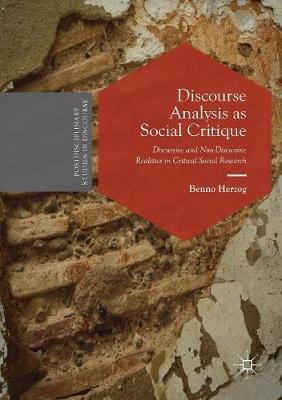
This book presents post-Marxist theoretical approaches towards social critique and offers discourse analytical tools for critical research. How is a normative critique possible? The author, working at the crossroads of sociological discourse analysis and social philosophy, answers this question and others to show how empirical discourse research can be used to develop normative critique of societies. Divided into three major sections, Herzog introduces the reader to the theoretical approaches to critique, provides tools for normative evaluations of social structures, and finally offers practical examples of theoretical concepts. The book will be of interest to those working in the fields and subfields of discourse analysis, poststructuralism, hegemony theory, cultural political economy and critical theory, with an interdisciplinary orientation.
Full Product Details
Author: Benno Herzog
Publisher: Palgrave Macmillan
Imprint: Palgrave Macmillan
Edition: 1st ed. 2016
Weight: 0.454kg
ISBN: 9781349849307
ISBN 10: 1349849308
Pages: 203
Publication Date: 19 November 2018
Audience:
College/higher education
,
Professional and scholarly
,
Tertiary & Higher Education
,
Professional & Vocational
Format: Paperback
Publisher's Status: Active
Availability: Manufactured on demand

We will order this item for you from a manufactured on demand supplier.
Reviews
Discourse Analysis as Social Critique provides a balancing act that makes a highly valuable contribution to interdisciplinary DS: combining a thorough and convincing theoretical and methodological argument with accessible hands-on examples, this book is equally interesting as a teaching resource for students and scholars looking for a workable critical approach to discourse, as well as an inspiration for more advanced discourse analysts who seek to enrich their own practice of critique. (Veit Schwab, Discourse & Society, Vol. 29 (05), September, 2018) The author acknowledges the ambition of the task as 'there is no easy way to perform social critique' (p. 195). The book does not shy from difficulty ... . The tone is lively, personal (with the regular use of first and second personal pronouns) and the reader is regularly challenged ... . The reader thus feels involved in the questioning and probing of key texts and methodologies in the search for better and more time-relevant ways to be critical. (Christine Penman, Language and Intercultural Communication, Vol. 18 (06), 2018)
Discourse Analysis as Social Critique provides a balancing act that makes a highly valuable contribution to interdisciplinary DS: combining a thorough and convincing theoretical and methodological argument with accessible hands-on examples, this book is equally interesting as a teaching resource for students and scholars looking for a workable critical approach to discourse, as well as an inspiration for more advanced discourse analysts who seek to enrich their own practice of critique. (Veit Schwab, Discourse & Society, Vol. 29 (05), September, 2018)
Discourse Analysis as Social Critique provides a balancing act that makes a highly valuable contribution to interdisciplinary DS: combining a thorough and convincing theoretical and methodological argument with accessible hands-on examples, this book is equally interesting as a teaching resource for students and scholars looking for a workable critical approach to discourse, as well as an inspiration for more advanced discourse analysts who seek to enrich their own practice of critique. (Veit Schwab, Discourse & Society, Vol. 29 (05), September, 2018) The author acknowledges the ambition of the task as `there is no easy way to perform social critique' (p. 195). The book does not shy from difficulty ... . The tone is lively, personal (with the regular use of first and second personal pronouns) and the reader is regularly challenged ... . The reader thus feels involved in the questioning and probing of key texts and methodologies in the search for better and more time-relevant ways to be critical. (Christine Penman, Language and Intercultural Communication, Vol. 18 (06), 2018)
Author Information
Benno Herzog is Associate Professor at the Department of Sociology and Social Anthropology, University of Valencia, Spain. He has worked and conducted research in Germany (Universities of Frankfurt and Mainz), the United Kingdom (University of Manchester, Open University, University of Warwick) and Brazil (Federal University of Paraíba). His research focuses on social critique & critical theory of society, on discourse theory & discourse analysis and on migration & discrimination.