Overview
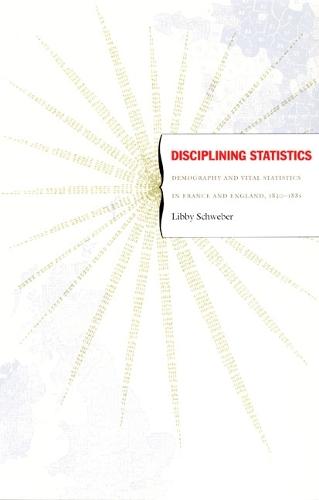
In Disciplining Statistics Libby Schweber compares the science of population statistics in England and France during the nineteenth century, demonstrating radical differences in the interpretation and use of statistical knowledge. Through a comparison of vital statistics and demography, Schweber describes how the English government embraced statistics, using probabilistic interpretations of statistical data to analyze issues related to poverty and public health. The French were far less enthusiastic. Political and scientific elites in France struggled with the ""reality"" of statistical populations, wrestling with concerns about the accuracy of figures that aggregated heterogeneous groups such as the rich and poor and rejecting probabilistic interpretations. Tracing the introduction and promotion of vital statistics and demography, Schweber identifies the institutional conditions that account for the contrasting styles of reasoning. She shows that the different reactions to statistics stemmed from different criteria for what counted as scientific knowledge. The French wanted certain knowledge, a one-to-one correspondence between observations and numbers. The English adopted an instrumental approach, using the numbers to influence public opinion and evaluate and justify legislation. Schweber recounts numerous attempts by vital statisticians and demographers to have their work recognized as legitimate scientific pursuits. While the British scientists had greater access to government policy makers, and were able to influence policy in a way that their French counterparts were not, ultimately neither the vital statisticians nor the demographers were able to institutionalize their endeavors. By 1885, both fields had been superseded by new forms of knowledge. Disciplining Statistics highlights how the development of ""scientific"" knowledge was shaped by interrelated epistemological, political, and institutional considerations.
Full Product Details
Author: Libby Schweber
Publisher: Duke University Press
Imprint: Duke University Press
Weight: 0.535kg
ISBN: 9780822338253
ISBN 10: 0822338254
Pages: 288
Publication Date: 28 November 2006
Audience:
Professional and scholarly
,
Professional & Vocational
Format: Hardback
Publisher's Status: Active
Availability: In Print

This item will be ordered in for you from one of our suppliers. Upon receipt, we will promptly dispatch it out to you. For in store availability, please contact us.
Reviews
Disciplining Statistics makes important contributions to our understanding of how a field of knowledge developed in France and England, and it may well be seen as a model comparative analysis based on research in public sources. -- Matthew Connelly, American Journal of Sociology [Schweber's] work adds to a growing body of literature about the origins of the new social sciences in the nineteenth century, and their relationship to other sciences, the state, and public-policy formation... The work is a closely argued, careful, and detailed reading of the organizational forms, intellectual debates, and scientific practices created by the men who defined, literally named, and built the new population sciences. -- Margo J. Anderson, Journal of Interdisciplinary History Schweber succeeds in terms of many of the goals she sets out at the beginning of her study. With the aid of an excellent opening historiographical survey in particular, we are reminded of the issues that divide scholars when it comes to discipline formation. Indeed, Schweber's own argument about how best to approach such subject matter offers many important insights for historians of science to consider. -- Chris Renwick, British Journal for the History of Science In this original and instructive book, Libby Schweber puts the history of statistics in a new light by providing an institutional and sociological account which connects the development of statistics to a broader history of state expertise. -Alain Desrosieres, author of The Politics of Large Numbers: A History of Statistical Reasoning Libby Schweber addresses both the institutional conditions of scientific change and the actual forms of knowledge produced. And she convincingly rejects the usual teleology of disciplines as what scientific practitioners always want and advanced states always need. She shows how the assertion of a discipline can be a sign of weakness, of inability to shape policy, really a course of action when all else fails. -Theodore M. Porter, author of Trust in Numbers: The Pursuit of Objectivity in Science and Public Life
In this original and instructive book, Libby Schweber puts the history of statistics in a new light by providing an institutional and sociological account which connects the development of statistics to a broader history of state expertise. --Alain Desrosieres, author of The Politics of Large Numbers: A History of Statistical Reasoning Libby Schweber addresses both the institutional conditions of scientific change and the actual forms of knowledge produced. And she convincingly rejects the usual teleology of disciplines as what scientific practitioners always want and advanced states always need. She shows how the assertion of a discipline can be a sign of weakness, of inability to shape policy, really a course of action when all else fails. --Theodore M. Porter, author of Trust in Numbers: The Pursuit of Objectivity in Science and Public Life
Author Information
Libby Schweber is a Reader in the Department of Sociology at the University of Reading.